
At its core, contact lens solution is a blend of key ingredients: a sterile saline (saltwater) base, disinfectants to kill germs, surfactants to remove debris, and wetting agents for comfort. Think of it as a carefully balanced recipe designed to clean, disinfect, and store your lenses safely, with each part playing a crucial role in protecting your eyes from infection and irritation.
What's Really in Your Contact Lens Solution?
Ever stop to think about what's actually in that bottle you use every single day? It might look like plain old water, but contact lens solution is a highly engineered fluid. It's designed to be gentle enough to mimic your eye's natural tear film, yet powerful enough to destroy the harmful microbes that can build up on your lenses.
The goal is to keep your lenses clean, comfortable, and—most importantly—safe to wear.
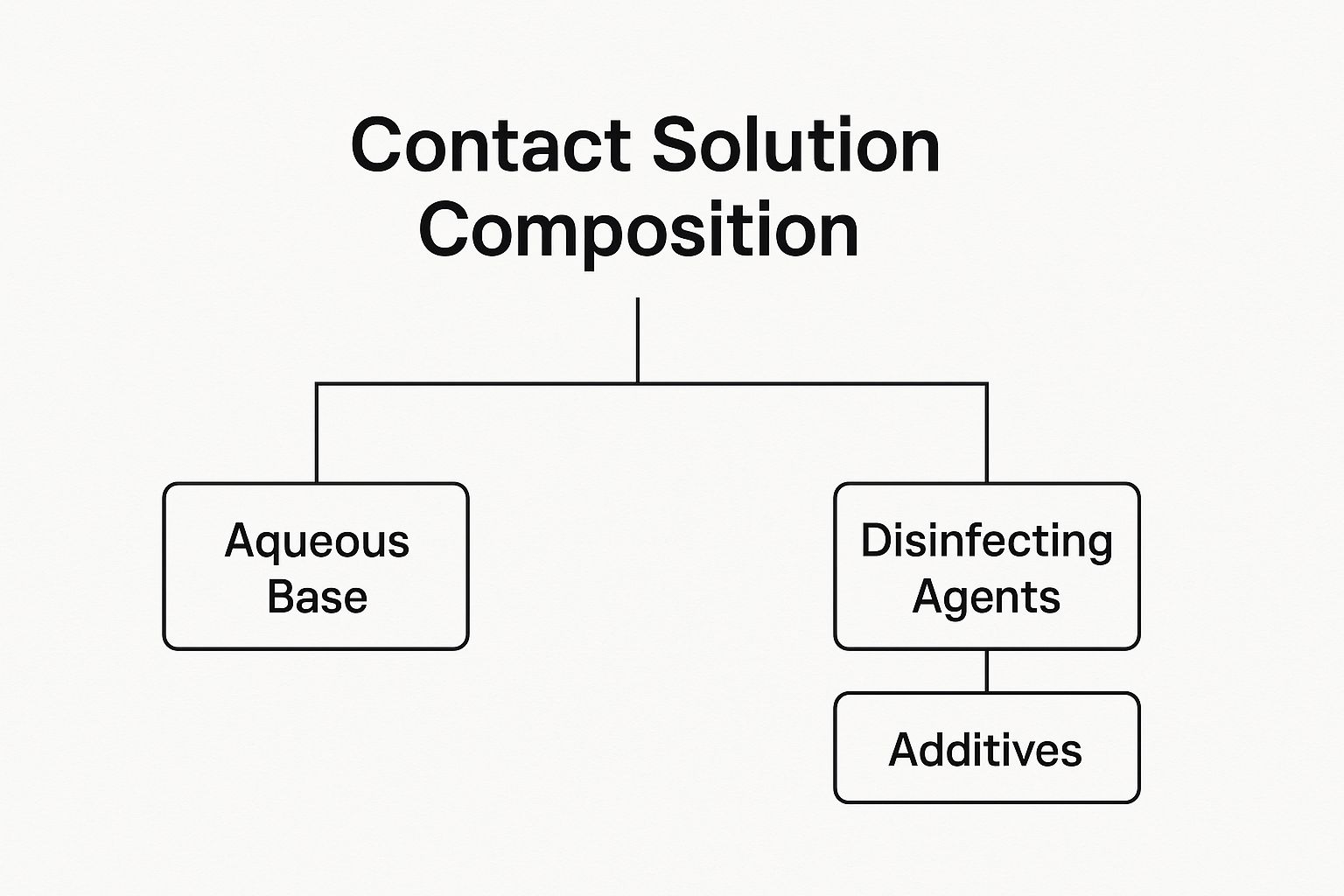
As the visual shows, every solution starts with a sterile base and adds a mix of active ingredients for disinfection, cleaning, and comfort. Getting a handle on these core components makes it much clearer how the solution works to keep your lenses pristine and your eyes healthy.
To get the job done, manufacturers combine several key types of ingredients.
The Heavy Lifters: Disinfecting and Cleaning Agents
First up are the disinfecting agents. These are the most critical ingredients, responsible for neutralizing nasty bacteria, fungi, and other microorganisms that can lead to serious eye infections. Without them, your contact lens case would become a breeding ground for germs.
Next are the surfactants. These act like a gentle soap for your lenses. They work by lifting away the daily buildup of protein deposits, lipids (oils), and other gunk that can make your lenses cloudy and uncomfortable.
The Comfort Crew: Wetting and Buffering Agents
Then you have wetting agents, also known as lubricants. These are all about comfort. They help the lenses hold onto moisture, creating a soft, comfortable cushion between the lens and the surface of your eye, which helps fight that dreaded end-of-day dryness.
Finally, buffering agents are included to maintain the solution's pH level. They ensure the formula closely matches the natural pH of your tears. This simple but vital job is what prevents that all-too-familiar stinging or burning sensation when you put your lenses in.
Here's a quick look at how these ingredients come together to care for your lenses and your eyes.
Key Ingredients in Contact Solution and Their Roles
| Ingredient Type | Primary Function | Common Examples |
|---|---|---|
| Disinfectants | Kill harmful microorganisms like bacteria and fungi. | Polyquaternium-1 (Polyquad), Aldox, hydrogen peroxide |
| Surfactants | Clean the lens surface by removing debris and deposits. | Poloxamine, hydranate |
| Wetting Agents | Help lenses retain moisture for improved comfort. | Tetronic 1304, hyaluronic acid, HPMC |
| Buffering Agents | Maintain a stable pH level to match natural tears. | Borate, phosphate, citrate |
Together, these ingredients create a multi-purpose system that handles all the essential tasks of contact lens care in one simple bottle.
How Disinfectants Protect Your Eyes From Germs
The single most important job your contact solution has is keeping your eyes safe from infection. Think of the disinfectants in the formula as the active-duty germ fighters for your lenses. They're constantly working to hunt down and neutralize the harmful bacteria and fungi that inevitably build up throughout the day.
Without this line of defense, your contact lens case could quickly turn into a breeding ground for nasty microbes. These ingredients are the real workhorses, creating a sterile environment for your lenses to rest in overnight.
Most of us use multipurpose solutions (MPS) that conveniently bundle cleaning, disinfecting, and storing into one bottle. These formulas rely on powerful disinfectants like polyhexamethylene biguanide (PHMB) or polyquaternium-1. They're gentle on the eyes but ruthless against germs. PHMB, for instance, works by literally breaking apart the cell walls of microbes like Pseudomonas aeruginosa—a common bacteria behind some very serious eye infections.
The Two Main Disinfecting Systems
While the goal is always the same—germ-free lenses—there are two distinct approaches to getting there.
- Multipurpose Solutions: These are the go-to for most contact lens wearers. They use those clever chemical agents like PHMB to disinfect your lenses while they soak. The solution also contains preservatives to keep the liquid in the bottle sterile from the moment you open it. We have a full guide on how to clean contact lenses properly if you need a refresher.
- Hydrogen Peroxide Systems: This is the deep-clean option. These systems use a 3% hydrogen peroxide solution to obliterate microbes. But since peroxide is too harsh for the eye, these kits come with a special case containing a neutralizing disc. Over a few hours, this disc converts the potent peroxide into a simple, harmless saline solution.
Critical Safety Note: Never, ever put hydrogen peroxide solution directly into your eye or use a regular, flat lens case. The neutralization process is absolutely essential to avoid a very painful chemical burn.
At the end of the day, both systems are incredibly effective at killing the pathogens that could harm your eyes. The best choice for you usually boils down to your personal eye sensitivity, your lifestyle, and, most importantly, the recommendation from your eye doctor.
Tackling Grime and Buildup with Surfactants and Chelating Agents
While disinfectants are busy fighting off invisible germs, another set of ingredients gets to work on the visible gunk. Ever notice that annoying, cloudy film on your lenses after a long day? That’s the natural buildup of proteins and lipids from your own tears. To keep your vision crystal clear, your solution needs a dedicated cleaning crew.
This is where surfactants step in. You can think of them as a highly specialized soap, but one that’s gentle enough for your contact lenses. In the same way dish soap cuts through grease on a pan, surfactants lift away the stubborn deposits that accumulate on your lens surface.
How Surfactants Work Their Magic
A surfactant molecule is pretty clever. It has two distinct ends: one that is drawn to water (hydrophilic) and another that is drawn to oils and grime (lipophilic).
When you drop your lenses into the case, these molecules get right to work. The oil-loving ends grab onto the protein and lipid deposits, surrounding them. Then, the water-loving ends pull the entire bundle of grime off the lens and suspend it in the solution. It's a microscopic deep clean that leaves the surface pristine.
This process is what prevents that hazy, uncomfortable feeling and ensures you get crisp, clear vision every time you put your lenses in.
This image from All About Vision shows how these ingredients are often listed on the bottle, highlighting their specific roles.
As you can see, surfactants are listed as key cleaning agents, working in tandem with disinfectants to give you complete lens care.
The Unsung Hero: Chelating Agents
Surfactants are great, but they often have a powerful partner: a chelating agent. If you scan the ingredients list on your bottle, you'll almost certainly find EDTA (edetate disodium), the most common one.
Think of chelating agents as the support crew. They don't remove the grime themselves, but they break down the tough bonds holding deposits and bacterial biofilms together, making it much easier for the surfactants and disinfectants to do their jobs.
This teamwork is what makes a good contact solution so effective. By weakening stubborn deposits, EDTA seriously boosts the cleaning and disinfecting power of the whole formula. This ensures a much deeper, more thorough clean while your lenses soak overnight.
Keeping Your Lenses Comfortable All Day with Buffers and Wetting Agents
A great contact lens solution does more than just clean and disinfect. It has to make sure your lenses feel comfortable from the moment you put them in until you take them out at night. This is where two unsung heroes come into play: buffering agents and wetting agents.
Why pH Balance Matters
Let's start with buffering agents, like borate or phosphate. Ever jump into a swimming pool and have the water sting your eyes? That's usually because the pH is out of whack. Your eyes work the same way.
Your natural tears have a very specific pH balance. If your contact solution doesn't match it, you'll get that familiar stinging or burning feeling. Buffering agents are the stabilizers that keep the solution's pH perfectly in sync with your tears, creating a gentle, irritation-free experience.
The Secret to All-Day Hydration
Next up are wetting agents. Think of them as high-tech moisturizers for your lenses. Ingredients like hyaluronic acid or Tetronic are fantastic at attracting and holding water, creating a thin, silky cushion of moisture across the lens surface.
This moisture cushion is the key to preventing that gritty, dry-eye feeling that can ruin your day. It reduces friction between the lens and your cornea, which is a lifesaver for anyone who spends hours staring at a screen. If that sounds like you, our guide on how to prevent dry eyes with contacts has even more great tips.
By maintaining a layer of hydration, wetting agents help your lenses feel smooth and almost unnoticeable, even after a long day.
To really get the job done, many multipurpose solutions also include extra ingredients to help with the cleaning process. Surfactants, for instance, team up with other agents to break down and wash away those stubborn protein and lipid deposits. If you want a deep dive into the science, you can check out patent filings on solution formulations to see how it all comes together.
Why Your Lens Type Determines Your Solution Choice
It’s easy to think all contact lens solutions are the same, but that’s a common mistake. The truth is, not all lenses are created equal, and neither are the formulas designed to clean them. Using the wrong solution for your specific lens type isn't just a minor issue—it can seriously affect your comfort, how clearly you see, and the long-term health of your eyes.
Think of it this way: you wouldn't put diesel in a regular gasoline engine. The same logic applies here. Different lens materials have completely different needs.
Matching Solution to Lens Material
For example, rigid gas permeable (RGP) lenses are hard and non-porous. They need a solution that can scrub and condition a solid surface. Soft lenses, on the other hand, are made from flexible, water-loving plastics. They soak up solution, so the formula has to disinfect and hydrate from within without harming the delicate lens structure.
Even within the world of soft lenses, the material is a huge factor. Older hydrogel lenses have very different properties from modern silicone hydrogel lenses, which are designed to let much more oxygen flow to your cornea. If you want to dive deeper, we break it all down in our guide to silicone hydrogel vs hydrogel contact lenses.
These newer silicone hydrogel materials tend to attract different kinds of buildup, especially lipids (oily deposits). Older hydrogels? They're magnets for protein. This is why solution makers have developed very specific formulas—to tackle the unique challenges of each material and keep your lenses feeling great.
The composition of your contact solution is precisely engineered to be compatible with certain lens materials. A mismatch can lead to ineffective cleaning, lens damage, or eye irritation.
This compatibility is especially critical for managing protein deposits, which can make lenses feel gritty and cloudy. The difference between older and newer solutions in tackling this is night and day.
To illustrate, let's look at some data comparing older multipurpose solutions (MPS) with newer formulas (NuMPS) on their ability to prevent protein buildup.
Impact of Solution Type on Protein Deposits
| Lens Type | Older MPS Protein Level (µg/mg) | NuMPS Protein Level (µg/mg) | % Reduction |
|---|---|---|---|
| Group II Hydrogel | 41.5 | 11.2 | 73% |
| Group IV Hydrogel | 129.8 | 62.7 | 52% |
| Silicone Hydrogel | 10.9 | 3.5 | 68% |
Source: Research on Protein Adsorption on Lenses
As you can see, the newer solutions dramatically reduce the amount of protein that sticks to the lens, regardless of the material. This directly translates to better comfort and clearer vision for you.
Ultimately, the best advice is the simplest: always follow your eye doctor's recommendation. They know your eyes and your lenses, and they’ll point you to the perfect solution to keep both healthy.
When it comes to your eyes, sticking to the facts about lens care is crucial. A lot of dangerous myths still float around, and they often come from not understanding what contact lens solution actually is—a carefully balanced, sterile formula with very specific ingredients. Let's clear up some of the riskiest "hacks" people try.
Myth 1: Using Tap Water or Saliva is Fine in a Pinch
This is, without a doubt, the most dangerous shortcut you could ever take. It might seem harmless, but tap water is far from sterile and is crawling with microorganisms you don't want anywhere near your eyes.
The biggest worry is a nasty parasite called Acanthamoeba. If it gets on your lens, it can lead to Acanthamoeba keratitis, a severe and incredibly painful infection that can seriously threaten your vision. Saliva is no better; your mouth is full of bacteria that belong there, not in your eyes. Always, always stick to sterile, commercially prepared contact lens solution.
Myth 2: Saline Solution is the Same as Disinfecting Solution
It's easy to get these two mixed up, but they do completely different jobs. Think of saline solution as just a simple, pH-balanced saltwater rinse. It's perfect for a quick wash-off after you've disinfected your lenses, but that's all it does. It has absolutely no cleaning or disinfecting agents in it.
Storing your lenses overnight in saline is like leaving raw chicken in a bowl of plain water. It does nothing to stop harmful bacteria from growing all over the surface.
Myth 3: "Topping Off" Old Solution Saves Money
We all like to save a few bucks, but this is not the place to do it. Reusing the solution in your lens case by just adding a little more on top is a huge no-no.
The moment you put your lenses in the case, the solution goes to work, killing germs and breaking down deposits. Its disinfecting power gets used up. What's left behind is a contaminated soup of germs, proteins, and lipids from your lenses. Pouring a splash of fresh liquid into that dirty bath won't re-energize it. To properly disinfect your lenses and keep your eyes safe, you have to dump the old solution and use a fresh batch every single time.
Your Questions About Contact Solution, Answered
Even after breaking down the ingredients, you probably still have a few questions floating around. Let's tackle some of the most common ones so you can feel confident about your lens care routine.
Can I Be Allergic to My Contact Solution?
Absolutely. It’s more common than you might think to develop a sensitivity or a full-blown allergy to an ingredient in your contact solution. The preservatives are usually the main offenders.
If your eyes feel constantly red, itchy, or have a burning sensation that just doesn't quit, your solution could be the problem. Stop using it and give your eye doctor a call. They can pinpoint the issue and often suggest a preservative-free alternative, like a hydrogen peroxide system.
Is It Safe to Switch Contact Solution Brands?
It's tempting to grab whatever is on sale, but you should always talk to your eye doctor before switching brands. It might look like just another bottle of clear liquid, but every formula is different.
A particular solution is designed to work well with specific lens materials and your unique tear chemistry. Making the wrong switch could lead to irritation or less effective cleaning. Your optometrist knows the science behind the products and can recommend a brand that’s a perfect match for your lenses and your eyes.
The chemistry inside these bottles is incredibly precise. For example, a common disinfectant like polyquaternium-1 is often used at a concentration of just 0.001%. In contrast, hydrogen peroxide systems need a much higher concentration of at least 3% to do their job before being neutralized. You can dive deeper into these formulations in this detailed study.
What Is the Difference Between Multipurpose and Hydrogen Peroxide Solutions?
Think of it as choosing between a quick, all-in-one car wash and a deep, professional detailing. Both get the job done, but in very different ways.
- Multipurpose solutions are all about convenience. They clean, disinfect, rinse, and store your lenses with a single product. They're incredibly easy to use, but the trade-off is that they contain preservatives, which can be an issue for people with sensitive eyes.
- Hydrogen peroxide solutions provide a powerful, deep clean without any preservatives. This makes them a fantastic choice if you struggle with sensitivities. The catch? They require a mandatory neutralization step using a special case, which turns the potent peroxide into simple, eye-safe saline.
At Contact Lens HQ, we believe that the more you know, the healthier your eyes will be. Check out our library of doctor-reviewed guides to make smart, safe decisions for your vision. Visit us at https://contactlenshq.com to learn more.


