
When you look at your contact lens box, you'll see a number next to the word "power." This isn't just a generic strength rating; it's a very specific measurement of how much the lens needs to bend light so you can see the world in sharp focus.
This corrective power is measured in units called diopters (D). Think of it as the exact prescription your eye needs to go from blurry to crystal clear.
Your Eyes: A Camera Lens in Disguise
A great way to understand this is to picture your eye as a sophisticated camera. Its natural lens works just like a camera's lens, focusing light onto the retina at the back of your eye (which acts like the camera's film or sensor).
If a camera is out of focus, you twist the lens until the image becomes sharp. A contact lens essentially does the same job for your eye. The "power" is simply the precise adjustment required to fine-tune your vision. When your eye's natural lens doesn't bend light correctly, the contact lens steps in to provide the exact counter-correction needed.
Getting to Grips With Diopters
So, what exactly is a diopter? It's the unit of measurement that tells us how much a lens converges or diverges light. The bigger the number—whether it's a plus or a minus—the stronger the prescription.
Here's what you'll typically see:
- Nearsightedness (Myopia): Prescriptions usually range from −0.25 D to −12.00 D.
- Farsightedness (Hyperopia): Prescriptions often fall between +0.25 D to +8.00 D.
This number has to be incredibly precise. Even a small error of just 0.25 D can make a noticeable difference, especially when you’re trying to read fine print or drive at night.
The power of your contact lens isn’t just a number—it’s the custom key cut to unlock perfect vision. A generic or incorrect power won’t work, leaving your world fuzzy and indistinct.
Nailing this number is the most crucial part of your prescription. Of course, it's just one piece of the puzzle. To see how it fits with the other measurements, you can learn more by checking out our guide on understanding contact lens prescriptions. Every detail matters for a comfortable and effective fit.
Decoding Your Prescription: Plus vs. Minus Power
When you look at your contact lens prescription, the first thing you'll probably notice is a plus (+) or minus (-) sign next to a number. That little symbol tells a huge story about your vision and is the key to understanding how your contacts bring the world into focus.
Think of your eye as a camera. For a sharp, clear photo, the lens has to focus light perfectly onto the film (or sensor). Your retina, the light-sensitive tissue at the back of your eye, is that film. If the light isn't focused precisely on the retina, the picture you see is blurry.
What Do the Plus and Minus Signs Really Mean?
The plus or minus sign simply tells your optometrist which way your eye’s natural focus is off. It’s the blueprint for how your contact lens needs to bend light to get everything lined up perfectly.
-
A minus sign (-) is for nearsightedness, also known as myopia. This means your eye focuses images a little too soon, in front of the retina. The result? Distant objects, like a street sign down the road, look fuzzy. A minus-power lens helps push that focal point back onto the retina, making your distance vision sharp again.
-
A plus sign (+) corrects farsightedness, or hyperopia. In this case, your eye focuses images behind the retina. This makes it tough to see things up close, like the text on your phone, without your eyes working overtime. A plus-power lens pulls the focal point forward, giving you clear, comfortable near vision.
The further the number is from zero (in either direction), the stronger the prescription. Someone with a -6.00 prescription needs a lot more correction than someone with a -1.50. The same goes for plus powers—a +4.25 is much stronger than a +0.75.
To make sure your vision is just right, these numbers are measured in tiny increments of 0.25 diopters. This precision allows for a highly customized fit, ensuring you get the sharpest sight possible without the headaches or eye strain that can come from a prescription that’s even slightly off.
Here’s a simple breakdown to help you keep it all straight:
Contact Lens Power At a Glance
| Power Type | Sign | Corrects | Common Name | How It Helps |
|---|---|---|---|---|
| Minus Power | – | Nearsightedness | Myopia | Moves the eye's focal point backward to clarify distant objects. |
| Plus Power | + | Farsightedness | Hyperopia | Pulls the eye's focal point forward to sharpen close-up objects. |
Ultimately, whether you have a plus or minus prescription just describes how your unique eyes see the world. Understanding this is the first step toward getting contacts that feel like they were made just for you.
Dealing with Astigmatism: Understanding Cylinder and Axis
If you glance at your contact lens prescription and see three numbers instead of one, don't worry. It's a very common sign that you have astigmatism, which just means your eye isn't perfectly round. This slight imperfection in shape causes light to bend unevenly, resulting in blurry vision no matter how near or far you're looking.
A good way to picture it is to think of a basketball. An eye without astigmatism is shaped like that, perfectly spherical, which lets light focus on one single, sharp point. An eye with astigmatism, on the other hand, is shaped more like an American football—it's more curved in one direction than the other. Because of that oblong shape, light entering the eye gets scattered instead of focused, creating that frustrating blur.
How Cylinder and Axis Bring Your World into Focus
To counteract that football shape, your prescription needs two extra measurements that work together: Cylinder (CYL) and Axis.
-
Cylinder (CYL): This measures the amount of extra lens power needed to correct the astigmatism. Just like the main power, it's measured in diopters and will have a minus sign in front of it.
-
Axis: This tells the lens manufacturer the orientation of the astigmatism. It’s a number between 1 and 180 degrees, pinpointing the exact location on the lens where that cylinder power needs to be placed to match your eye's unique curve.
For anyone who needs contacts for astigmatism—often called toric lenses—these two values are absolutely essential. Without the correct Cylinder and Axis, the lens simply can't tame the blur caused by the eye's irregular shape. Your vision would feel unstable and never quite sharp.
This map provides a great visual breakdown of how basic vision correction differs from astigmatism correction.
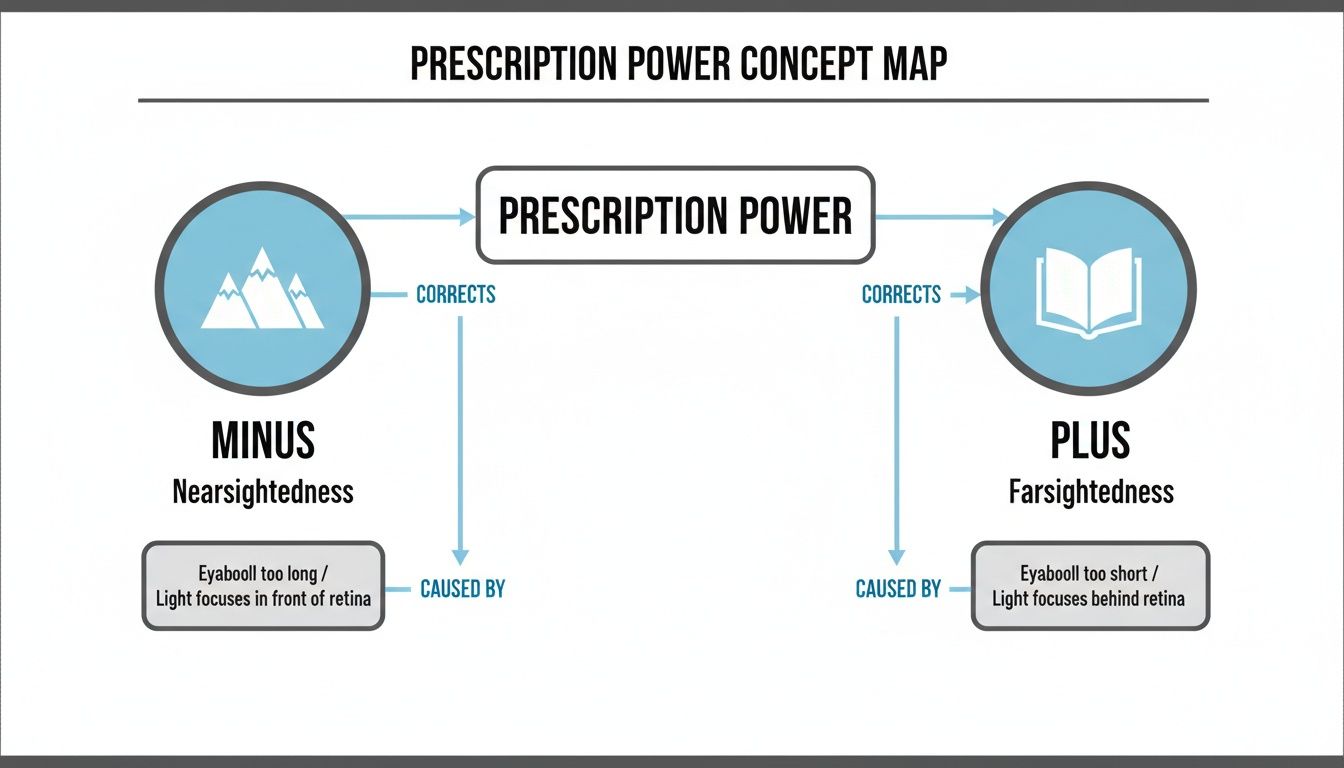
You can see how a simple plus or minus power fixes basic focusing issues. But for the more complex problem of astigmatism, you need that two-part fix from the Cylinder and Axis to get truly crisp, clear vision.
A Closer Look at ADD Power in Multifocal Lenses
Around your 40s, something frustrating starts to happen. That menu at your favorite restaurant or the text from a friend suddenly becomes a blurry mess. This is presbyopia, a completely normal change in your eyes that makes focusing up close a real challenge.
For years, the only answer was a pair of reading glasses. But if you're a contact lens wearer, you don't have to give up that freedom. This is where ADD power in multifocal contacts comes into play.
Think of ADD power as the extra "boost" of magnification built right into your contact lens. It's like having a tiny, invisible magnifying glass seamlessly blended with your distance prescription, giving you the power you need for reading and other close-up tasks.
These sophisticated lenses have different zones for different distances, allowing you to see clearly whether you're looking far away, at a computer screen, or at the book in your hands. It’s all about ditching the on-again, off-again hassle of reading glasses. For a deeper dive, check out our guide to bifocal and multifocal contact lenses.
What ADD Power Means on Your Prescription
When you look at your prescription, the ADD power will show up either as a number (like +1.50) or a simple label like "Low," "Medium," or "High."
This tells your eye doctor how much extra magnification you need to read comfortably. A higher ADD power means you need a stronger boost for your near vision.
Your ADD power is more than just a number—it’s the key to keeping your visual world seamless. It's what lets you glance from your phone to the TV without missing a beat.
This isn't just a niche issue; it's a huge part of vision care. As people hit their mid-40s and presbyopia sets in, millions shift from standard contacts to multifocal designs. According to market analysis from SNS Insider, this demographic makes up a massive part of the global demand. It reframes the conversation: choosing the right lens isn't just for convenience, it's a vital part of your long-term eye health.
How Your Prescription Power Shapes Your Contact Lens
Ever wondered why your eye doctor recommends a specific brand of contacts? It’s not just about comfort—your prescription’s power is a major driver behind that decision. It's the blueprint that dictates the physical shape and material of the lens you'll be wearing every day.
Think about it this way: a stronger prescription, like a -8.00 for nearsightedness or a +5.00 for farsightedness, requires a more substantial lens. This means the lens will be thicker, either at the edges or in the center, to bend light correctly. But that added thickness creates a potential problem—it can act as a barrier, making it tougher for oxygen to reach your cornea.

Your cornea needs to breathe to stay healthy. This is precisely why the lens material becomes so critical, especially for those of us with higher prescriptions.
Why Advanced Materials Matter for High Powers
To solve the oxygen problem, lens manufacturers came up with some pretty amazing materials. For high-power prescriptions, the go-to choice today is almost always silicone hydrogel.
This material was a breakthrough. It allows significantly more oxygen to pass through to the eye than the older hydrogel materials ever could. Imagine the difference between wearing a standard t-shirt and a modern, moisture-wicking athletic shirt on a hot day. That’s the kind of upgrade we're talking about for your eyes—it makes wearing stronger lenses safer and far more comfortable for long periods.
The connection between prescription power and material technology is a huge deal in the contact lens world. Since corrective lenses are the largest part of the market, there’s been a massive push to create materials like silicone hydrogel that can safely handle higher powers. You can see how this plays out by looking at these global contact lens market insights.
The power on your prescription isn't just a number; it’s a direct command to the manufacturer about the lens's shape, thickness, and the specific material required to keep your eyes healthy and your vision sharp.
So, when your optometrist suggests one brand over another, they're not just picking a name out of a hat. They are carefully matching your unique vision needs with the best lens technology designed to support your specific prescription power.
Why Your Glasses Prescription Is Not for Contacts
It's one of the first things you learn in eye care: never, ever use your glasses prescription to order contact lenses. It seems like the numbers should just transfer over, right? But the reason they can't comes down to some surprisingly simple physics.
Your eyeglasses sit about 12 millimeters from the surface of your eyes, but contacts rest directly on them. That small gap, which we call the vertex distance, makes a huge difference in the lens power needed to focus light perfectly on your retina. For a mild prescription, the adjustment might be minor, but with stronger prescriptions, the conversion is absolutely critical for clear vision.
It's More Than Just Power
A contact lens prescription has a whole other layer of detail that your glasses Rx simply doesn't include. These extra measurements are all about ensuring the lens fits your eye safely and comfortably.
- Base Curve (BC): This number, measured in millimeters, describes the curvature of the lens itself. It needs to match the unique curve of your cornea to keep the lens stable and in place.
- Diameter (DIA): This is the total width of the contact lens. The right diameter ensures the lens covers the right parts of your eye without being too tight or too loose.
Trying to guess these numbers or skip a proper fitting is a serious gamble with your eye health. A poorly fitting contact can cause anything from constant irritation and corneal scratches to serious infections from a lack of oxygen.
At the end of the day, a separate contact lens fitting with your eye doctor is non-negotiable. For a deeper dive, you can learn more about why a glasses prescription can't be used for contacts and make sure you're keeping your eyes safe.
Common Questions About Contact Lens Power
Even with a good grasp of diopters, you probably still have a few questions floating around. That's completely normal. Getting answers to these common curiosities will help you feel more confident about your vision correction and how the power of your contacts really impacts your day-to-day life.
Let's tackle some of the most frequent questions we hear.
Can My Contact Lens Power Change Over Time?
Absolutely, and it’s something you should expect. Our vision naturally changes throughout our lives. You might notice shifts during your teenage years and then again after you hit 40, when age-related changes often kick in.
This is precisely why your eye doctor insists on annual check-ups. A yearly exam ensures your prescription is up-to-date, saving you from the eye strain and headaches that come with wearing the wrong power. It’s all about keeping your world in sharp focus.
What Happens If I Wear the Wrong Power?
Wearing the wrong prescription won't permanently damage your eyes, but it will definitely make your life miserable. You'll be dealing with blurry vision, which quickly leads to eye fatigue, nagging headaches, and a whole lot of strain.
Think of it like trying to listen to a radio station that’s just slightly off-frequency—all you get is frustrating static instead of clear music. It makes simple things like reading a book or driving at night uncomfortable, and even unsafe.
Is a Higher Power Number Better?
Not at all. When it comes to contact lenses, "higher" doesn't mean "stronger" or "better." The best power is the one that’s been precisely measured to bring your vision to a crisp 20/20.
A lens power that’s too high is just as bad as one that’s too low—both will distort your vision and can even cause dizziness. The golden rule is to always stick to the exact power your eye doctor prescribed. That’s your ticket to clear, comfortable vision.
At Contact Lens HQ, we believe an informed wearer is a happy wearer. Dive into our library of doctor-reviewed guides and articles to get the most out of your contact lenses.


