
We’ve all been there: staring at an empty bottle of contact lens solution late at night. The temptation to find a quick substitute is real, but let me be clear: no household item is a safe substitute.
Using things like tap water, saliva, or a homemade salt mixture can introduce incredibly dangerous bacteria to your eyes. These substitutes completely lack the disinfecting agents your lenses need, putting your vision at serious risk. The only thing you can use in a true pinch is a commercially prepared sterile saline solution, and even that is just for a very brief time until you can disinfect them properly.
Why You Can't Just Use Water for Contacts
When you're out of solution, reaching for the tap might seem like the most logical thing to do. It’s just water, right? Unfortunately, this is one of the biggest mistakes you can make for your eye health. Contact solution isn't just glorified saltwater; it's a sophisticated, sterile medical product designed for a very specific job.
Think of your contact lens like a tiny, high-tech sponge that sits directly on your eye. The soft, flexible material is designed to absorb and hold moisture to keep your eyes comfortable all day. You can learn more about these fascinating materials in our guide on what contact lenses are made out of.
When you place that "sponge" in tap water, it soaks up everything in it—chlorine, minerals, impurities, and microscopic organisms. One of the most frightening of these is a microorganism called Acanthamoeba, which is commonly found in tap water, lakes, and even your shower.
Trapping this amoeba between the lens and your eye creates the perfect environment for a severe, painful, and potentially blinding infection known as Acanthamoeba keratitis.
More Than Just a Rinse
A proper contact solution does three critical jobs that water simply can't handle:
- Disinfection: It’s formulated with powerful agents that kill the nasty bacteria, viruses, and fungi that collect on your lenses from daily wear.
- Protein Removal: It actively breaks down the protein deposits from your tears that can make your lenses cloudy and your eyes feel scratchy.
- Hydration and Balance: The solution is pH-balanced to mimic your natural tears. This keeps the lenses comfortable and ensures your cornea gets the oxygen it needs to stay healthy.
Saline Solution Is Not a Disinfectant
Okay, so what about sterile saline solution? It seems much safer than tap water, but it's crucial to understand its limitations. Saline is great for rinsing, but it has zero disinfecting power.
A controlled lab study confirmed that basic saline is useless against bacteria and the slimy biofilms that germs build on lenses. While multipurpose disinfecting solutions successfully destroyed these biofilms, saline didn't make a dent. You can read the full study about biofilm removal from contact lenses for the details.
This is exactly why the "rub and rinse" step with a real disinfecting solution is so important for safe contact lens care. Anything less is a gamble you don't want to take with your eyesight.
The Hidden Dangers lurking in Your Cabinets
When you're out of contact solution and desperation kicks in, it's tempting to look around your kitchen or bathroom for a quick fix. You might think, "What can I use instead of contact solution just for tonight?" But what seems like a simple substitute can be genuinely harmful to your eyes.
Let's walk through why some of the most common go-to's are actually a terrible idea.
Tap Water: A Microscopic Minefield
It might seem harmless—it's just water, right? Wrong. Using tap water to store or even rinse your contacts is one of the riskiest things you can do for your eye health.
Your tap water, while safe to drink, is far from sterile. It contains all sorts of microorganisms, but the most terrifying one for contact lens wearers is an amoeba called Acanthamoeba. If this nasty bug gets trapped between your lens and your eye, it can cause Acanthamoeba keratitis, a rare but devastating infection. We're talking severe pain, scarring on your cornea, and in the worst cases, permanent vision loss. It's just not worth the risk.
Saliva: A Direct Path to Infection
In a real pinch, the thought of using your own spit might cross your mind. Please don't do it. Your mouth is teeming with bacteria—hundreds of different kinds.
When you put saliva on your lens, you're essentially smearing that bacteria all over it and then placing it directly onto your eye. This is a fast track to a nasty bacterial infection, like a corneal ulcer. A corneal ulcer is an open sore on your eye's surface that's incredibly painful and can seriously threaten your sight if you don't get medical help immediately.
The Myth of "Clean" Water (Bottled or Purified)
Okay, so tap water is out. What about bottled or purified water? It has to be safer, right? Unfortunately, no.
While these types of water might be filtered to remove minerals and impurities, they are not sterile. They still lack the specific disinfecting agents that kill the germs, fungi, and bacteria that build up on your lenses all day long. Storing your contacts in any kind of water doesn't clean them; it just gives contaminants a perfect place to multiply.
Why Homemade Saline Is a Terrible Idea
Whipping up a quick saltwater solution at home seems like a clever, old-school hack. In reality, it's a recipe for disaster. Getting the salt-to-water ratio and pH balance just right is something that can only be done in a sterile, laboratory setting.
This image shows a typical DIY setup, but it’s a practice loaded with hidden risks.
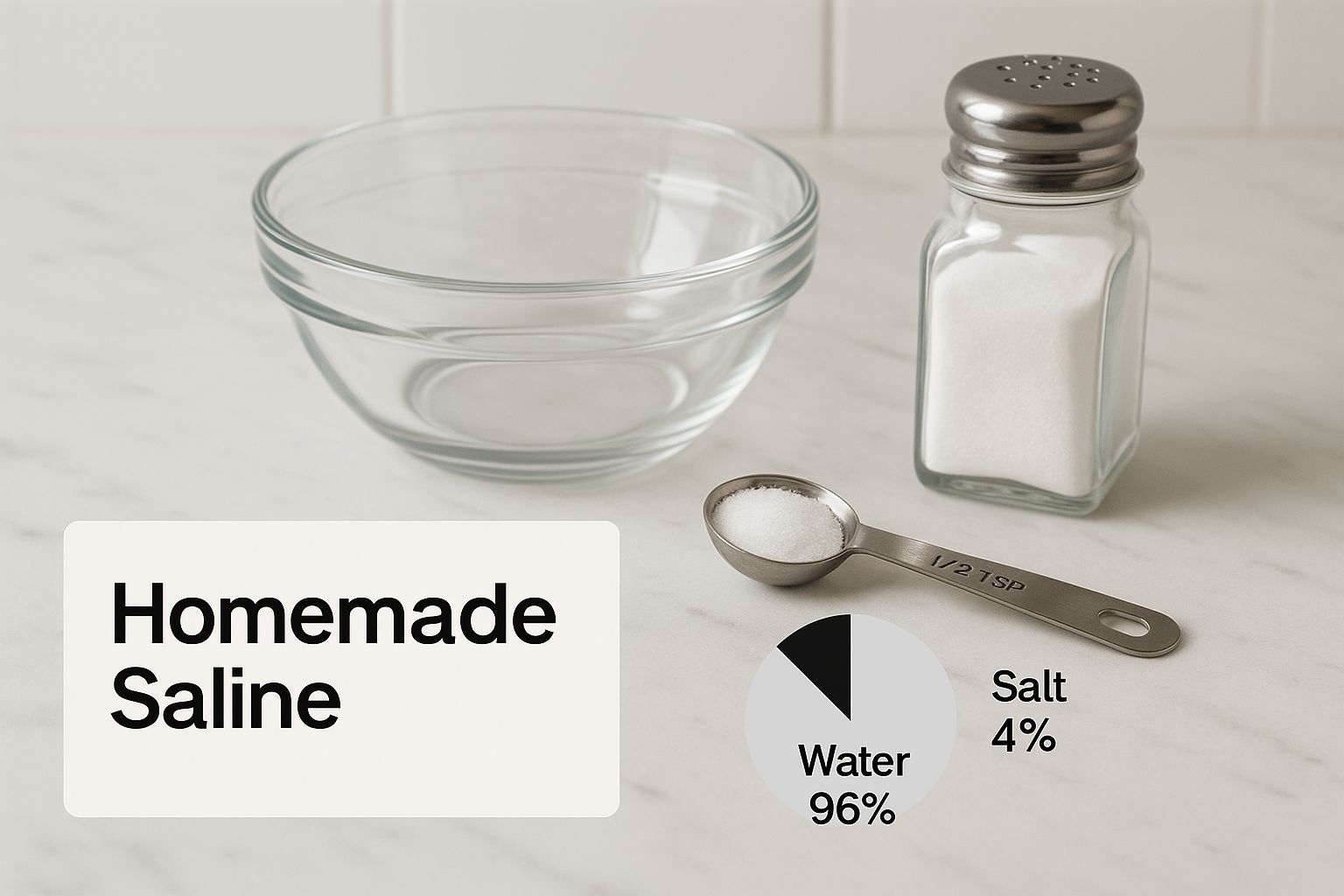
Even with the best intentions, you can't control for contamination at home. Here’s what can go wrong:
- Wrong Salt Level: Too much salt will dehydrate your lenses and your eyes, leading to serious irritation. Too little, and it won't be compatible with your natural tears.
- Incorrect pH Balance: If the solution isn't pH-balanced to match your tears, it can cause a stinging, burning sensation and can even lead to tiny scratches on your cornea, known as corneal abrasions.
- Contamination is Unavoidable: Your kitchen is simply not a sterile lab. It's incredibly easy for airborne bacteria or fungi to land in your mixture, which you then put directly into your eyes.
Contact solution is a complex, carefully balanced formula for a reason. To really understand why it's so hard to replicate, check out our guide on what contact solution is made of.
Risk Profile of Common Contact Solution Substitutes
To make it even clearer, here's a quick breakdown of the risks associated with these common but dangerous substitutes.
| Substitute | Primary Risk | Why It's Unsafe |
|---|---|---|
| Tap Water | Acanthamoeba Keratitis | Contains microorganisms, including a dangerous amoeba, that can cause severe, sight-threatening infections. |
| Saliva | Bacterial Keratitis (Corneal Ulcer) | Transfers a high concentration of bacteria from your mouth directly to your eye, leading to painful infections. |
| Bottled/Distilled Water | Bacterial & Fungal Infections | Lacks any disinfecting agents, allowing harmful pathogens on the lens to multiply and contaminate the eye. |
| Homemade Saline | Corneal Abrasions & Infection | Impossible to make sterile or properly pH-balanced at home, leading to irritation, eye damage, and contamination. |
As you can see, the convenience of a DIY solution is completely outweighed by the potential for serious, and sometimes permanent, damage to your vision. It's always better to be safe than sorry.
Finding a Safe Temporary Solution in an Emergency
It’s a familiar scenario for just about every contact lens wearer: that moment of panic when you realize you're completely out of solution and miles from the nearest store. In a pinch like that, it's tempting to reach for risky substitutes. But when you’re wondering what you can use instead of contact solution, there is only one genuinely safe, temporary option.
Honestly, the best and smartest move you can make is to just take your lenses out and put on your glasses. Think of it less as a hassle and more as a crucial investment in your long-term eye health. Choosing your glasses keeps a minor inconvenience from snowballing into a serious medical issue with lasting consequences.
The Only Acceptable Temporary Fix
Let's say wearing glasses just isn't possible and you're in a real bind. In that case, the only acceptable substitute for very short-term storage is a commercially prepared, sterile saline solution. It’s critical to understand what this is—and, just as importantly, what it isn't.
Sterile saline is just a purified saltwater solution that's been pH-balanced to be compatible with your eyes and lenses. You can use it to give your lenses a quick rinse or, in a pinch, store them for a few hours. It will keep them hydrated and prevent them from drying out and getting damaged.
But that's where its job ends.
Sterile saline is not a disinfectant. It has zero cleaning agents. It won't do anything to kill the bacteria, lipids, and protein deposits that have built up on your lenses all day. It’s strictly for rinsing and temporary holding—that's it.
The Critical Next Step After Emergency Storage
If you've had to store your lenses in saline overnight, you absolutely cannot just pop them back into your eyes the next morning. You might as well be putting a contaminated petri dish directly onto your cornea.
Before those lenses are safe to wear again, you must follow these steps:
- Clean them thoroughly with a proper multipurpose or hydrogen peroxide-based disinfecting solution.
- Use the "rub and rinse" method to physically break up any biofilm and get rid of debris.
- Soak the lenses in fresh disinfecting solution for the full time recommended by the manufacturer, which is usually at least six hours.
Skipping this full disinfection cycle is not an option. It’s the only way to be certain that any nasty germs that have been multiplying on your lenses are completely neutralized.
Ultimately, while sterile saline can get you through a single night in an emergency, it really just underscores the importance of being prepared. The safest bet is to always have a backup pair of glasses and a travel-sized bottle of your regular contact solution handy. This simple habit is the best defense for protecting your vision.
A Deeper Dive into Hydrogen Peroxide Lens Care Systems
If you've ever felt like your lenses just aren't getting clean enough with standard solutions, or if your eyes are sensitive to preservatives, there's another world of lens care to explore: hydrogen peroxide systems. These aren't your typical all-in-one bottles. Think of them as a deep-cleaning treatment for your contacts.
These systems are specifically designed for a more powerful, aggressive disinfection. They use an oxidative reaction to obliterate stubborn protein and lipid gunk that can build up over time, leaving your lenses feeling brand new.
But this power comes with one massive, non-negotiable rule: the hydrogen peroxide must be neutralized before those lenses go anywhere near your eyes.

The Neutralization Process: How It Works
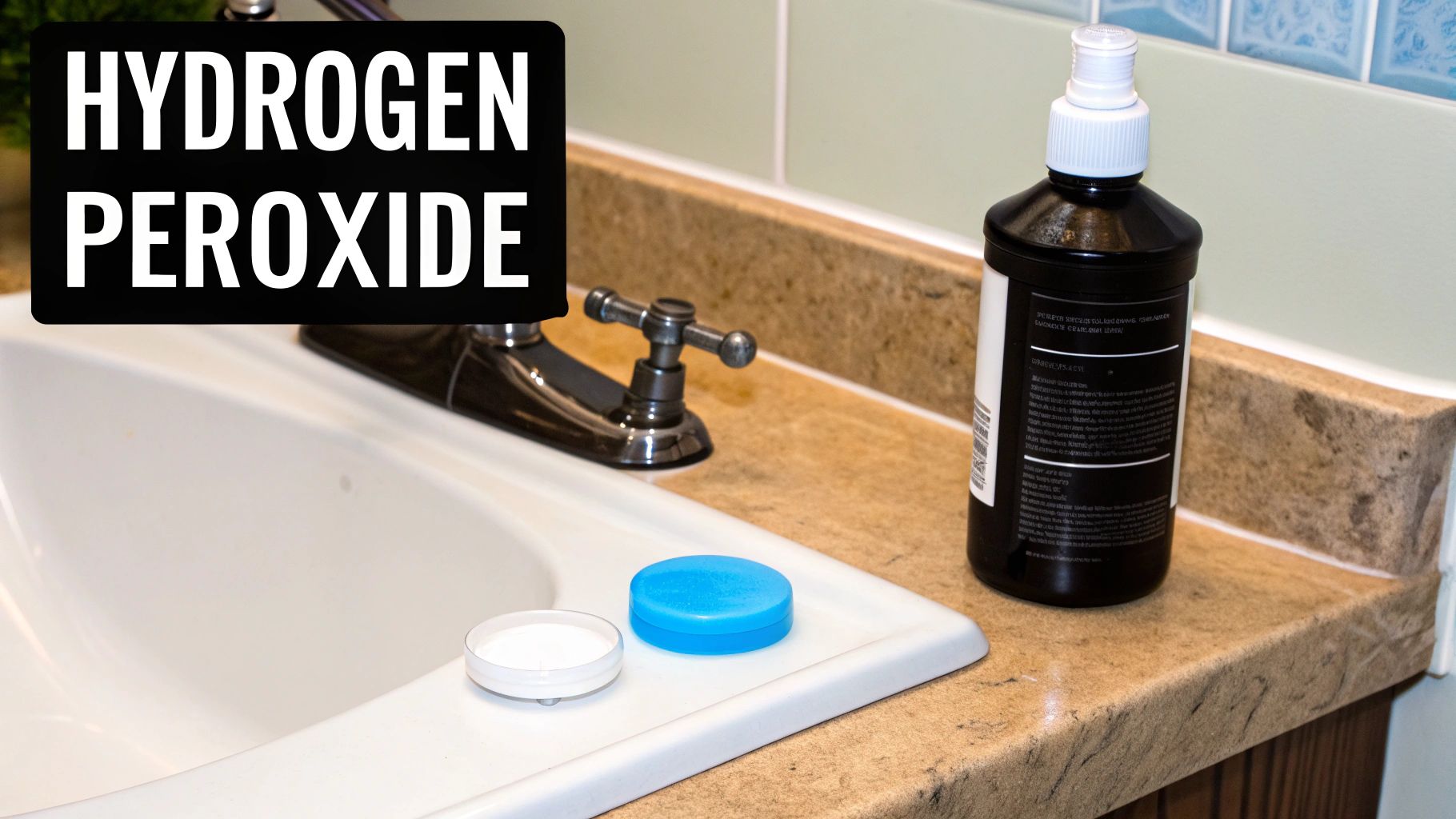
Imagine the 3% hydrogen peroxide solution as a potent cleaning agent—fantastic for scrubbing away debris, but way too harsh for the delicate surface of your eye. To make it safe, these systems include a specially designed lens case that has a built-in neutralizer, usually a small disc coated in platinum.
When you drop your lenses into the case and add the peroxide solution, that little disc sparks a chemical reaction. You'll see it start to bubble almost immediately. That's the catalyst at work, breaking down the powerful hydrogen peroxide and turning it into a simple, gentle saline solution that won't harm your eyes. This whole process takes a while, typically at least six hours.
This system is incredibly effective for a thorough clean, but you absolutely cannot rush it. Cutting the neutralization time short is a recipe for disaster. Putting a lens soaked in un-neutralized peroxide into your eye will cause serious pain and can even damage your cornea.
Why It Delivers a Superior Clean
There's a reason eye care professionals often recommend these systems. They are champs at killing a whole host of microorganisms. In fact, studies have shown that peroxide systems do a better job of protecting the eye's surface and lead to significantly less corneal staining compared to many multipurpose solutions.
The proof is in the cleanliness. Research has found that 30% of lens cases used with peroxide systems showed zero microbial contamination, which speaks volumes about how well they maintain hygiene. If you want to dig into the science, you can find a lot more information about the best practices in contact lens care and their benefits.
Even with all these pros, you have to be meticulous. Following the instructions to the letter is key.
- Always use the provided case. A standard, flat lens case doesn't have the catalyst disc, so the solution will remain pure, un-neutralized hydrogen peroxide.
- Never, ever rinse with it. Do not use the peroxide solution as a quick rinse before popping your lenses in. It will burn. A lot.
- Give it the full soak time. Let the lenses soak for the entire six-hour minimum. This ensures the neutralization is 100% complete.
For people who need that next-level clean or who just can't tolerate the preservatives in other solutions, hydrogen peroxide systems are a fantastic option. They require a bit more discipline than your average all-in-one, but the reward is exceptionally clean, comfortable lenses.
Why Good Habits Matter More Than the Brand
Let's be honest. That frantic search for a contact solution substitute usually happens for one simple reason: you've run out. It's a common mistake, but it points to a much bigger truth—your daily habits are far more important for your eye health than the brand name on the bottle.
While a quality solution is certainly part of the equation, it's the consistent, day-in-and-day-out care that truly protects your eyes. Think of it like brushing your teeth. The fanciest, most expensive toothpaste in the world won’t do a thing if you only use it once a week. It’s the daily discipline that keeps your smile healthy. The same goes for your contacts.
The Non-Negotiable Rules of Lens Care
When it comes to wearing contacts safely, some rules just aren't optional. These aren't just helpful tips; they are the absolute foundation for preventing serious eye infections and keeping your lenses comfortable. Getting these habits down is your best defense.
There are three big ones that really matter:
- The "Rub and Rinse" Method: This is probably the single most important step. Just letting your lenses soak overnight isn't enough to get rid of all the gunk, like protein deposits and other invisible debris. You have to physically rub the lens in your palm with a bit of fresh solution before rinsing it clean.
- Daily Case Cleaning: Your lens case can turn into a petri dish for bacteria surprisingly fast. Every single morning, dump out the old solution, rinse the case with fresh solution (never tap water!), and leave it open and upside down on a clean tissue to air dry.
- Regular Case Replacement: Even with perfect cleaning, nasty biofilms can build up over time. Make it a non-negotiable habit to toss your old lens case and replace it with a fresh one every three months.
Following these simple actions dramatically lowers your risk of infection. To make sure you've got the technique down pat, take a look at our complete guide on how to clean contact lenses properly.
Why Your Eye Doctor Is Your Best Resource
Even with the best habits in the world, not every solution works for every person or every lens. The material your contacts are made from and the unique chemistry of your own tears are huge factors in what will work for you. That’s why just grabbing any bottle off the shelf is a risky move.
Your optometrist is the only one who can truly match you with the right solution. They understand how different preservatives and cleaning agents interact with your eyes and can recommend a formula that cleans effectively without causing irritation.
Before you ever switch brands or try a new type of solution, you must talk to your eye doctor. They know the science behind lens materials and can stop you from making a choice that leads to discomfort or even more serious problems.
This professional advice is so critical because poor hygiene and a lack of knowledge are surprisingly common. Research shows that while a solid 85.7% of wearers wash their hands before handling lenses, far fewer follow other key rules. In fact, a startling 1.8% admit they never clean their lens cases at all.
It's this gap in proper care that often sends people looking for dangerous DIY alternatives in a pinch. Ultimately, building good habits and listening to your eye doctor are the only real shortcuts to keeping your vision safe and clear.
Your Top Questions About Contact Lens Care, Answered
When you're dealing with something as important as your eyesight, it's natural to have questions. This is especially true when you find yourself in a bind without proper contact solution. Getting the right information is key to keeping your eyes healthy, so let's clear up some of the most common uncertainties.
Can I Use Rewetting Drops Instead of Contact Solution?
Absolutely not. It's a common mix-up, but rewetting drops and contact solution are designed for completely different jobs. You should never, ever use rewetting drops to clean or store your lenses.
Think of it like this: rewetting drops are just there to add a bit of moisture to your eyes while you're wearing your contacts. They're like a quick sip of water on a hot day. They offer temporary relief from dryness but contain zero cleaning or disinfecting ingredients. Storing your lenses in them is like leaving dirty dishes in a sink of plain water—it does nothing to kill the germs, which can lead to a nasty eye infection.
A quick but vital safety note: Never put contact solution directly into your eyes like you would with eye drops. The cleaning agents in contact solution are far too harsh for your eye's delicate surface and can cause serious irritation, redness, or even a chemical burn on your cornea. Stick to using products only as they're intended.
What's the Real Difference Between Saline and Multipurpose Solution?
The biggest, most crucial difference comes down to one word: disinfection.
Saline solution is basically just a sterile, pH-balanced saltwater. Its only purpose is for rinsing. You can use it to wash off debris that your cleaning solution has already loosened or to re-wet a lens right before popping it in your eye. That's it. It has zero germ-killing power.
Multipurpose solution, on the other hand, is a complex, all-in-one product. It’s packed with ingredients that do several jobs at once:
- Surfactants: These are the "soaps" that scrub away all the gunk—proteins, oils, and other deposits—that builds up on your lenses throughout the day.
- Disinfectants: These are the heavy hitters. They actively kill harmful bacteria, fungi, and other nasty microbes that could cause an infection.
- Wetting Agents: These ingredients help your lenses stay moist and comfortable from the moment you put them in until you take them out.
So, while saline is just for a quick rinse, multipurpose solution is your cleaner, disinfectant, and storage case liquid all rolled into one. Mistaking one for the other is a gamble you don't want to take with your eyes.
I Already Stored My Contacts in Water. What Do I Do Now?
If you've stored your contacts in any kind of water—tap, bottled, distilled, it doesn't matter—there's only one safe thing to do: throw them away immediately. I know it's frustrating, but please do not put those lenses back in your eyes.
Water is teeming with microorganisms, including a particularly dangerous amoeba called Acanthamoeba. This parasite can latch onto the soft material of your contact lens and is incredibly difficult to remove. Even if you soak the lenses in proper solution afterward, you can't be sure you've gotten rid of it.
The risk of developing an infection like Acanthamoeba keratitis, which is incredibly painful and can lead to permanent vision loss, just isn't worth it. It’s always better to sacrifice a single pair of contacts than to risk your sight. When in doubt, start fresh with a new pair.
At Contact Lens HQ, our mission is to provide you with doctor-reviewed, accurate information to protect your vision. Explore our extensive library of guides and articles to become an expert on your own eye health. Learn more at https://contactlenshq.com.


