
If you've ever wondered about contact lenses, you're probably thinking of soft contacts. They're the go-to choice for millions of people around the globe for a simple reason: they masterfully combine comfort, convenience, and crystal-clear vision.
Think of a soft contact lens as a tiny, flexible, water-infused disc that sits right on the surface of your eye, correcting your vision without you even noticing it's there.
What Are Soft Contact Lenses

At its core, a soft contact lens is a sophisticated medical device made from a pliable, gel-like plastic. Unlike glasses that create a rigid frame in front of your eyes, these lenses conform perfectly to the unique shape of your cornea. They move with your eye, giving you a completely natural and unobstructed field of vision.
The magic is in how they redirect light. If your eye is like a camera that's slightly out of focus, a soft contact lens acts like a custom-fit corrective filter. It bends the incoming light just right, ensuring it lands precisely on your retina at the back of your eye. The result? Sharp, clear sight.
Correcting Common Vision Problems
The main purpose of soft contact lenses is to fix these common focusing issues, known as refractive errors. Their versatility is impressive, and they can handle a whole spectrum of vision problems that many of us experience.
- Nearsightedness (Myopia): Having trouble seeing things far away? Myopia makes distant objects look blurry. Soft lenses for myopia help spread the light rays out, pushing the focus point back onto the retina where it belongs.
- Farsightedness (Hyperopia): This is the opposite problem, where close-up objects are fuzzy. These lenses do the opposite job—they bring light rays together, pulling the focus point forward onto the retina.
- Astigmatism: If your eye is shaped a bit more like a football than a sphere, you might have astigmatism, which causes blurriness at all distances. Special toric lenses are engineered with different powers in different meridians to counteract this irregular shape.
- Presbyopia: As we get older, our eyes naturally lose the ability to focus up close. For this, multifocal soft lenses are a fantastic solution, featuring different zones for near, intermediate, and distance vision, all in one lens.
The Evolution to Modern Comfort
It’s easy to take today’s comfort for granted, but contact lenses have come a long way. The earliest versions were made from glass or hard, unforgiving plastic—not exactly something you'd want to wear all day. The real game-changer came in the mid-20th century with the invention of "hydrogel," a special water-loving material.
Modern soft contact lenses are a marvel of material science. Their ability to combine high water content for comfort with advanced polymers for oxygen breathability is what makes them suitable for all-day wear for millions of people.
Today’s lenses are crafted from incredibly advanced plastics that allow plenty of oxygen to pass through to the cornea, which is vital for keeping your eyes healthy and comfortable. This journey from stiff discs to breathable, flexible materials is why soft contact lenses are now the most popular type of contact lens worldwide. They’ve truly set the standard for modern vision correction.
Finding Your Perfect Wear Schedule
Once you and your eye doctor agree that soft contacts are a good fit, the next big question is: how often will you replace them? This isn't just about convenience—it's one of the most important decisions you'll make for your comfort, hygiene, and long-term eye health.
Think of it like choosing between a fresh paper plate for every meal or washing a ceramic one after each use. Both get the job done, but they cater to very different lifestyles and priorities.
The replacement schedule your doctor gives you is a firm rule, not a friendly suggestion. Stretching your lenses past their disposal date allows irritating proteins and lipids from your tears to build up, which can cloud your vision and seriously increase your risk of a nasty eye infection. Let’s break down the common schedules so you can figure out which one is the right match for you.
Daily Disposable Lenses: The Ultimate in Convenience
Daily disposable soft contacts are the gold standard for anyone who values simplicity and hygiene above all else. Just as the name says, you pop in a brand-new, sterile pair every single morning and simply toss them out before bed. No cleaning solutions, no storage cases, no hassle.
This "fresh start" every day comes with some major perks:
- Peak Hygiene: Because you never reuse the lens, there’s virtually no time for irritating gunk like proteins, lipids, and allergens to accumulate. This makes dailies a fantastic choice for people with allergies or sensitive eyes.
- Unmatched Convenience: If you have a busy, unpredictable schedule, daily disposables are a dream. There’s no nightly cleaning routine to remember, making them perfect for travel, sports, or just occasional wear.
- Consistent Comfort: Nothing beats the feeling of a perfectly fresh, smooth lens. Many people find they get the best all-day comfort with dailies.
So, what's the catch? The main trade-off is the price tag. Daily disposables are usually the most expensive option upfront since you're buying 365 pairs of lenses a year. The good news is you won't be spending money on cleaning solutions and cases, which helps balance out some of the cost.
Reusable Lenses: Bi-Weekly and Monthly Options
For a lot of wearers, reusable soft contact lenses hit that sweet spot between cost and performance. These lenses are designed to be worn daily, but you take them out each night to be cleaned and disinfected. Then you replace them on a fixed schedule—either every two weeks (bi-weekly) or once a month (monthly).
The biggest advantage here is cost-effectiveness. A six-month supply of monthly lenses comes in a single box, making them a much more budget-friendly choice than dailies. Of course, that savings comes with a little bit of responsibility: a consistent nightly cleaning routine.
Proper care is absolutely non-negotiable with reusable lenses. A quick "rub and rinse" with a quality disinfecting solution every night is crucial for removing debris and killing germs, keeping your lenses safe and comfortable for their entire lifespan.
Here’s a quick comparison:
- Bi-Weekly Lenses: Replaced every 14 days, these offer a great middle ground. They’re less likely to accumulate deposits than monthlies but still require that diligent cleaning.
- Monthly Lenses: As the most economical option, monthlies are incredibly popular. Their materials are designed to resist buildup over a 30-day period, but sticking to that cleaning routine is critical to avoid complications.
Your eye's sensitivity and your willingness to commit to a daily care routine will often be the deciding factors between these two.
Comparing Soft Contact Lens Replacement Schedules
To make things even clearer, let's put these options side-by-side. This table breaks down how the different replacement schedules stack up against each other.
| Lens Type | Replacement Frequency | Daily Maintenance | Best For | Average Cost |
|---|---|---|---|---|
| Daily Disposable | Every day | None—just discard after wear | Convenience, hygiene, allergies, travel, occasional wear | $$$$ |
| Bi-Weekly Reusable | Every 2 weeks | Required—clean & store nightly | Balancing cost and hygiene, full-time wear | $$$ |
| Monthly Reusable | Every month | Critical—clean & store nightly | Budget-conscious users, consistent full-time wear | $$ |
| Extended Wear | Up to 30 days | Minimal, but requires professional guidance | Specific lifestyles (e.g., first responders), continuous vision needs | $$$ |
Ultimately, the best schedule is the one that you and your eye doctor decide is safest and most effective for your eyes and your lifestyle.
Extended Wear Lenses: For Continuous Vision
Ever wondered if you could just wear your contacts to sleep? Extended wear soft contact lenses are specifically engineered for that. They're designed for continuous wear, even overnight, for up to 30 consecutive days and nights.
These aren't your average lenses. They are made from advanced silicone hydrogel materials that allow an incredibly high amount of oxygen to pass through to the cornea, which is absolutely vital for keeping your eyes healthy while you sleep.
This option is usually reserved for people with specific jobs or lifestyles—think first responders, military personnel, or shift workers—who might not have a chance to remove and clean their lenses every single day.
However, this level of convenience comes with a major warning. Sleeping in any contact lens, even one approved for overnight use, significantly increases the risk of serious eye infections. For this reason, extended wear is only an option under the close supervision of an eye care professional. They need to determine if you're a good candidate and monitor you closely. It's essential to understand the specifics, and you can learn more about how long you should wear contacts to keep your eyes safe. This is a decision that requires a very thorough conversation about the risks and benefits with your doctor.
How Lens Materials Affect Comfort and Eye Health
The secret to a comfortable, healthy experience with soft contacts isn't magic—it's all in the material. They might all look like simple, clear discs, but the science packed into them is what makes all-day wear not just possible, but comfortable.
Think of it like choosing the right fabric for a shirt. Two main "fabrics" are used for soft lenses: Hydrogel and Silicone Hydrogel. Understanding the difference between them is the key to figuring out why one lens might feel amazing while another leaves your eyes feeling dry and tired by 3 p.m.
Hydrogel: The Classic Sponge
Hydrogel was the original game-changer for soft contacts. The best way to think of a hydrogel lens is as a tiny, super-absorbent sponge. Its defining feature is water content—literally, the percentage of the lens made of water.
This water is what makes the lens soft, pliable, and comfortable on your eye. It also acts as the primary vehicle for oxygen to pass through to your cornea. The catch? Just like a real sponge, a hydrogel lens can start to lose moisture throughout the day, which can lead to that classic end-of-day dryness, especially if you're in a dry or air-conditioned space.
Silicone Hydrogel: The Breathable Mesh
To get around the limitations of hydrogel, scientists created a brilliant successor: silicone hydrogel. This newer material is less like a sponge and more like a high-tech, breathable mesh. It cleverly combines the water-loving nature of hydrogel with the fantastic oxygen permeability of silicone.
Silicone is a unique polymer that allows oxygen to pass directly through its structure, so it doesn't have to rely solely on water to do the job.
The big win here is superior oxygen transmissibility. Silicone hydrogel lenses can deliver up to five times more oxygen to the cornea than their traditional hydrogel counterparts, even if they have a lower water content.
This massive increase in oxygen flow is a huge deal for keeping your eyes healthy. A well-oxygenated cornea is far less likely to get red, irritated, or run into complications from long-term wear. If you spend long hours in your lenses, stare at a screen all day, or just tend to have dry eyes, silicone hydrogel is almost always the way to go. It just creates a healthier environment that keeps your eyes feeling and looking fresh.
If you want to get into the nitty-gritty, you can check out a more detailed comparison of silicone hydrogel versus hydrogel contact lenses.
The infographic below shows some of the common replacement schedules, which are often tied to the lens material.

As you can see, the more advanced silicone hydrogel materials are typically used for longer-wear options, like monthly or extended-wear lenses, precisely because they are so much healthier for the eye over time.
Why Oxygen Matters So Much
Here’s a quick anatomy lesson that makes this all click: your cornea, the clear dome at the front of your eye, has no blood vessels. It gets the oxygen it needs to survive directly from the air. When you pop a contact lens on, you're essentially placing a barrier between your cornea and its life source.
When the cornea doesn't get enough oxygen, it leads to a state called hypoxia, which can cause some real problems:
- Red, bloodshot eyes: Your eye tries to compensate by growing new, tiny blood vessels toward the center to search for oxygen.
- Corneal swelling (edema): This can make your vision blurry or hazy.
- Increased risk of infection: An oxygen-starved cornea is weaker and more vulnerable to nasty bacteria.
This is exactly why the development of silicone hydrogel was such a monumental leap forward. By creating a material that lets so much more oxygen through, these advanced soft contact lenses provide better comfort and, more importantly, support better long-term eye health for millions of people. Chatting with your eye doctor about these material options is the most critical step to finding the perfect lens for your eyes and your life.
Specialized Soft Lenses for More Complex Vision
Standard soft contact lenses are fantastic for correcting straightforward nearsightedness and farsightedness. But let's be honest, vision is rarely that simple. Many of us deal with more complex issues, from the unique corneal shape that causes astigmatism to the frustrating, age-related blur of fine print.
The good news is that contact lens technology has come a long way from the one-size-fits-all models of the past. Today's specialized lenses are designed with incredible precision to tackle these specific challenges head-on. They offer crisp, comfortable vision to millions who once thought contacts simply weren't for them.
Spherical Lenses: The Foundation of Vision Correction
The most common type of soft contact is the spherical lens. You can think of it as the foundational design—the trusty all-rounder in the vision correction toolkit. These lenses have the exact same power across the entire surface.
This uniform design is perfect for correcting the two most common refractive errors:
- Myopia (Nearsightedness): When you see things clearly up close, but objects in the distance look fuzzy.
- Hyperopia (Farsightedness): When distant vision is sharp, but close-up tasks like reading are a struggle.
Spherical lenses are simple and effective, which is why they are fitted so frequently. Market data shows that they account for about 41% of all reported fits. While that's a huge slice of the pie, specialized designs are gaining ground as more people realize clear vision is possible even with complex needs. If you're curious about the numbers, you can discover more insights from the 2025 fitting report.
Toric Lenses: The Answer to Astigmatism
So, what happens if your eye isn't perfectly round? For a lot of people, the cornea is shaped more like a football than a basketball. This common condition, called astigmatism, causes light to scatter to multiple focus points instead of just one, resulting in blurry or distorted vision at any distance.
A standard spherical lens just can't correct this because it doesn't account for the eye's unique curvature. That’s where toric soft contact lenses step in.
Think of a toric lens as a custom-made map for your eye. It’s designed with different powers in different areas to perfectly match the unique landscape of your cornea.
For this "map" to work, it has to stay put. If the lens rotates, your vision goes right back to being blurry. Toric lenses solve this with some clever engineering. Many have a slightly thicker, weighted zone at the bottom that uses gravity and the pressure from your eyelids to keep the lens perfectly oriented every time you blink. This ensures the corrective powers are always aligned exactly where they need to be.
Multifocal Lenses: Freedom from Reading Glasses
Sometime around age 40, many of us start noticing a frustrating change. Reading a menu in a dim restaurant or checking a text message becomes a real challenge. This is presbyopia, a completely natural process where the eye’s internal lens loses flexibility, making it tough to focus on things up close.
For years, the only solutions were bifocal glasses or keeping a pair of "readers" in every room. But multifocal soft contact lenses now offer a seamless alternative, providing clear vision at all distances—no frames required.
These lenses are an optical wonder. Most designs use a series of concentric rings with different prescriptions, almost like a bullseye.
- The Center Zone: This area might be designed for your near vision, letting you read your phone with ease.
- The Outer Rings: The subsequent rings transition to intermediate and distance powers, allowing you to see your computer screen and the road ahead just as clearly.
Amazingly, your brain quickly learns to select the visual information it needs from the different zones, automatically ignoring the parts of the lens it isn't using at that moment. This creates a smooth, natural transition from near to far without the distracting lines you get with bifocal glasses. It’s all about giving you the freedom to live your life without constantly reaching for another pair of specs.
Navigating Your First Contact Lens Fitting
Getting fitted for soft contact lenses for the first time is a whole different ballgame than a regular eye exam for glasses. It's a highly personalized process. Think of it less like picking a frame off the shelf and more like getting a custom-tailored suit—a generic size just won't cut it.
For your contacts to be comfortable, safe, and effective, they have to match the unique shape of your eyes perfectly. Your eye doctor will take you through a specific process to find that perfect match, looking at a lot more than just your prescription numbers.
What to Expect During the Examination
The fitting starts with a familiar eye health check, but then it dives deep into measurements specific to contact lenses. Your doctor needs two critical pieces of information to dial in the right fit.
- Corneal Curvature (Keratometry): The clear front surface of your eye, the cornea, isn't perfectly round. It has its own unique curve. A keratometer measures this shape, which helps determine the right base curve for your lens. If the curve is too tight, it can starve your eye of oxygen. Too loose, and the lens will slide around with every blink.
- Corneal Diameter: Your doctor also measures the overall size of your cornea. This measurement dictates the lens diameter, ensuring it's large enough to sit securely and comfortably on your eye without shifting.
Armed with these numbers, your optometrist will pick out a trial pair of lenses for you. This is where the real evaluation begins.
The first lens you try on is just a starting point. Your doctor will carefully watch how it moves and settles on your eye as you look around and blink. This hands-on assessment is crucial for confirming a healthy fit.
Once they're happy with how the lens sits, they’ll check your vision. This is the moment of truth to see if the prescription gives you the crisp, clear sight you're looking for. Small tweaks to the lens power are common at this stage.
Your Role as an Active Participant
Don't just be a passenger during your fitting—be an active participant! The "best" contact lens is a partnership between your eye's anatomy and your daily life, and you're the expert on the latter. Come prepared to talk about your routine.
Here are a few smart questions to bring up with your eye doctor:
- I spend a lot of time on the computer. Which lens material is best for preventing dryness?
- Since I have mild allergies, would daily disposable lenses be a better choice for me?
- Is it possible to try a couple of different brands to see what feels most comfortable?
- What are some of the most common mistakes you see new wearers make?
Before you leave, you’ll get a full tutorial on how to insert, remove, and care for your new lenses. Getting this part right is absolutely essential. For a great refresher, check out our guide with tips for first-time contact lens wearers.
The appointment isn't over until both you and your doctor feel confident that you've found a lens that provides great vision, feels comfortable all day, and keeps your eyes healthy.
Essential Do's and Don'ts for Lens Care
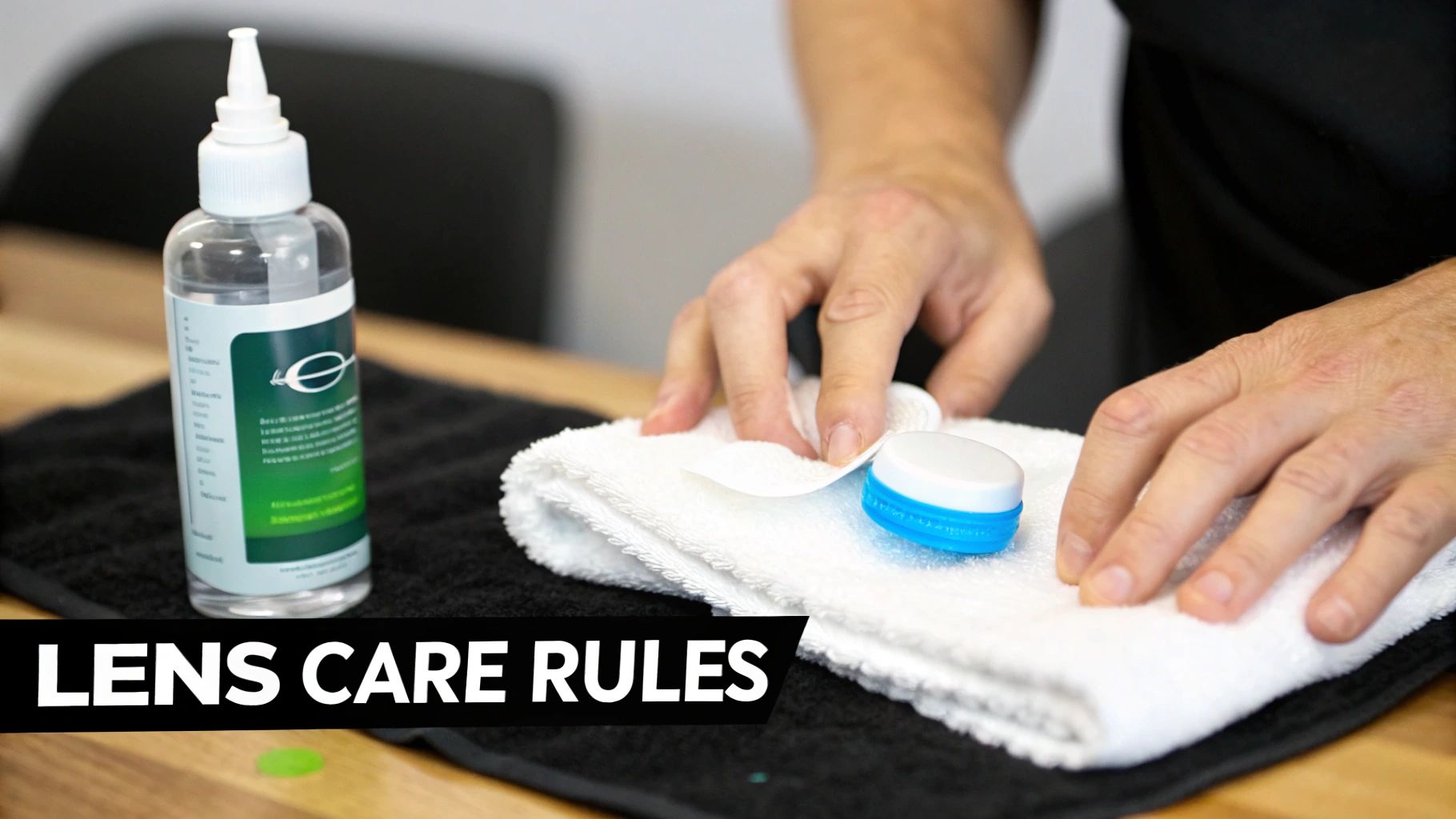
If you're wearing reusable soft contacts, proper care isn't optional—it's the single most important thing you can do to keep your eyes healthy and comfortable. Think of it like this: you wouldn't wear the same pair of socks for a month, right? Your lenses need that same daily attention to stay clean and safe.
A few minutes spent on your cleaning routine each day is a tiny price to pay for preventing nasty bacteria from setting up shop. This isn't just about avoiding minor irritation; it's about protecting your long-term vision.
The Do's Your Eyes Depend On
Getting into a good routine is easy, and it quickly becomes second nature. These are the non-negotiables that every contact lens wearer should live by.
-
Always Wash Your Hands First
Before a lens or even a finger gets near your eye, wash your hands thoroughly. Use a mild soap that doesn't have a lot of oils or fragrances, and dry them completely with a lint-free towel. This is your first line of defense, and it’s a powerful one. -
Use Fresh Solution Every Single Time
Never, ever top off the old solution in your lens case. Always dump out the used liquid, give the case a quick rinse with fresh solution, and fill it back up. Yesterday's solution has already done its job and is now just a stagnant pool where germs can thrive. -
Master the Rub and Rinse Method
I know some solutions are marketed as "no-rub," but take it from experience: a little mechanical cleaning goes a long way. Put the lens in your palm, add a few drops of solution, and gently rub it with your fingertip for about 20 seconds. This physically removes the grime and protein that rinsing alone can miss. -
Keep Your Lens Case Squeaky Clean
Your lens case needs cleaning, too! After you put your lenses in, empty the old solution, rinse the case with fresh solution (never water!), and leave it upside down on a clean tissue to air-dry. It’s also crucial to toss your case and start with a new one every three months, minimum.
The Don'ts You Must Avoid
Knowing what not to do is just as critical. A few common shortcuts can lead to serious problems, from simple irritation to infections that could threaten your sight.
The Centers for Disease Control and Prevention (CDC) estimates that serious eye infections hit about one out of every 500 contact lens wearers each year. The kicker? Nearly all of them are preventable by sidestepping a few high-risk habits.
Never Use Water on Your Lenses
This is the golden rule. Tap water, bottled water, even purified water—none of it should ever touch your contacts. Water harbors a nasty microorganism called Acanthamoeba that can latch onto soft contact lenses and cause a devastating infection that’s incredibly painful and can lead to permanent vision loss.
- No Showering in Lenses: Take them out before you get in the shower.
- No Swimming in Lenses: This goes for pools, hot tubs, lakes, and the ocean.
- No Rinsing with Water: Never use it to clean your lenses or your case. Stick to the solution.
Don't Overwear Your Lenses
Listen to your eye doctor and stick to the replacement schedule they gave you, whether that's every two weeks or once a month. Stretching your lenses past their limit allows deposits to build up, cuts down on oxygen to your cornea, and sends your infection risk skyrocketing. Fresh lenses are happy lenses, and your eyes will thank you.
Your Top Questions About Soft Lenses, Answered
Getting started with soft contacts—or even wearing them for years—always comes with a few questions. Let's tackle some of the most common ones I hear from patients so you can wear your lenses safely and with total confidence.
Can I Go Swimming or Take a Shower with My Lenses In?
This is a hard no, and it's one of the most important rules for keeping your eyes healthy. Think of your soft lens as a tiny sponge. When it comes into contact with water from a pool, shower, hot tub, or lake, it can absorb whatever is in that water.
Unfortunately, this includes nasty microorganisms like Acanthamoeba, a particularly dangerous amoeba that can latch onto the lens. This can lead to a severe, painful infection that’s incredibly tough to treat and can even threaten your vision. Always, always take your lenses out before you get in the water.
What Do I Do If a Lens Suddenly Feels Uncomfortable?
Your first move should always be to take the lens out. Don't try to power through the irritation. Once it's out, place it in the palm of your hand and take a close look. Is there a tiny tear on the edge? Is there a piece of fuzz or an eyelash stuck to it?
Give it a good rinse with fresh contact lens solution (never water!) to wash away any debris. If you put it back in and it feels fine, you're good to go. But if the discomfort, redness, or blurry vision continues, take it out for good and call your eye doctor. It's not worth risking a bigger problem.
A Quick Tip: Sometimes, the lens is just inside out. It won’t hurt you, but it will feel a little strange and might not sit still on your eye. A lens that's ready to wear looks like a perfect little bowl. If the edges flare out, it's inverted.
Are Soft Lenses a Safe Choice for Kids and Teenagers?
Absolutely. In fact, for many kids and teens, soft lenses are a fantastic option. The real question isn't about age; it's about responsibility. Can they handle the routine of cleaning, storing, and caring for their lenses every single day?
With proper training from an eye care professional and good support at home, most young people do incredibly well. The freedom from glasses for sports and everyday activities can be a huge confidence booster.
Ready to explore the best soft contact lenses for your eyes, or do you have more questions for an expert? At Contact Lens HQ, we're dedicated to providing doctor-reviewed guides and clear, up-to-date information. Check out all our resources to help you see the world clearly and comfortably at https://contactlenshq.com.


