
Let's get right to it: the initial cost for rigid gas permeable (RGP) contact lenses is almost always higher than what you'd pay for soft lenses. You're typically looking at a range of $200 to $500 per lens.
That might sound steep at first, but here’s the key difference: their incredible durability means a single pair can last for a year, sometimes even longer. This longevity completely changes the long-term cost equation, often making them a more budget-friendly choice over time.
Understanding the True Cost of RGP Lenses
When you're thinking about the price of RGP lenses, it's crucial to look beyond the number on the box. The total investment covers more than just the physical lenses; it also includes the highly specialized fitting process, which is non-negotiable for ensuring they fit perfectly, see clearly, and keep your eyes healthy.
Think of it this way: buying soft contacts is like buying a shirt off the rack. But getting RGP lenses is like having a suit custom-tailored. It requires precise measurements and expert adjustments from your eye doctor to get that flawless fit.
While that initial investment feels larger, their long-lasting nature flips the script on value. You aren't constantly re-buying them like daily or monthly disposables. With proper care, that one pair can serve you well for a year or more, making them a really smart solution for anyone prioritizing sharp, stable vision.
What to Expect in Your First Year
To give you a clearer picture of what to budget for, let's break down the typical expenses you'll encounter in the first year.
Here’s a quick summary of the typical costs that make up your initial investment in RGP contact lenses.
Estimated Annual Cost Breakdown for RGP Lenses
| Cost Component | Average Price Range (USD) |
|---|---|
| RGP Lenses (per pair) | $400 – $1,000 |
| RGP Fitting & Exam Fee | $150 – $400 |
| Cleaning & Disinfecting Solutions (annual supply) | $100 – $200 |
| Estimated Total First-Year Cost | $650 – $1,600 |
Of course, keep in mind these are just estimates. Your final cost will hinge on a few key things: the complexity of your prescription, the specific lens brand your doctor recommends, and the professional fees at your eye clinic.
The big takeaway? While the upfront cost is higher, the cost-per-wear for RGP lenses often works out to be less than daily disposables when you look at it over their entire lifespan. This makes them a wise financial choice for committed, long-term wearers who want the best in vision clarity and eye health.
Why RGP Lenses Are a Premium Vision Solution
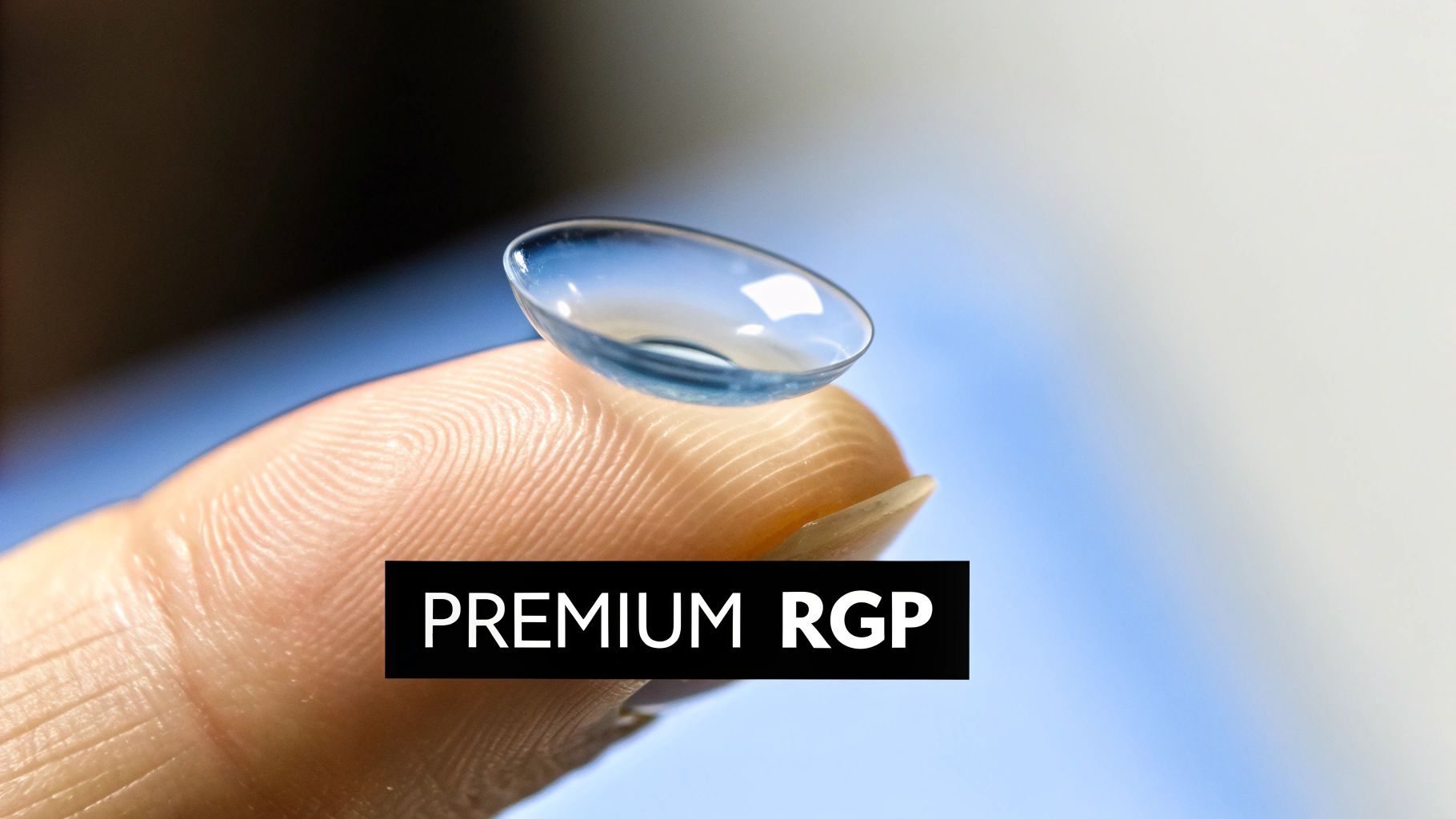
When you look at the rigid gas permeable contact lenses cost, it's easy to wonder why they're priced differently than standard soft contacts. The old term "hard lenses" really doesn't do them justice—it's a bit like calling a high-performance running shoe just a piece of rubber. RGP lenses are more like precision-engineered equipment for your eyes.
Unlike soft lenses, which are designed to drape over your cornea like a piece of cling film, RGPs are made from a firm, durable polymer. This material holds its specific shape on your eye, creating a perfectly smooth, new surface for light to pass through. It's this rigidity that delivers the kind of exceptionally sharp, crisp vision that soft lenses often struggle to match.
Unlocking Unmatched Visual Clarity
The real genius behind RGP lenses is how they're custom-fitted. Because they don't just conform to the existing imperfections on your eye's surface, they essentially create a brand-new, flawless one. This is a game-changer for people with more complex vision challenges.
RGPs are particularly effective for individuals with:
- Astigmatism: The lens provides a stable, uniform surface that completely masks the corneal irregularities responsible for blurry vision.
- Keratoconus: For people with this condition, where the cornea bulges into a cone shape, an RGP lens creates a smooth dome over that irregular surface, which can dramatically restore vision.
- High Prescriptions: The rigid design delivers precise, stable correction that stays consistent with every single blink.
Think of an RGP lens as a custom-ground lens for a high-end camera. It ensures that light enters your eye in the most focused way possible. This level of custom correction is a huge part of their value.
The Science of Healthier Eyes
Beyond pure clarity, the "gas permeable" part of the name is critical for your long-term eye health. The advanced polymer used to make these lenses is riddled with microscopic pores that allow a high volume of oxygen to flow directly through to your cornea. This is measured by something called a Dk value, which is just a technical term for oxygen permeability.
A higher Dk value means your eyes can "breathe" much more freely. This significantly reduces the risk of problems like corneal swelling or hypoxia (oxygen deprivation), which can sometimes be a concern with less breathable lens types. This superior oxygen flow makes RGPs an investment not just in sharper vision, but in the ongoing well-being of your eyes.
This combination of performance and health is why so many people are turning to them. The global RGP contact lens market was valued at USD 907.7 million in 2021 and is expected to grow significantly. This reflects a clear and growing demand for durable, high-performance vision solutions. For a deeper dive, you can explore the full research report on RGP market trends.
What Goes Into the Price of RGP Lenses?
You’ll quickly find that not all RGP lenses carry the same price tag, and for good reason. The rigid gas permeable contact lenses cost is a direct reflection of the technology packed into them. It helps to think of it like buying a camera lens—a standard lens gets the job done, but a high-performance zoom lens with special coatings is a more significant investment. The same logic applies here.
The biggest driver of the final price is how complex your lens needs to be. A simple, single-vision lens is the most affordable starting point. But for many of us, achieving that perfectly sharp vision requires a more specialized, custom-built lens.
Lens Design and Your Prescription
The more unique your vision needs, the more sophisticated the lens design has to be. That extra layer of engineering is what you're paying for.
- Spherical Lenses: This is your straightforward "base model." It has one power throughout the entire lens and is perfect for correcting standard nearsightedness or farsightedness.
- Toric Lenses: If you have astigmatism, you need a toric lens. It’s built with different powers in different areas to compensate for the irregular shape of your eye. That custom design makes them more expensive.
- Multifocal or Bifocal Lenses: These are for people with presbyopia, the common age-related change that makes you reach for reading glasses. These lenses cleverly pack multiple prescription zones into one tiny disc to give you clear vision up close, far away, and everywhere in between. The intricate work required bumps up the cost significantly.
Getting a handle on how these designs influence the price is the first step in budgeting for your eye care. For a bigger picture of how prescriptions affect pricing across all types of contacts, check out our guide on how much prescription contact lenses cost.
A toric or multifocal RGP lens isn't just a lens; it's a piece of custom optical engineering. The higher price covers the advanced manufacturing needed to build multiple corrective powers into a single, tiny, durable device for your eye.
Materials and Special Coatings
Beyond the core design, the actual material used to make the lens matters, too. RGP lenses are made from sophisticated polymers, and some materials are more breathable than others.
This breathability is measured by an oxygen permeability score, or Dk value. A lens with a higher Dk value lets more oxygen flow to your cornea, which is fantastic for your eye health, especially if you wear your lenses for long hours. As you might guess, this premium material comes at a premium price.
On top of that, some lenses come with special surface treatments or coatings. These can make the lens feel smoother, more comfortable, and better at resisting those annoying protein buildups. While these coatings add to the upfront cost, they can make a world of difference in your day-to-day comfort, making them a worthwhile upgrade for many people.
The RGP Lens Fitting Fee Explained
When you first look into the cost of rigid gas permeable contact lenses, one of the biggest surprises is often the separate fitting fee. It’s easy to mistake this for an extra, unnecessary charge, but it’s actually payment for a highly specialized medical service—one that ensures your custom lenses are safe, comfortable, and a perfect match for your eyes.
Think of it like getting a custom-tailored suit. You wouldn't just tell a tailor your height and expect a perfect result. They need to take dozens of precise measurements to get it right. An RGP fitting is the optical equivalent of that detailed, hands-on process.
This is a world away from a standard fitting for soft contacts. A soft lens fitting often just involves trying on a pre-made, one-size-fits-most lens. With RGPs, your eye doctor essentially becomes a corneal architect, designing a unique lens from the ground up to match the specific landscape of your eye.
What Does the Fitting Fee Actually Cover?
The fitting fee directly compensates your optometrist for their advanced expertise and the time-intensive steps needed to make your RGP lens experience a success. It’s a genuine investment in your long-term eye health and vision quality. This isn't just about reading an eye chart; it's about creating a medical device that works in harmony with your body.
Here's what that service typically includes:
- Advanced Corneal Mapping: Your doctor uses a special instrument called a corneal topographer to create a detailed, 3D digital map of your eye's surface. This process reveals the unique hills, valleys, and curves of your cornea that a standard eye exam would completely miss.
- Diagnostic Lens Trials: Using that map as a blueprint, your doctor will select several trial lenses from a fitting set. You’ll wear these right there in the office, allowing the doctor to observe how they move, where they sit, and how your tears flow underneath them.
- Multiple Follow-Up Visits: Nailing the perfect fit often takes more than one appointment. The fee covers these crucial follow-up visits, where your doctor makes tiny adjustments to the lens design to fine-tune your comfort and vision.
The RGP fitting fee reflects the significant time, specialized equipment, and professional judgment required to custom-design a lens. It's the difference between buying something off the rack and commissioning a bespoke piece of medical hardware just for your eyes.
Getting a handle on all the different parts of your lens order is key. For a deeper dive into what all those numbers and abbreviations mean, check out our guide to understanding contact lens prescriptions. In the end, this meticulous fitting process is precisely what makes RGP lenses such an effective and powerful solution for so many people.
How to Make RGP Lenses More Affordable
That initial price tag for rigid gas permeable contact lenses can feel a bit steep, I get it. But with a little planning and some smart financial strategies, that upfront investment becomes a lot easier to handle. The trick is to think about the long-term value and use the tools available to you.
One of the best ways to immediately slash your out-of-pocket costs is by using your vision insurance. Most plans give you a set allowance for contact lenses each year, and you can apply that directly to your RGP lens purchase.
Using Insurance, FSAs, and HSAs to Your Advantage
For some people, RGP lenses aren't just a preference—they're a medical necessity. If you have a condition like keratoconus or a very high degree of astigmatism, your eye doctor might classify your lenses as medically necessary. This is a game-changer. It often unlocks a much higher level of insurance coverage, sometimes covering the full cost of both the lenses and the specialized fitting.
Don't forget about your tax-advantaged health accounts. You can use funds from a Flexible Spending Account (FSA) or Health Savings Account (HSA) to pay for your lenses and fitting fees. Since this money is pre-tax, you're essentially getting a discount on the final price that's equal to your income tax rate.
This chart gives you a peek behind the curtain at what your RGP fitting fee actually pays for—it's much more than just the lenses themselves.
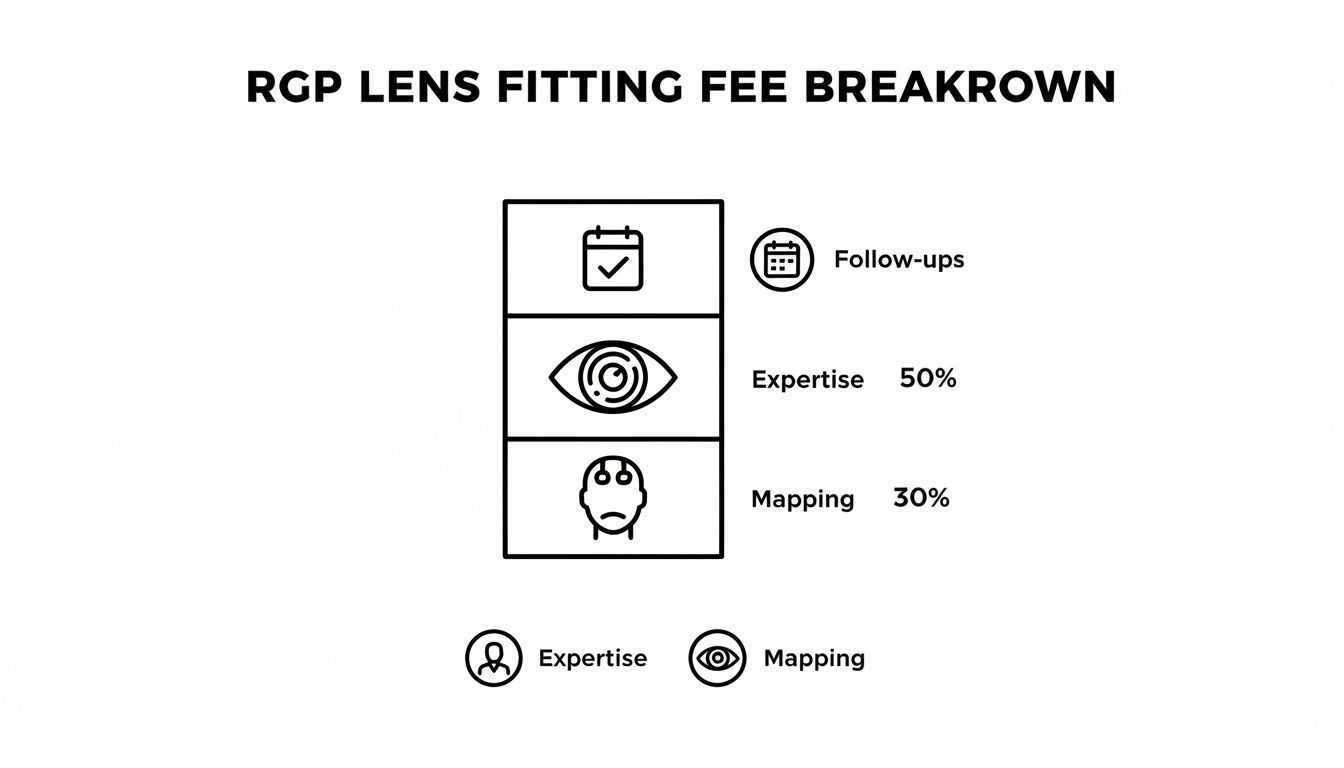
As you can see, a huge chunk of that fee is for the doctor's time and expertise, which includes mapping the unique curve of your cornea and conducting several follow-up appointments to ensure a perfect fit.
The Long-Term Savings of RGP Lenses
The real financial magic of RGP lenses happens over time. Take good care of a single pair, and they can easily last you a year, sometimes even longer. This is a world away from the constant re-ordering cycle you get with disposable soft lenses.
The key is to shift your perspective. Think of RGP lenses less as a one-time purchase and more as a long-term investment in your vision. When you do the math and spread that initial cost over their entire lifespan, they often come out cheaper than disposables.
Let's look at a real-world cost comparison over two years. The upfront cost for RGP lenses and cleaning solutions might seem higher at first, but a daily disposable lens wearer will go through about 730 lenses in that same period. The total bill for those disposables quickly adds up.
Cost Comparison Over Two Years: RGP vs Daily Disposables
This table illustrates how the costs stack up over a two-year period, showing the long-term economic benefit of choosing durable RGP lenses.
| Expense | RGP Lenses (One Pair) | Daily Disposable Lenses |
|---|---|---|
| Fitting Fee (Year 1) | $200 – $500 | $100 – $250 |
| Lenses (2-Year Supply) | $200 – $600 (one pair) | $1,200 – $1,800 |
| Care Solutions (2-Year Supply) | $150 – $200 | $0 |
| Total 2-Year Cost | $550 – $1,300 | $1,300 – $2,050 |
As the numbers show, the cumulative cost of daily disposables can easily surpass the one-time investment in RGPs, making them a surprisingly budget-friendly option in the long run.
Once you have your final, settled prescription, you might also find better prices by shopping around. For some tips on this, check out our guide on how to buy contact lenses online to find reputable and affordable retailers. This long-view approach reveals RGPs as not just a great vision solution, but a financially sound one, too.
Common Questions About RGP Lens Costs
When you start looking into RGP lenses, the practical, money-related questions usually pop up first. Getting a handle on insurance, how long the lenses last, and those fitting fees is key to planning for this investment in your vision.
Will My Insurance Help Pay for RGP Lenses?
It's one of the first things people ask, and the short answer is: probably. Most vision insurance plans have an allowance for contact lenses, and you can absolutely apply that toward the rigid gas permeable contact lenses cost.
The real game-changer, though, is when your lenses are considered medically necessary. If you have a condition like keratoconus or a very high degree of astigmatism that soft lenses just can't correct, insurance often steps up in a big way. In these cases, they might cover a much larger chunk of the cost, sometimes even the entire fitting fee.
How Long Do These Lenses Actually Last?
This is where RGPs really shine. With good care, a single pair of RGP lenses can last for one to three years—sometimes even longer. Think about that for a second. Their incredible durability is what makes them so much more affordable in the long run compared to the endless cycle of buying disposable soft lenses.
Why Is the RGP Fitting Fee So High?
It’s easy to get sticker shock from the fitting fee, but it's important to understand what you're actually paying for.
The RGP fitting process isn't just about buying a product; it's a highly specialized medical service. Your eye doctor is essentially designing and crafting a custom-fit medical device for the unique shape of your eye, which takes significant expertise, advanced corneal mapping, and several trial fittings.
An RGP fitting is a completely different beast than a standard soft lens fitting. Your doctor has to create a detailed 3D map of your cornea and will likely need you to come back for a few follow-up visits to get the fit just right. This fee covers the doctor's time, skill, and the sophisticated technology required to make sure your lenses are safe, comfortable, and give you crystal-clear vision for years.
Ready to explore your options and find the perfect contact lenses for your needs? Contact Lens HQ offers expert guides and unbiased reviews to help you make confident decisions about your eye health. Learn more at https://contactlenshq.com.


