
If you've ever wondered, do photochromic lenses work in the car?, the short answer is that most standard versions don't. It's a common and understandable frustration, but the problem isn't your glasses—it's your car's windshield.
Why Your Windshield Acts Like a Blocker
Have you noticed your high-tech adaptive lenses stay stubbornly clear behind the wheel? You're not alone. The science behind it is pretty straightforward.
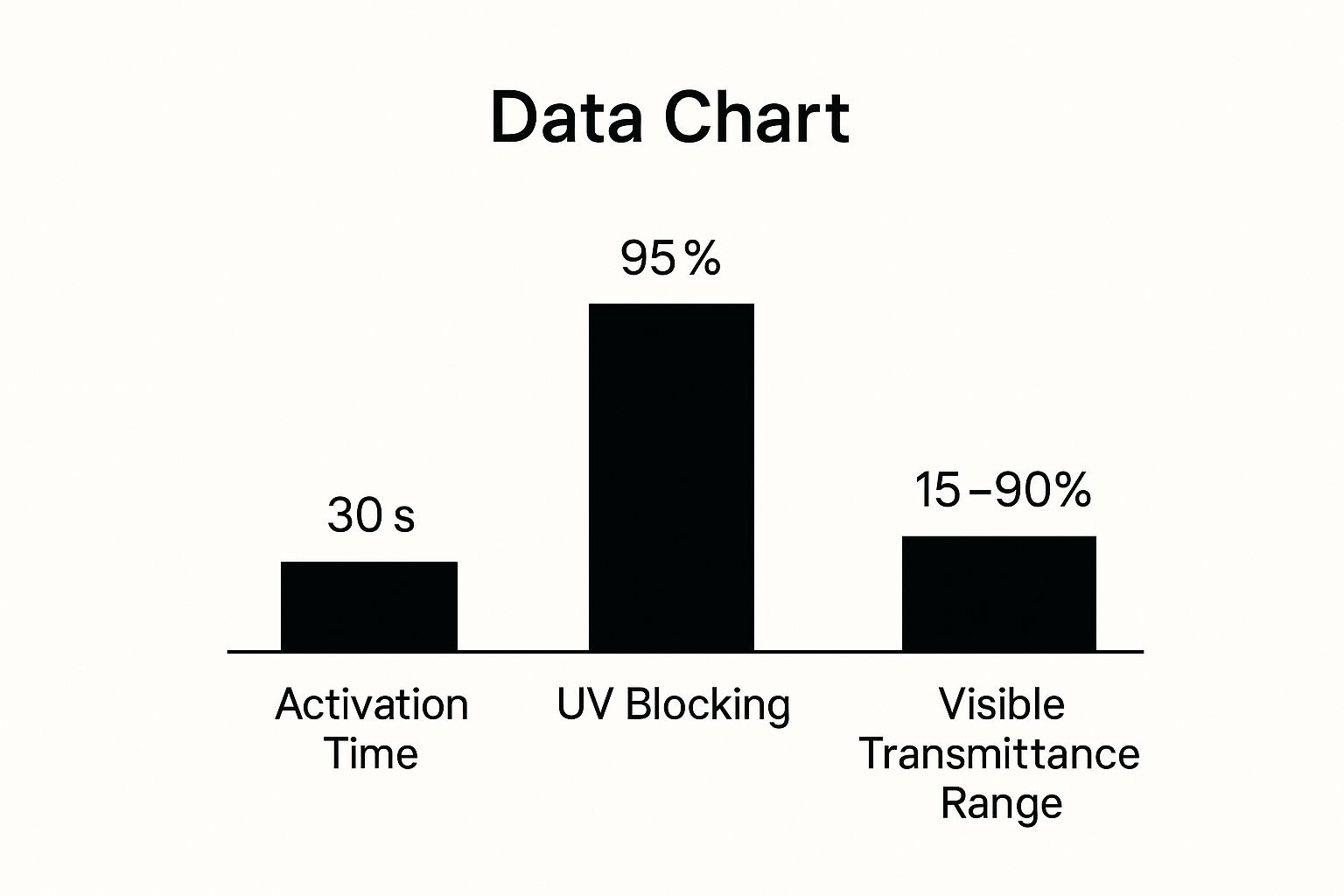
Think of standard photochromic lenses as tiny machines that need a specific fuel source to run: ultraviolet (UV) light. When those UV rays hit the lenses, a chemical reaction causes them to darken. The problem is, your car's windshield is designed to be a powerful UV filter, blocking nearly 100% of UV rays to protect you and your car's interior.
This built-in protection creates a barrier, stopping the very energy your lenses are waiting for. So, while the sun might be bright, the essential trigger never reaches your glasses.
While standard lenses perform beautifully outdoors, that performance becomes a moot point once you're inside the car. Thankfully, lens technology has come a long way, and newer options are specifically designed to solve this exact problem.
How Different Photochromic Lenses Perform While Driving
To really get why some lenses work for driving and others don't, it helps to see a direct comparison. The magic is in what triggers the tinting process. Is it just UV light, or can the lens react to other light sources too?
This table breaks down the key differences.
| Lens Type | Activation Trigger | Performance Outside | Performance Inside Car |
|---|---|---|---|
| Standard Photochromic | UV Light Only | Excellent – darkens fully | Poor – remains clear |
| Specialized Driving Lenses | UV & Visible Light | Excellent – darkens fully | Good – activates moderately |
As you can see, the game-changer is the ability to react to visible light. Lenses like Transitions® XTRActive® are engineered to respond to the bright, ambient light inside a car's cabin, not just the UV rays that the windshield blocks. This finally gives drivers a real, working solution for glare-free vision on the road.
The Science Behind Your Self-Tinting Lenses
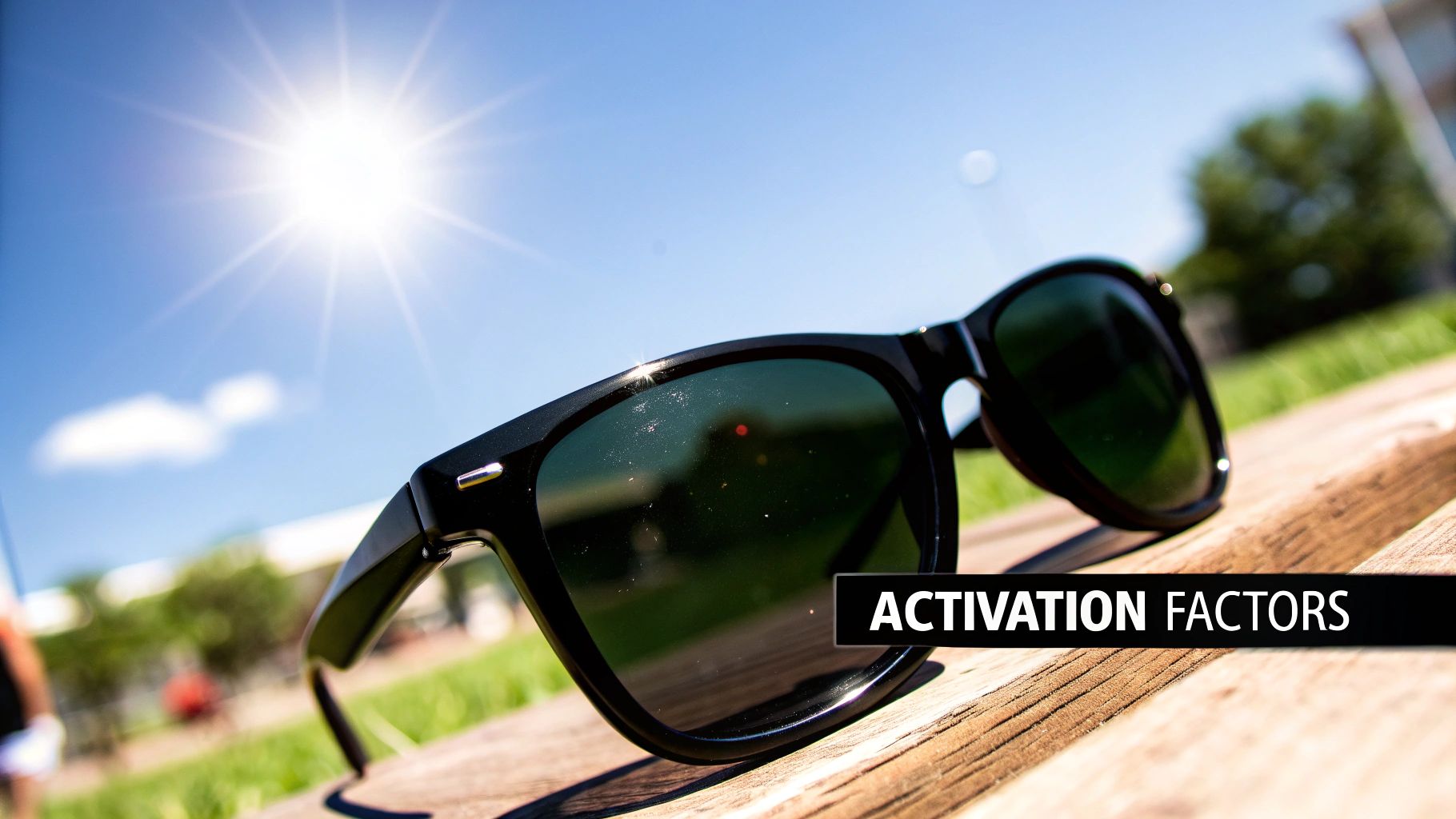
To really get why your glasses behave differently inside a car, we have to look at the clever chemistry embedded right into the lenses. It feels like magic, but it's all down to some brilliant molecular science.
Think of your lenses as being coated with trillions of microscopic molecules. When you're inside, away from the sun, these molecules are in their "resting" state. They're basically folded up and transparent, letting light pass right through. That's why your glasses are crystal clear.
What Makes Them Change?
The secret ingredient is ultraviolet (UV) radiation. The moment you step outside and sunlight hits your glasses, these tiny molecules spring into action.
When exposed to UV rays, they undergo a rapid chemical reaction that changes their structure. A good analogy is to imagine each molecule as a tiny, tightly-closed bud. When sunlight (UV) hits it, the bud instantly blossoms, changing its shape. This new, "open" shape is what absorbs visible light, causing the lens to darken before your eyes.
This transformation is surprisingly quick, with most of the tinting happening within the first 30 to 60 seconds of sun exposure. The brighter the sun and the more intense the UV, the more molecules "blossom," and the darker your glasses get.
The most important thing to remember is this: UV radiation is the on-switch for the tinting in almost all standard photochromic lenses. This single fact explains everything about the driving problem.
When you go back inside, the process reverses. Without UV light to keep them open, the molecules slowly fold back into their original, transparent shape. This fading process is always a bit slower, usually taking a few minutes.
This complete reliance on UV light is both their greatest feature and their biggest drawback. It's a fantastic system for walking around outside, but as we'll see, the inside of a car presents a unique challenge. Before we get into that, it helps to weigh the general photochromic lenses pros and cons to understand the full picture.
Why Your Windshield Is an Invisible UV Forcefield
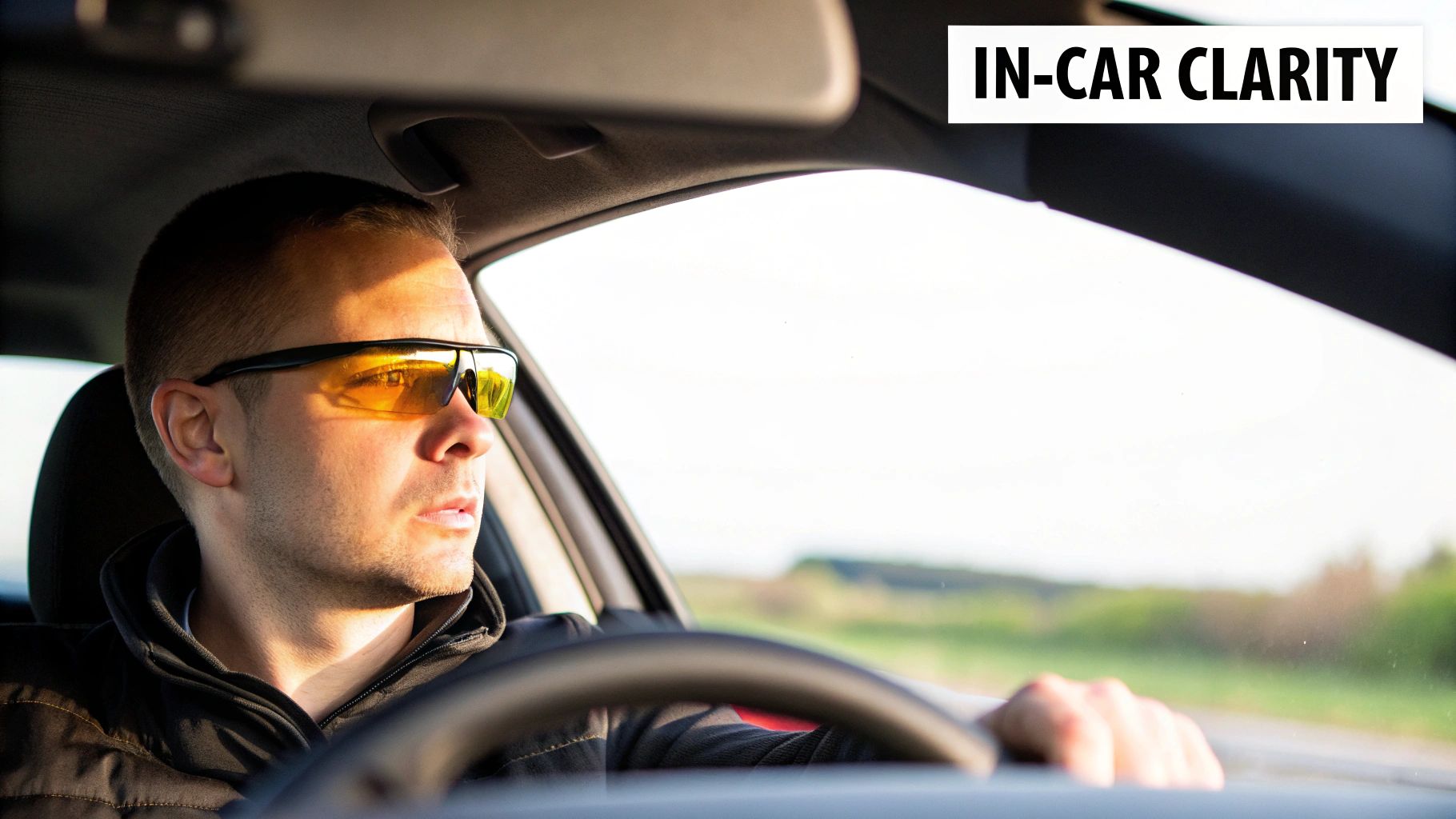
So, let's get to the heart of the matter: why do your fancy light-adjusting lenses seem to take a break the second you get behind the wheel? The culprit isn't a flaw in your glasses. It's actually a sophisticated safety feature built right into your car’s windshield.
Think of your windshield as more than just a piece of glass. It’s a highly engineered component made of laminated safety glass. This means it's a sandwich—two layers of glass with a thin slice of tough plastic, called polyvinyl butyral (PVB), pressed between them.
That middle PVB layer is the secret ingredient. It’s loaded with powerful UV-blocking agents that do their job exceptionally well, creating an invisible shield that stops nearly all ultraviolet radiation from getting into your car.
The Unintended Consequence for Your Lenses
This UV protection is a great thing for your skin and for keeping your car's interior from fading and cracking. But for standard photochromic lenses, it’s a showstopper.
Because those lenses are designed to react almost entirely to UV light, your windshield essentially cuts off their power supply. It’s like trying to run a solar-powered toy in a dark closet; the toy works fine, but it has no energy source to draw from.
This is why so many of us have had that frustrating experience. Your lenses darken perfectly the moment you step outside, but they stay completely clear inside the car. In fact, most modern car windshields block a staggering 98 to 99 percent of UV rays—more than enough to keep the photochromic magic from happening. You can find more detailed insights about why transition lenses don't work well in the car if you want to dive deeper.
The very same technology that protects you from the sun's harmful rays is also what prevents your standard photochromic lenses from providing the tint you need while driving.
This fundamental problem is exactly what drove the innovation of specialized driving lenses. Eyewear companies needed to find a whole new trigger to make lenses adapt to the unique, UV-filtered world inside a vehicle.
Meet the New Lenses Engineered for the Road
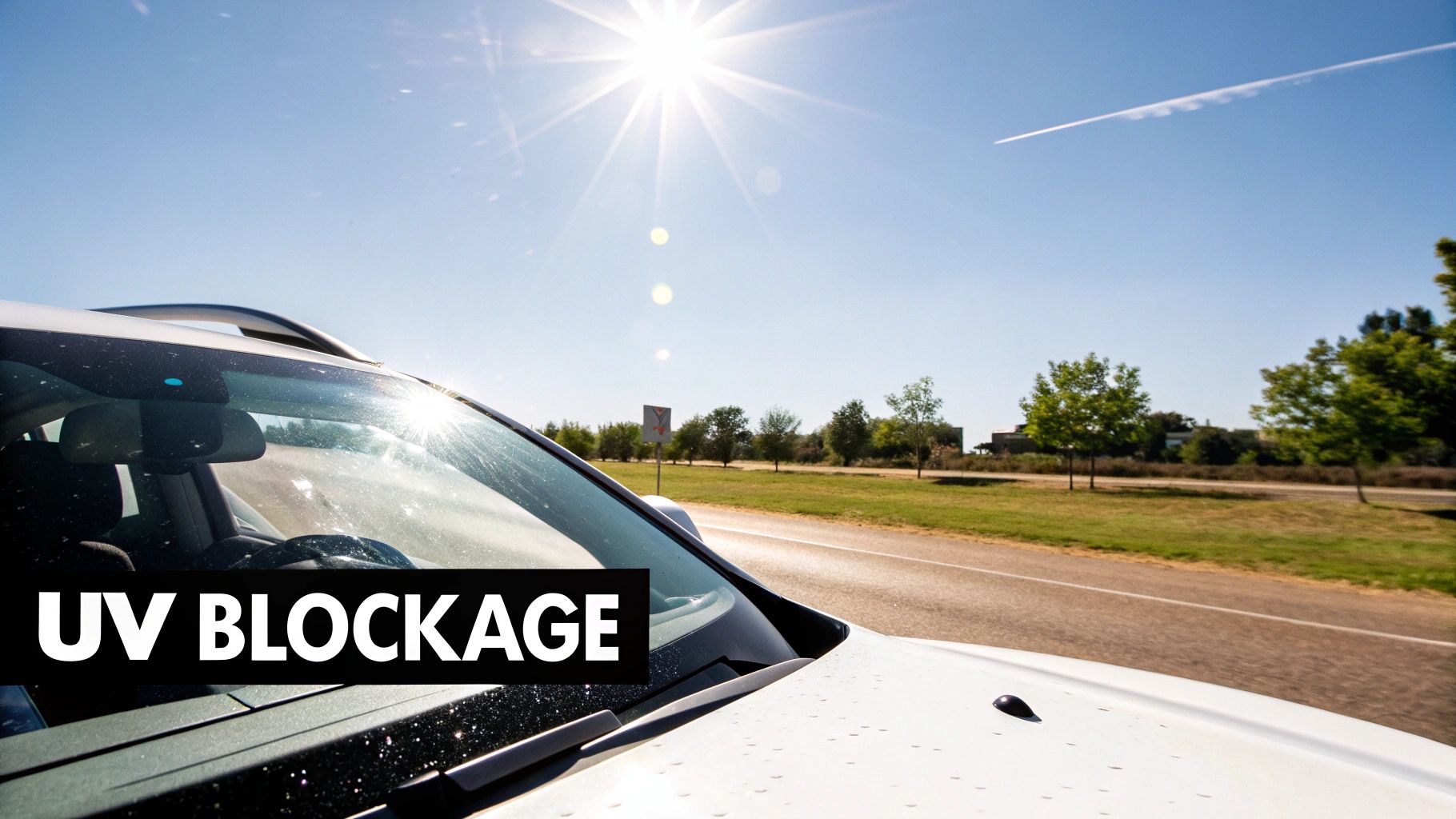
Since windshields block the UV light that powers standard photochromic lenses, the industry needed to find a different trigger. It was a classic "back to the drawing board" moment, and eyewear innovators came up with a brilliant solution: smart lenses built specifically for the driver's seat.
Enter groundbreaking technologies like Transitions XTRActive and DriveWear. These aren't your average light-adaptive lenses. They’re engineered with a specialized formula of photochromic molecules sensitive to a much broader spectrum of light, including the lower end of the visible light spectrum.
This unique sensitivity is the secret sauce that makes them work behind the wheel. It's the key difference between a lens that works everywhere except the car and one that works perfectly in the car.
How They Activate Inside the Car
Think about driving on a bright, sunny day. Even though your windshield is blocking UV rays, your car's interior is still flooded with intense, visible light. That very brightness is what triggers the molecules in these advanced lenses, causing them to darken.
They won't get quite as dark as they would if you were standing in direct, unfiltered sunlight, but they tint enough to cut down on harsh glare and reduce eye strain significantly. This means you get a safer, more comfortable drive without fumbling for a separate pair of prescription sunglasses.
The crucial difference is the activation source. By responding to both UV and visible light, these advanced lenses successfully answer the question, "do photochromic lenses work in the car?" with a resounding yes.
The proof is in the performance. Consumer feedback consistently highlights how effective these lenses are for driving. For example, one survey found that 72% of users were satisfied with the darkness level of their Transitions XTRActive lenses while driving in very sunny conditions. You can discover more about these user insights on Eyesentials.com. This kind of real-world experience shows just how much of a difference a lens designed for the road can make.
Here’s a rewritten version that sounds more human and natural, following all the provided guidelines.
What About Driving With Them at Night?
This is a question I get all the time, and it's an important one: If these lenses get dark in the car during the day, will they be too dark to drive with once the sun goes down?
Thankfully, the answer is a clear no. They are perfectly safe for night driving.
The chemists who design these lenses are pretty smart. They've built in a kind of failsafe. The special molecules in driving-specific photochromic lenses are engineered to react only to the intensity of bright visible light. At night, that trigger just isn't there, so the lenses simply stay in their default, completely clear state.
This means you get the sharpest, clearest vision possible right when you need it most.
Backed by Real-World Testing
This isn't just theory; it's been proven in practical studies. Researchers have put these adaptive lenses through their paces in all sorts of driving conditions, paying close attention to nighttime performance.
The key takeaway from clinical trials was that photochromic lenses were "noninferior" to regular clear lenses. In plain English, that means they performed just as well and posed no extra risk to a driver's vision or overall performance.
When it came to night driving, the studies found that any difference between the adaptive lenses and standard clear ones was negligible. The research consistently backs up their safety and effectiveness after dark.
So, you can enjoy the comfort of a lens that adapts to daylight glare without worrying about it compromising your safety on the road at night. If you'd like to dive into the data yourself, you can read the full clinical trial on photochromic lens performance.
Finding the Right Glasses for Your Drive
So, with all this information under your belt, you're in a great position to choose your next pair of glasses wisely. Finding the perfect fit is all about matching the lens technology to your real-world habits, especially when it comes to driving.
Take a moment to think about your typical day. How much of it is spent behind the wheel compared to being outside on foot? Is the idea of a single pair of glasses for everything a huge plus for you? Figuring this out will make the conversation with your optometrist much more productive.
What to Ask Your Eye Doctor
When you go for your eye exam, having a few specific questions ready can make all the difference. This helps ensure the glasses you walk out with actually live up to your expectations.
Here’s what to bring up:
- In-Car Performance: Be sure to ask about lenses specifically made to react to visible light, not just UV rays. Get the details on exactly how dark they’ll get inside your car.
- The Power of Polarization: If you’re tired of blinding glare from wet roads or other cars, ask about adding polarization. It’s a game-changer for cutting down on those harsh reflections.
- Crystal Clear Indoors: Confirm that the lenses will become 100% clear when you're inside. The last thing you want is to have to take them off every time you walk into a building.
And if your active lifestyle extends beyond driving, you might find our guide to the best contact lenses for sports helpful for keeping your vision sharp during any activity.
Frequently Asked Questions About Photochromic Lenses and Driving
Even after getting the science down, you probably have some real-world questions about how these lenses actually perform when you’re behind the wheel. Let's tackle some of the most common ones.
Will My Lenses Darken if I Open the Window?
Good question. And the answer is yes, they often will—at least a little bit.
Your front windshield is built to be a UV-blocking fortress, but your side windows are a different story. They usually offer far less protection. Cracking a window open lets unfiltered UV rays hit your lenses directly, which is all it takes to kickstart the darkening process. Just how dark they get will depend on the angle of the sun and how much light is actually hitting them.
Are Polarized Lenses Better for Driving?
This is an "apples and oranges" situation. They do different, but very complementary, jobs. Polarized lenses have a permanent tint that’s specifically engineered to slice through the blinding horizontal glare that bounces off wet roads or the hood of the car in front of you. That’s a huge plus for safety.
Photochromic lenses adapt to the overall brightness, while polarized lenses are masters of cutting a specific, dangerous type of glare. The ultimate driving lenses, like DriveWear, actually combine both technologies. You get the best of both worlds.
Do All Modern Cars Block UV Rays?
Pretty much, yes. For decades, the industry standard for front windshields has been laminated safety glass that has UV-blocking agents baked right in. This is great for protecting you and your car's interior from sun damage.
It's a safe assumption that your car's windshield is stopping the very UV rays your standard photochromic lenses need to activate. This is the main reason specialized lenses that react to visible light were developed for drivers. If you're weighing your options for vision correction, exploring the pros and cons of switching from glasses to contacts can also add some useful perspective.
At Contact Lens HQ, we're dedicated to providing clear, doctor-reviewed information to help you see the world better. Explore more expert guides and reviews at https://contactlenshq.com.


