
Yes, you can absolutely get contact lenses toric color to correct your astigmatism and change up your eye color at the same time. These are specially designed lenses that pull double duty, combining the vision-correcting features of a toric lens with the fun of cosmetic color. It's a single, clever solution for both clear sight and personal style.
Vision Correction Meets Style
For a long time, people with astigmatism were stuck. The choice was pretty frustrating: wear glasses, use clear toric contacts, or put up with blurry vision by wearing standard colored lenses. Regular colored contacts just aren't built for the more football-like shape of an astigmatic eye, so they couldn't deliver sharp focus. It was always a trade-off between seeing clearly and getting the look you wanted.
Thankfully, that compromise is a thing of the past. The development of contact lenses toric color options finally brings together advanced optical technology and cosmetic design, solving two problems in one great product.
The Best of Both Worlds
You can think of these lenses as a custom-tailored suit for your eyes—one that also happens to come in a fantastic color. They are engineered with incredible precision to give you stable, crisp vision while also offering a natural-looking and vibrant color change. This dual purpose has made them a go-to for anyone who doesn't want to settle.
Here's what makes them so great:
- Precise Astigmatism Correction: They provide the specific power and axis needed to keep your vision consistently sharp.
- Cosmetic Enhancement: You can subtly play up your natural eye color or go for a bold, completely different look.
- Total Convenience: No more layering prescription glasses over non-prescription colored contacts.
- A Real Confidence Boost: It's empowering to see the world perfectly while also showing off your personal style.
This marriage of function and fashion is a big deal in the eye care world. In 2023, the global contact lens market hit a value of USD 18.6 billion. The toric lens segment, in particular, is expected to grow by over 11.4% each year through 2030. A huge driver for this is just how common astigmatism is—it affects about one in every three people. If you're interested, you can read the full research about these market trends and what they mean for vision care.
A toric color contact lens is more than just a medical device; it's a statement. It says that clear vision and self-expression don't have to be mutually exclusive.
Ultimately, these lenses are a major step forward. They offer a practical way to manage a common vision issue without giving up the desire to customize your look. By understanding how they work, you can get the sharp vision you need and the aesthetic you want, all in one comfortable lens.
How Toric Lenses Tame Astigmatism
Before we get into the cool colors, we first need to understand what makes a toric lens special. It all starts with the eye condition they're designed to fix: astigmatism.
Imagine a perfectly normal eye is shaped like a basketball—symmetrical all the way around. When light enters an eye with this shape, it focuses neatly on a single point on the retina, giving you sharp, clear vision.
Now, picture an eye with astigmatism. It’s shaped less like a basketball and more like a football or the back of a spoon. Because of this irregular curve, light entering the eye can't focus on one single spot. Instead, it scatters to multiple points, which is why your vision ends up looking blurry or distorted, whether you're looking at something up close or far away.
A standard, spherical contact lens just won't cut it here. Trying to correct a football-shaped eye with a basketball-shaped lens is a bit like putting a round peg in a square hole—it simply doesn't address the core problem.
The Clever Design Behind Toric Lenses
This is where the smart engineering of a toric lens comes into play. A regular contact lens has the same power all the way across its surface. A toric lens, on the other hand, is built with two different powers, each with a different strength located on different meridians of the lens. It's custom-built to match and correct the unique irregularity of your cornea.
Think of it like trying to level a wobbly table. You wouldn't just slap a flat piece of wood on top. You’d place shims of different thicknesses under the legs that need it. A toric lens does something similar for your eye, using its different corrective powers to "level out" the light, so it focuses on one sharp point on your retina.
This image shows you exactly what that looks like—the two different curves that create the two distinct powers.
As you can see, one curve is flatter and the other is steeper. This design is what directly compensates for the football-like shape of an eye with astigmatism, leading to incredibly precise vision.
This dual-power system is also why your prescription for toric lenses has a couple of extra numbers on it:
- Cylinder (CYL): This tells you how much extra power is needed to correct the astigmatism.
- Axis: This is a number between 1 and 180 degrees that shows exactly where on the lens that extra power needs to sit to line up perfectly with your eye.
Getting that axis right is critical. If the lens twists out of place even a little bit, your vision will go right back to being blurry. And that brings us to the most important feature of any toric lens.
The Secret to Keeping Your Vision Stable
The biggest challenge with a lens that has different powers in different spots is preventing it from spinning around on your eye. If it rotates, the corrective zones no longer align with your cornea, and poof—your astigmatism is back.
To solve this, toric lenses are made with built-in stabilization features. Think of it like a roly-poly toy that always pops back upright. No matter how you push it, its weighted bottom ensures it returns to the correct position.
Manufacturers use a few clever design tricks to make sure the lens stays put, using a combination of gravity and the gentle pressure from your eyelids every time you blink.
Common Stabilization Methods:
- Prism Ballasting: The bottom of the lens is made just a tiny bit thicker and heavier, so gravity naturally pulls it into the correct orientation.
- Thin Zones (or Dynamic Stabilization): This popular design thins out the top and bottom edges of the lens, allowing your eyelids to squeeze it into place with each blink.
- Truncation: The very bottom of the lens is trimmed off, creating a flat edge that rests on your lower eyelid, preventing it from rotating.
For anyone wanting toric colored contact lenses, this stability is everything. Without it, the lens would spin, not only making your vision blurry but also causing the colored part of the lens to drift awkwardly over the white of your eye. These stabilization features ensure you get consistently crisp vision and a natural, beautiful look that lasts all day.
Finding Your Perfect Color and Style
Once your eye doctor has nailed down the technical side of things—the fit, the astigmatism correction—you get to the fun part: picking a color that defines your look. This is where you can really express yourself, whether you're aiming for a subtle tweak or a total transformation. The trick is to understand the different types of tints and how they’ll play with your natural eye color.
Not all colored lenses are made the same. They generally fall into one of two camps, each designed for a completely different effect. What works best for you will come down to your natural eye color and just how much of a change you’re after.
The flowchart below gives you a great visual of how a toric lens gets the job done. It's built to counteract the cornea's irregular shape, bending light in just the right way to give you that sharp, clear vision you've been missing.
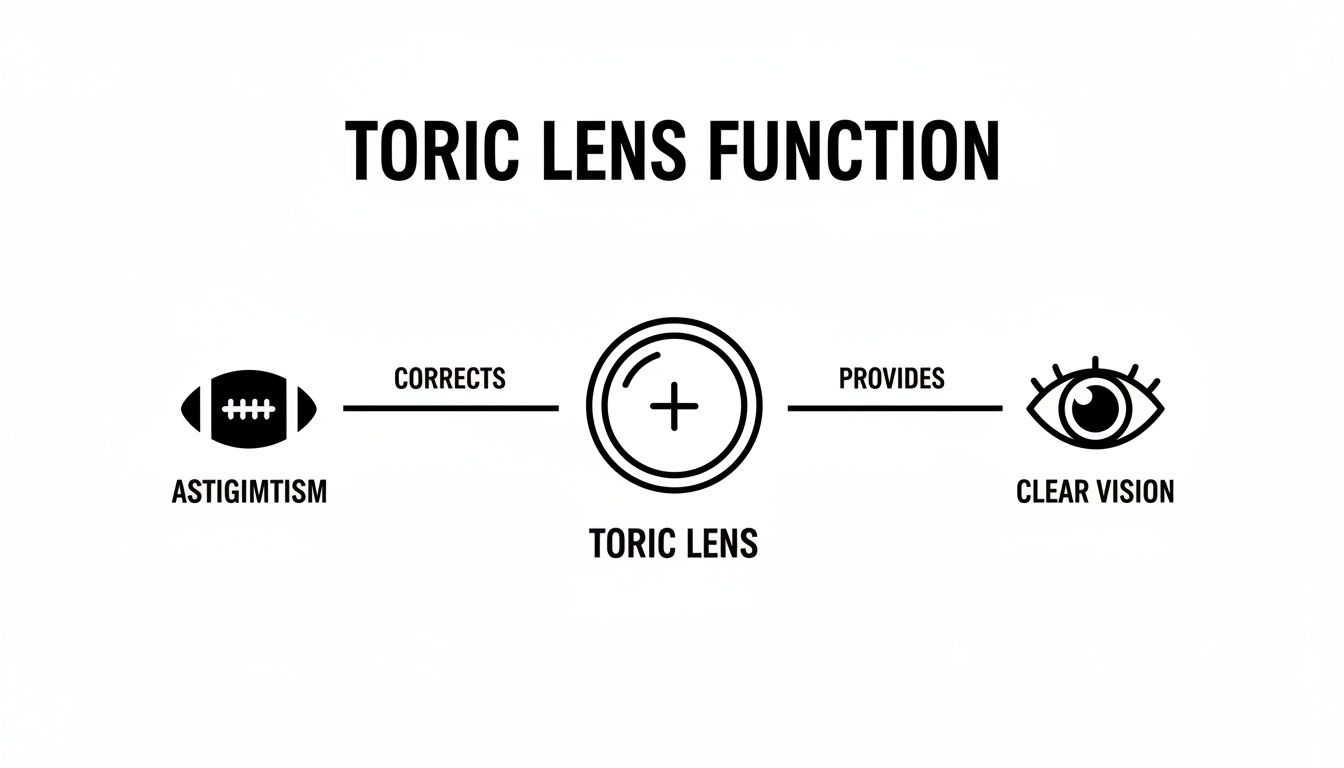
It’s a simple but brilliant concept: the lens's unique shape essentially cancels out the eye's irregularity, letting light focus perfectly on the retina.
Enhancement Tints For a Natural Boost
Think of enhancement tints as a translucent filter for your eyes. They aren't meant to completely cover your natural color but to work with it, adding a bit more depth, sparkle, or a slightly different hue.
These are absolutely perfect if you already have lighter eyes—say, blue, green, or light hazel—and just want to turn up the volume. Someone with blue eyes, for instance, might use a sapphire enhancement tint to make their natural color look richer and more striking without appearing fake.
Opaque Tints For a Dramatic Change
If you're dreaming of a complete color switch-up, opaque tints are your answer. These lenses feature a solid, non-transparent color pattern that entirely masks your natural eye color. It's how someone with deep brown eyes can suddenly have a pair of piercing, realistic-looking light blue or vibrant green eyes.
Opaque lenses offer the most dramatic effects, making them the go-to choice for anyone wanting to experiment with a bold, new style.
The goal is to find a color that harmonizes with your unique combination of skin, hair, and natural eye color. A shade that looks amazing on one person might clash with another's features.
A Guide to Choosing Your Shade
Picking the right color is a personal journey, but a few guidelines can help you find a truly flattering match. The two biggest factors to consider are your skin tone and hair color.
- For Warm Skin Tones: If your skin has golden, peachy, or yellow undertones, colors like honey, hazel, light brown, or even a warm green will likely look fantastic.
- For Cool Skin Tones: If you have pink or blue undertones, you can really pull off vibrant shades. Think icy blue, amethyst, violet, or a cool-toned gray for a stunning contrast.
This isn't just a niche market, either. The demand for colored contacts is exploding, with the global market expected to hit USD 5 billion in 2025 and projected to soar to USD 12.18 billion by 2034. The overwhelming trend is a natural look, with features like limbal rings contributing to 80% of wearers reporting higher satisfaction with their lenses.
Picking the Perfect Tint
To make the choice a bit easier, here’s a quick breakdown of the different tint types and what they’re best for.
Comparing Color Contact Lens Tints
| Tint Type | Best For | Color Change Effect | Example Use Case |
|---|---|---|---|
| Enhancement | Light-colored eyes (blue, green, hazel) | Deepens or intensifies natural eye color | A person with light blue eyes wants a more vibrant, sapphire-like shade. |
| Opaque | Any eye color, especially dark eyes | Completely masks the natural eye color | A person with dark brown eyes wants to try a striking light green or gray. |
Ultimately, the right tint depends on the look you're trying to achieve—a subtle boost or a complete reinvention.
One last detail to look for is a limbal ring. This is that dark circle on the outer edge of the iris. Lenses that mimic this natural feature tend to make the eyes look bigger, more defined, and more youthful. It’s a small touch that has a huge impact on creating a believable, attractive look.
For even more ideas, you can explore our guide on choosing from a wide variety of colored contact lenses colors.
Why a Professional Fitting Is Non-Negotiable
It’s easy to get caught up in the fun of picking a brand-new eye color. But before you get too far, we need to talk about a critical truth: contact lenses toric color are medical devices first and cosmetic accessories second. Their main job is correcting a pretty complex vision issue, and that’s definitely not a do-it-yourself project. An improper fit can do more than just feel annoying—it can lead to blurry vision and even serious eye health complications.
Trying to skip a professional fitting is a bit like buying a bespoke suit off the rack and hoping for the best. The odds of it fitting you perfectly are next to nothing. Every person's eyes have a unique size, shape, and curvature, and only an eye care professional has the right tools and know-how to match a lens to your specific needs. This is the only way to guarantee the lens will sit comfortably and actually do its job of correcting your vision.
The bottom line is simple: Your long-term eye health is far more important than saving a few minutes or dollars. A professional fitting is the only way to ensure your lenses are safe, comfortable, and effective.
This process is absolutely crucial for toric lenses because of how they correct astigmatism. A good fit involves much more than just the basic power of your prescription.
The Precision of a Toric Lens Fitting
When your eye doctor fits you for contact lenses toric color, they're looking at several very specific factors that aren't a concern with standard contacts. Think of them as a master locksmith crafting a key for a tricky lock—every single groove has to be perfect, or it just won't work.
Your prescription for astigmatism has two extra numbers that are vital for clear vision: the cylinder (CYL) and the axis. The cylinder value measures the severity of your astigmatism, but the axis is the real game-changer. It's a number between 1 and 180 that tells the lens its exact orientation on your eye. If that lens rotates even a tiny bit, that precise alignment is lost, and your vision goes right back to being blurry.
During the fitting, your optometrist will carefully check:
- Lens Rotation: They’ll observe how the lens behaves as you blink and look around to make sure it stays put.
- Movement: A healthy lens needs to move just the right amount with each blink—not too much, and not too little.
- Corneal Coverage: The lens has to be the right diameter to cover your cornea completely and comfortably.
These detailed checks ensure the lens's stabilization features are working correctly, giving you consistently crisp vision throughout the day. If you want to dive deeper into all the numbers on your prescription, our complete guide to understanding contact lens prescriptions breaks it all down.
The Dangers of Unprescribed Lenses
Buying lenses from an unauthorized online vendor without a valid prescription might seem like a convenient shortcut, but it puts your eyes at serious risk. These products are often unregulated and may be made from materials that aren't safe or breathable.
The potential consequences are no joke and can include:
- Corneal Scratches (Abrasions): A poorly fitting lens can easily scrape the delicate surface of your eye, causing a lot of pain and opening the door for infection.
- Oxygen Deprivation: If the lens material is cheap and non-breathable, it can starve your cornea of oxygen. This can lead to swelling, blurry vision, and even cause new blood vessels to grow into your cornea, a serious condition.
- Serious Infections: Lenses from sketchy sources can be contaminated with nasty bacteria. This can lead to corneal ulcers, which are painful open sores on your eye that can cause permanent scarring and even vision loss.
Ultimately, a professional fitting is your best defense against these dangers. It's a non-negotiable step that protects your vision and ensures you can enjoy the fun side of your new lenses safely and comfortably.
How to Choose the Right Lenses for You
Alright, you've got your prescription and a color in mind—now for the fun part. It’s time to work with your eye doctor to pick the perfect pair of toric colored contact lenses. This is about more than just seeing clearly and looking great; it’s about finding a lens that truly fits your life.
We'll need to look at a few key things, like what the lens is made of and how often you'll replace it. These details make a massive difference in how comfortable the lenses feel and how healthy your eyes stay in the long run. Let's walk through the options so you can have a really productive conversation with your optometrist.
Understanding Lens Materials
The material a contact lens is made of is probably the single most important factor for all-day comfort. Modern soft toric colored contacts are made from some pretty amazing plastics that are designed to let your eyes breathe.
Think of it like choosing a shirt. You could wear a basic cotton tee, or you could opt for a high-tech, moisture-wicking athletic fabric. Both get the job done, but that athletic fabric keeps you way more comfortable when you're active. In the same way, advanced lens materials let plenty of oxygen pass through to your cornea, keeping your eyes happy.
The whole goal of modern lens technology is to maximize oxygen. An eye that gets enough oxygen is healthier, feels more comfortable, and is less likely to get irritated, especially if you wear your lenses from morning to night.
The top contender in materials right now is silicone hydrogel. This stuff is a huge leap forward from the older hydrogel plastics, letting up to five times more oxygen reach the eye. This extra breathability is what helps fight off that dreaded end-of-day dryness and redness.
Daily Disposables vs. Monthly Lenses
Next up is the replacement schedule. This simply means how long you wear one pair of lenses before swapping them for a fresh set. Your lifestyle, budget, and even things like allergies will all point you toward the best fit.
- Daily Disposables: These are the gold standard for convenience and hygiene. You pop in a brand-new pair every morning and just toss them out at night. No cleaning, no cases, no hassle.
- Monthly Lenses: You wear these lenses every day for up to 30 days. The catch is that you have to take them out, clean them, and store them in a disinfecting solution every single night. They're often more budget-friendly, but they do require a bit of discipline.
Let's break down the real-world differences.
| Feature | Daily Disposable Lenses | Monthly Reusable Lenses |
|---|---|---|
| Convenience | The easiest option—no cleaning ever. | Requires a daily cleaning routine. |
| Hygiene | Top-notch. A fresh, sterile lens every day. | Good, but only if you clean them perfectly. |
| Cost | Higher upfront cost for a supply. | Lower upfront cost, plus solution expenses. |
| Best For | Allergy sufferers, part-time wearers. | Full-time wearers on a tighter budget. |
Honestly, this often comes down to what you prefer. If your eyes are sensitive or you struggle with seasonal allergies, dailies are a lifesaver because you're not reintroducing irritants each day. But if you're great about your cleaning routine and wear lenses all the time, monthlies are a solid, cost-effective choice.
Matching Lenses to Your Lifestyle
Finally, let's talk about you. What does your average day look like? Are you staring at a computer screen for hours? Are you an athlete who needs their vision to stay put during a workout? The answers will help your eye doctor narrow down the specific brand of contact lenses toric color that will work best.
For instance, we know that spending a lot of time on digital devices can cause serious eye strain and dryness. The lens market has taken notice. In fact, specialty lenses like torics and multifocals (including color versions) are expected to make up over 30% of global demand by 2025. Here in the United States, the contact lens market is projected to hit USD 97.60 billion in 2025 and grow to a staggering USD 178.33 billion by 2034. A huge driver of this growth is technology designed to help the estimated 60% of users who experience digital eye strain. You can learn more about these contact lens market findings and what's pushing the industry forward.
By talking through the material, replacement schedule, and your daily routine, you and your eye doctor can pinpoint the exact toric colored lens that gives you everything you want: sharp vision, a fantastic look, and comfort that lasts all day long.
Proper Care for Healthy Eyes and Lenses
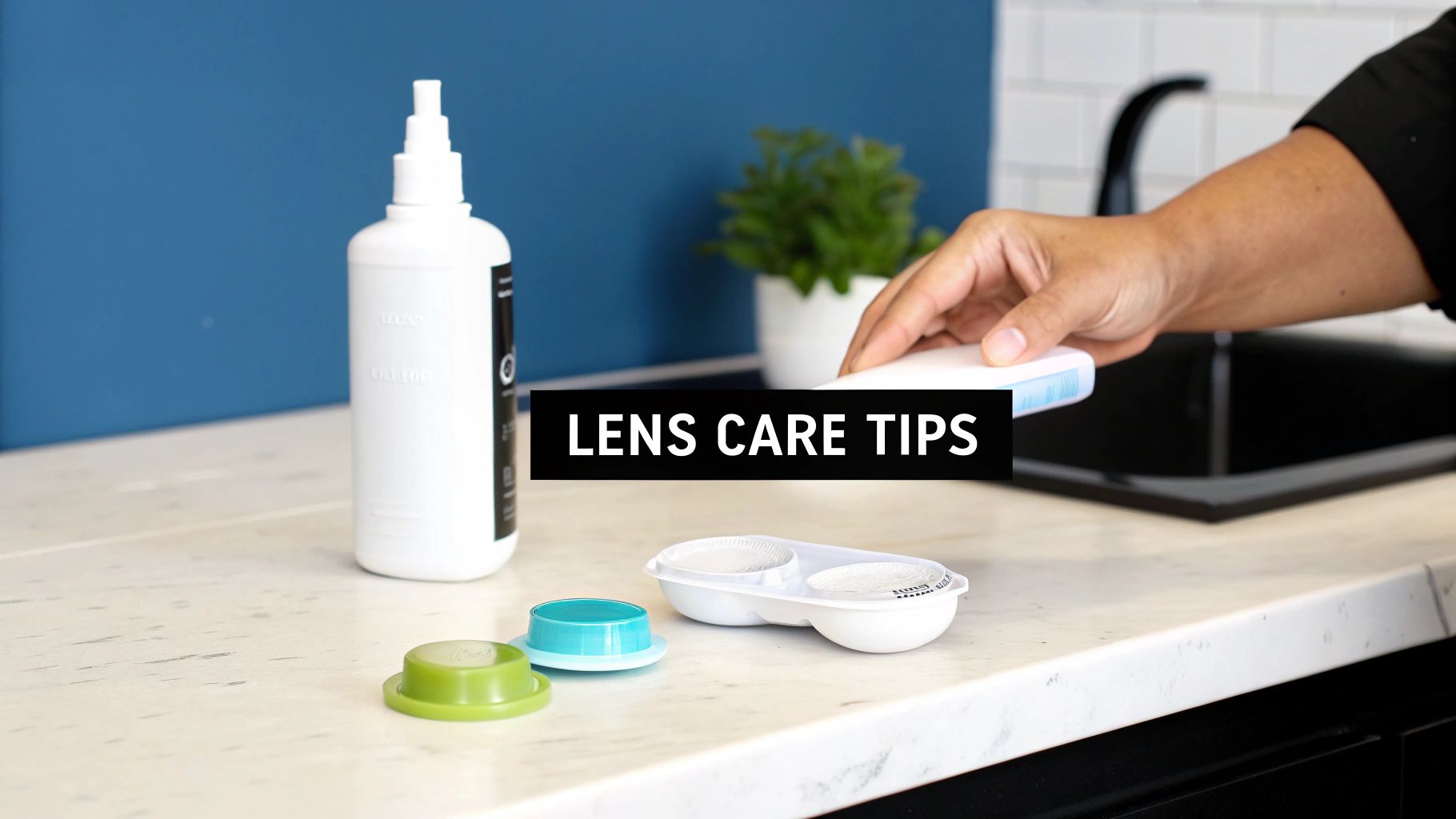
You’ve got your new contact lenses toric color—a fantastic blend of crisp vision and a fresh look. But to keep them comfortable and your eyes healthy, a solid care routine is non-negotiable. Good hygiene isn't just a friendly tip; it's the most critical part of preventing irritation and serious eye infections.
Think of it like daily maintenance for a precision instrument. Skipping steps might seem harmless, but it can cause real problems down the line. The good news is that once you get the hang of it, the process is quick and easy.
The Golden Rules of Contact Lens Hygiene
It all starts with clean hands. Every single time you touch your lenses—whether you're putting them in or taking them out—wash your hands with a mild, non-oily soap and dry them completely with a lint-free towel. This simple habit keeps germs and grime off your lenses and out of your eyes.
Don't forget about your storage case. It needs to be cleaned every day with fresh solution, then left open to air-dry. You should also replace it entirely at least every three months, because an old case can easily become a breeding ground for bacteria.
Never underestimate the power of your cleaning solution. It's specifically designed to disinfect and clean your lenses. Using anything else, especially tap water, is a major gamble that can introduce dangerous microorganisms to your eyes.
If you wear reusable lenses, the "rub and rinse" method is your best friend. After taking a lens out, put it in the palm of your hand with a few drops of solution and gently rub it with your fingertip. This physical cleaning step removes up to 90% of bacteria and protein deposits, which is way more effective than a simple rinse.
Common Mistakes to Avoid at All Costs
Even seasoned contact lens wearers can slip into bad habits. To protect your vision, you absolutely must avoid these common (and risky) shortcuts.
Lens Care "Don'ts":
- Don't Use Tap Water: Tap water is home to an amoeba called Acanthamoeba. It can cause a rare but incredibly painful eye infection that could lead to vision loss.
- Don't "Top Off" Solution: Never just add a little fresh solution to the old stuff in your case. Always dump the used liquid and start over with a fresh fill to guarantee proper disinfection.
- Don't Use Saliva: Your mouth is teeming with bacteria. Using saliva to wet a lens is practically asking for an infection.
- Don't Wear Lenses Longer Than Prescribed: Pushing your lenses past their replacement schedule starves your corneas of oxygen. This can lead to swelling, discomfort, and even long-term damage. Stick to the schedule your eye doctor gave you.
Daily vs Monthly Lens Care
The exact routine you'll follow depends on whether you have daily disposables or monthly lenses. Dailies are the peak of convenience and hygiene—you wear a brand-new pair each morning and just toss them at night. No cleaning needed.
Monthlies, however, require a nightly cleaning ritual. This means doing the "rub and rinse" and then storing them in a clean case filled with fresh disinfecting solution. It's a bit more hands-on, but it's perfectly safe as long as you're diligent.
For a more detailed breakdown, our guide shows you how to clean contact lenses properly. Follow these steps, and you can enjoy everything your toric colored contacts have to offer while keeping your eyes happy and healthy.
Got Questions About Toric Color Lenses? We've Got Answers
So, you're thinking about trying toric color contact lenses. It's totally normal to have a few last-minute questions. After all, these lenses are pretty sophisticated, combining vision correction for astigmatism with a fun cosmetic twist. Let's tackle some of the most common things people ask.
Are Toric Color Lenses More Expensive?
The short answer is yes, you can expect to pay a bit more for toric color contact lenses compared to standard clear toric lenses. It really comes down to the manufacturing process. Engineering a lens to correct astigmatism is complex enough, but then adding a stable, natural-looking color layer takes it to another level.
Think of it as getting two benefits in one—crystal-clear vision and a new eye color. For many, that dual function is well worth the investment. Of course, the final price tag will vary depending on the brand, the material (like a newer silicone hydrogel), and whether you opt for daily disposables or monthlies.
Can I Feel the Color on the Lens?
Not at all. With any quality, well-made lens, the color pigment should be completely unnoticeable. Top-tier brands embed the color inside the lens material, not on the surface. This creates a perfectly smooth finish that feels just as comfortable on your eye as a regular clear contact.
A word of caution: if you ever put in a lens and it feels gritty or scratchy, take it out right away. This could mean there’s a rare defect, the fit isn’t right, or something else is going on with your eye. Always best to check in with your eye doctor.
Will My Vision Look Tinted?
This is a great question, and one we hear all the time. The good news is, no, your vision won't look tinted. Colored contacts are designed with a clear zone right in the middle that aligns with your pupil. This lets light pass through naturally, so the world looks exactly as it should.
The only tiny exception? In very dark environments, your pupils can get bigger and may expand past that clear central area. If that happens, you might notice a faint hint of color or a soft halo at the very edge of your vision. It's usually subtle and doesn't happen in normal lighting conditions.
How Do I Know if My Lens Is Inside Out?
Most toric lenses today have some handy tricks to help you out. The easiest one is the "taco test."
- Pop the lens on the tip of your dry finger.
- Take a look at it from the side.
- If it forms a perfect bowl with the edges pointing straight up (like a taco!), it’s the right way.
- If the edges flare out, looking more like a saucer with a rim, it's inside out.
Some brands even etch tiny laser markings, like numbers or letters, on the edge of the lens to show you the correct orientation. Your optometrist will show you exactly what to look for during your fitting, so you'll feel confident putting your toric color contact lenses in correctly every single time.
At Contact Lens HQ, our goal is to provide the expert-backed information you need to make confident decisions about your eye health. Explore our comprehensive guides and reviews to learn more. https://contactlenshq.com


