
Straight to the point: Can you swim with contacts? If you ask any eye doctor, you'll get a swift and firm no. This isn't just overly cautious advice; it's a critical rule for keeping your eyes healthy and your vision safe.
Why Swimming With Contacts Is a Major Risk
Think of your soft contact lens as a tiny, absorbent sponge sitting directly on your eye. Its design is hydrophilic, meaning it loves water—that’s what keeps it comfortable and moist all day. But that very quality becomes a huge problem the second you jump into a pool, lake, or ocean.
Your lens doesn't just get wet. It actively soaks up the water and traps everything in it, holding it firmly against your cornea. This turns your helpful little vision corrector into a petri dish for nasty microorganisms.
Even the cleanest-looking water is swimming with invisible threats:
- Bacteria and Viruses: The usual suspects that can cause painful infections like conjunctivitis (pink eye).
- Fungi: Yep, fungi. Water-borne fungi can lead to fungal keratitis, a severe infection that’s notoriously tough to treat.
- Acanthamoeba: This is the big one. It's a dangerous amoeba found in pretty much all water—tap water, pools, oceans, you name it. It can cause Acanthamoeba keratitis, a devastating infection that can lead to corneal ulcers and even permanent vision loss.
A Visual Breakdown of the Dangers
The relationship between your contact lens, the water, and these microscopic dangers is pretty direct. Your lens essentially acts as a bridge, giving microbes a VIP pass to the surface of your eye.
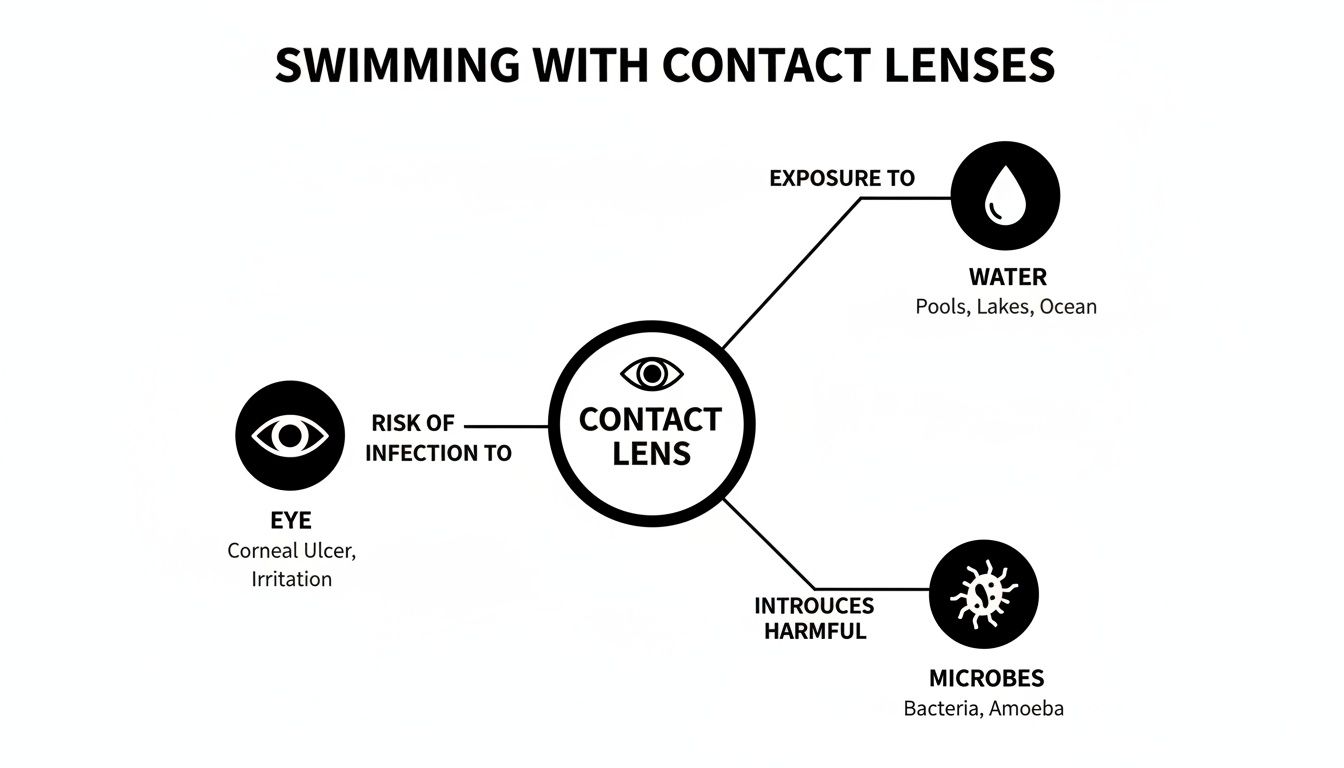
The image above perfectly illustrates how the lens traps these threats, creating the ideal conditions for an infection to take hold.
On top of the biological threats, water also messes with the physical fit of your lenses. Freshwater, like in a lake or pool, can make soft lenses swell up and tighten their grip on your eye. This chokes off the oxygen supply and can even lead to tiny scratches on your cornea. Saltwater and chlorinated water? They just lead to intense irritation and dryness.
The core takeaway is simple: Water and contacts just don't mix. The combination creates a perfect storm for infection and irritation, turning a refreshing swim into a serious gamble for your eyesight.
At-a-Glance Risks of Swimming With Contacts
Different water sources harbor their own unique blend of microscopic troublemakers. Here’s a quick summary of what you're up against.
| Water Source | Primary Microbe Threats | Potential Eye Condition |
|---|---|---|
| Swimming Pools | Acanthamoeba, Pseudomonas aeruginosa (bacteria), chlorine irritation | Acanthamoeba keratitis, bacterial keratitis, chemical conjunctivitis |
| Oceans/Seas | Acanthamoeba, Vibrio (bacteria), various fungi | Acanthamoeba keratitis, fungal keratitis, severe irritation |
| Lakes & Rivers | Acanthamoeba, various bacteria, fungi, parasites | Acanthamoeba keratitis, microbial keratitis, parasitic infections |
| Hot Tubs | Acanthamoeba, Pseudomonas aeruginosa (bacteria) | Acanthamoeba keratitis (high risk due to warm water) |
| Showers/Tap Water | Acanthamoeba | Acanthamoeba keratitis |
As you can see, the dangerous amoeba Acanthamoeba is a common threat across all water types, making it a primary concern for any contact lens wearer.
Ultimately, choosing to swim with your contacts in means you’re accepting a huge and totally avoidable risk. The potential consequences—from a minor irritation to a sight-threatening infection—are just not worth the brief convenience.
Understanding the Invisible Threats in Water
It’s tempting to look at a sparkling blue swimming pool or the clear ocean and think it's perfectly clean. But that water is actually a bustling microscopic world, teeming with invisible life. Most of these organisms are harmless, just floating by. The problem starts when a contact lens traps them directly against your eye.
Think of your contact lens like a tiny petri dish. In the water, it collects and holds onto all sorts of microorganisms that would normally just wash away. This creates a situation where your cornea has prolonged, direct exposure to a concentrated batch of germs.
The Main Culprits Lurking in Water
This microscopic zoo is full of potential troublemakers. While they each pose a different kind of threat, swimming with contacts makes all of them more dangerous.
- Bacteria: Nasty bugs like Pseudomonas aeruginosa can survive and even thrive in water, including properly chlorinated pools. If one gets trapped under your lens, it can lead to a painful infection called bacterial keratitis.
- Viruses and Fungi: While not as common, these pathogens can also hang out in the water, causing infections that are notoriously stubborn and difficult to clear up.
Shockingly, this is a risk many people take without a second thought. A study from the National Institutes of Health (NIH) revealed that a staggering 61.0% of contact lens wearers in the U.S. have gone swimming with their lenses in. This common habit is a big reason for infection outbreaks. In fact, the American Optometric Association (AOA) points out that most outbreaks happen at hotels and public pools, often from parasites like Cryptosporidium. You can dig into the details in the full study on water exposure risks for contact lens wearers.
This gap in awareness is a serious problem. But of all the invisible threats in the water, one organism stands out as the absolute worst-case scenario.
The Dangers of Acanthamoeba Keratitis
By far, the most terrifying risk of swimming with contacts is an infection from a microscopic amoeba called Acanthamoeba. This tiny organism is incredibly tough and can be found almost everywhere there’s water:
- Tap water
- Pools and hot tubs
- Lakes and rivers
- Oceans
- Even in your shower head
For the average person, Acanthamoeba poses no threat. But when it gets trapped behind a contact lens, it finds the perfect breeding ground. The lens acts as a shield, protecting the amoeba from your eye's natural defenses while giving it a surface to cling to. This is how Acanthamoeba keratitis begins—a rare but devastatingly serious infection of the cornea.
Acanthamoeba keratitis is a nightmare to diagnose and treat. It causes excruciating pain and extreme light sensitivity and can lead to corneal ulcers and permanent scarring. In the most severe cases, the damage is so bad that it causes permanent vision loss or even requires a corneal transplant.
The infection literally turns your contact lens from a tool for clear vision into a delivery system for a sight-stealing parasite. The very device meant to help you see becomes the reason your vision is put at risk, which is why the answer to "can you swim with contacts?" is always a firm, resounding no.
How Water Physically Changes Your Contact Lenses
It's not just about the invisible germs. The way water physically interacts with your contact lenses is a huge part of why swimming with them is such a bad idea. Soft contact lenses are made to be hydrophilic, a fancy way of saying they are “water-loving.” This quality is fantastic for keeping them moist and comfortable with your tears.
Think of your soft lens like a high-tech sponge. It’s engineered to hold a very specific amount of moisture, perfectly balanced with the saltiness of your natural tears. This balance is what allows it to keep its shape and let oxygen pass through to your eye. When you jump into a pool or the ocean, you're introducing a totally different kind of water, and that delicate balance gets thrown completely out of whack.
The Problem With Soft Lenses Swelling
When you submerge a soft contact lens in freshwater—like in a swimming pool or a lake—a basic science principle called osmosis kicks in. The lens immediately starts soaking up the water around it, causing it to swell up and lose its precise shape. This physical change leads to a few immediate and dangerous problems:
- Tightening on the Eye: As the lens swells, it effectively shrink-wraps itself onto your cornea. This can feel incredibly tight and uncomfortable, and worse, it cuts off the vital flow of oxygen your eye's surface needs to stay healthy.
- Corneal Abrasions: A lens that's suctioned tightly to your eye can easily cause tiny scratches on your cornea. These micro-scratches are like an open door, inviting bacteria and other nasty pathogens to start a serious infection.
- Blurred Vision: When a lens warps out of its intended shape, it can no longer bend light correctly. The result is sudden, blurry vision right when you're in the water.
This is a far more widespread issue than you might think. A 2017 study revealed that a staggering 62% of soft contact lens wearers admitted to swimming with their lenses in. Both the American Optometric Association (AOA) and the FDA strongly advise against this, pointing out that lenses don't just absorb water—they act like magnets for microbes. You can see the full details in the study on soft contact lens wearers and water exposure.
The very materials used to make the lenses are central to this problem. If you’re curious about the science, we have a guide that explains what contact lenses are made out of. This swelling can also make your lenses feel "stuck" to your eye, which can turn a simple removal into a painful ordeal that might further damage your cornea.
Simply put, exposing your soft lenses to water forces them to change their physical structure, making them tight, uncomfortable, and unsafe. This turns a device meant to improve your vision into one that actively harms your eye.
The Risk for Hard Contact Lenses
If you wear rigid gas permeable (RGP) lenses, often just called "hard contacts," the problem is different, but no less serious. These lenses aren't porous like soft ones, so they don’t absorb water and swell.
Instead, they're much more likely to just pop right out of your eye. A sudden splash or a quick turn of your head underwater is all it takes to dislodge one and send it floating away. Suddenly, you're left with poor vision in the water, which is a safety risk in itself. So no matter what type of lens you wear, swimming with them is just not worth it.
Recognizing the Warning Signs of an Eye Infection
If you’ve taken the plunge and swam with your contacts in, you need to know how to spot trouble before it gets serious. Eye infections rarely show up with a sudden, dramatic flair. They usually creep in quietly, making early detection your absolute best defense against lasting damage.
Think of these initial symptoms as your body’s early warning system. Ignoring them is like hitting the snooze button on a smoke alarm—a risk you really don't want to take. The second you notice anything off after being in the water, it’s time to take it seriously.
Key Symptoms to Watch For
The first signs of an eye infection can feel a lot like minor irritation, but they are anything but. Never just brush off unusual feelings in your eye, especially right after a swim. Keep a close watch for these red flags:
- Persistent Redness: I’m not talking about a little pinkness that disappears quickly. This is a stubborn, angry red that just won’t go away.
- Unusual Eye Pain: This could be anything from a dull, constant ache to a sharp, stabbing feeling. If it’s not your normal, pay attention.
- A Gritty Sensation: That awful feeling like there's a grain of sand stuck in your eye that you can't blink out.
- Excessive Watering or Discharge: If your eyes are tearing up for no reason or you see any yellowish or greenish gunk, that's a clear sign something is wrong.
- Sudden Light Sensitivity: Finding yourself squinting in regular indoor light? That’s called photophobia, and it’s a major warning.
- Unexplained Blurry Vision: Any sudden haziness or drop in clarity that doesn't clear up when you blink is a huge cause for concern.
These symptoms are your eye’s way of screaming for help, telling you that harmful microbes have invaded.
Why You Must Act Immediately
When it comes to eye infections from water, time is not on your side. Aggressive infections like Acanthamoeba keratitis can move incredibly fast and cause permanent damage before you know it.
The single most important factor in preventing severe, long-term vision damage is getting a diagnosis and starting treatment with an eye doctor as early as possible. "Waiting it out" is a dangerous gamble that gives the infection a head start.
If you notice any of these symptoms after swimming with your contacts, the next steps are straightforward but critical: take your lenses out immediately and call your optometrist. Don't try to guess what's wrong or use leftover eye drops. Getting professional care is the only safe way to protect your sight.
Smarter and Safer Ways to See in the Water
So, you get it—swimming with contacts is a bad idea. But what are you supposed to do if you can't see the other end of the pool? Don't worry, you've got some great options that will keep your vision sharp and your eyes safe. The name of the game is creating a solid barrier between the water and your eyes.
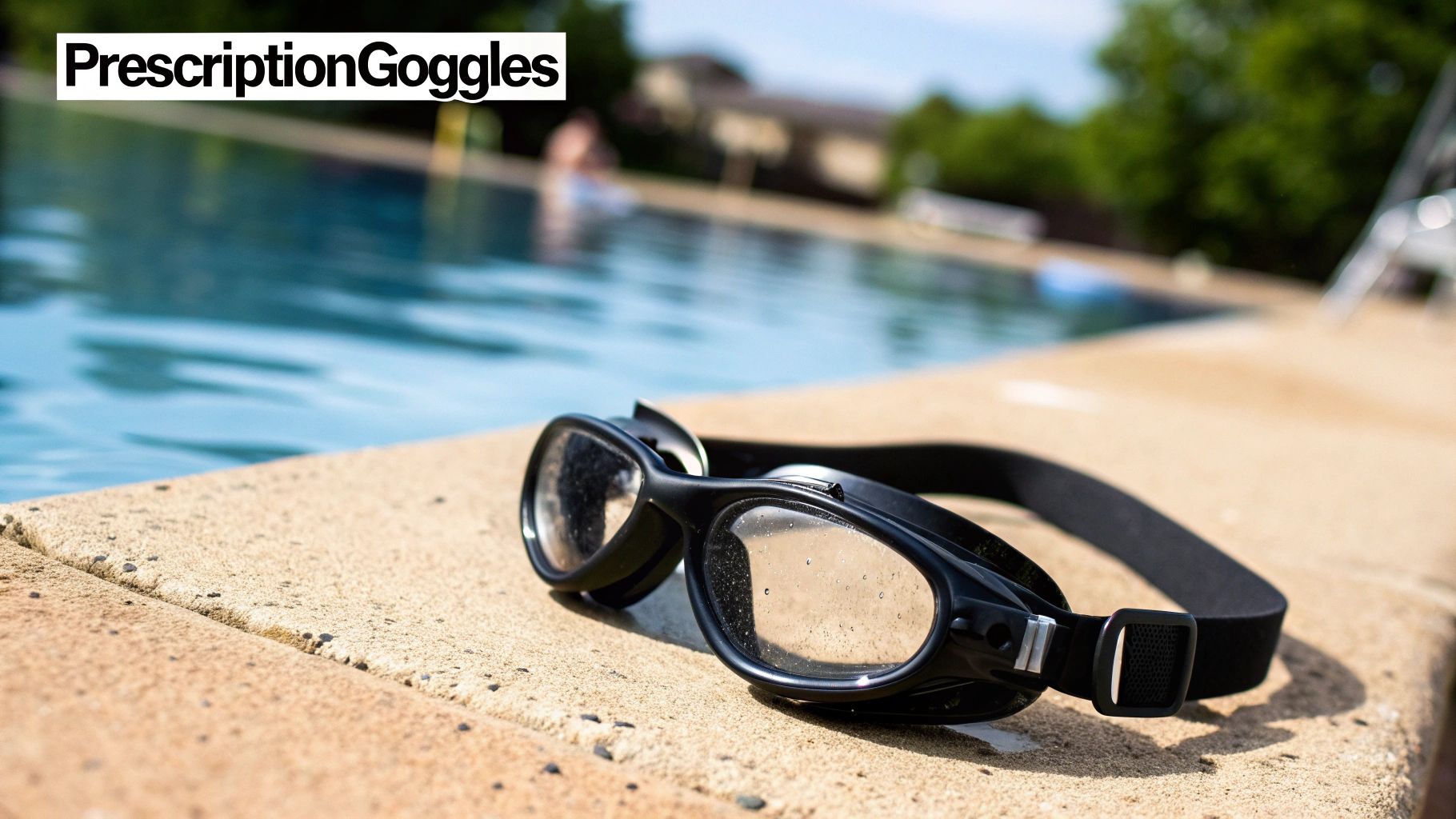
The single best recommendation from nearly every eye doctor out there is a pair of prescription swimming goggles. It's a simple, elegant solution. They're basically your regular glasses and a pair of high-quality goggles rolled into one, giving you the best of both worlds.
Prescription Goggles: The Gold Standard
Think about it: prescription goggles are designed from the ground up for this exact problem. They form a watertight seal that keeps everything you don't want in your eyes—chlorine, salt, and nasty microbes—out. This completely sidesteps the risk of a contact lens soaking up bacteria or shrinking onto your eye.
Here’s why they’re the top pick:
- Total Protection: A good seal means zero water gets in. That means no risk of an Acanthamoeba infection. Period.
- Crystal-Clear Vision: Your specific prescription is built right into the lenses. You’ll see perfectly, both above and below the surface.
- Comfort and Durability: Forget those old, clunky goggles. Modern designs are comfortable enough to wear for hours and are built to last season after season.
Getting a pair is easy. Just ask your optometrist for your prescription details during your next visit. From there, tons of online retailers and specialty sports shops sell different styles to help you find that perfect, leak-proof fit.
A Cautious Alternative: Daily Disposables
What if you’re in a pinch and can't get prescription goggles right away? There is a workaround, but it demands you follow the rules to the letter. You can wear daily disposable contact lenses, but only if they are tucked safely behind a pair of completely watertight, non-prescription swimming goggles.
This setup creates a two-layer defense. The goggles are your main shield, keeping the water out. The daily disposables are just there for vision and are treated as a single-use, throwaway tool.
The rule here is absolute: as soon as you get out of the water, those contact lenses come out and go straight into the trash. No exceptions. It doesn’t matter if you only swam for five minutes—they have to go.
This strategy works by tossing out any potential contaminants along with the lens. It minimizes the risk, but it isn't foolproof. A leaky goggle seal still opens the door to trouble. If you want to dive deeper into how they work, check out our guide on daily disposable contact lenses.
Long-Term Solutions for Serious Swimmers
If you practically live in the water—maybe you're a competitive swimmer, a surfer, or a triathlete—relying on temporary fixes can get old fast. For people who are serious about their water time, it might be worth looking into more permanent vision correction.
Two of the most common long-term solutions are:
- Orthokeratology (Ortho-K): This is a pretty cool technology. You wear special gas-permeable lenses overnight that gently reshape your cornea while you sleep. You take them out in the morning and can see clearly all day long with no glasses or contacts needed.
- Laser Eye Surgery (LASIK): A well-known surgical procedure that permanently changes the shape of your cornea to fix your vision. For many, it means complete freedom from glasses and contacts, both in and out of the water.
Both of these require a detailed consultation with an eye care professional to see if you're a good candidate. They’re a bigger upfront investment, of course, but for the avid swimmer, they offer a permanent end to the problem of seeing clearly and safely in the water.
What to Do If You Accidentally Swam With Your Contacts
It happens. Maybe you forgot you were wearing them or jumped in on a whim. If you've just taken a dip with your contacts in, the first rule is: don't panic. What you do in the next few minutes can make a huge difference in preventing a nasty infection. The main goal is to get those lenses out safely and as soon as you can.
One word of caution: never force a lens off your eye if it feels stuck. Water can make a soft lens tighten up against your cornea. Instead, reach for some sterile saline or contact lens rewetting drops. Lubricate your eye until the lens starts moving freely again, then you can take it out.
Your Immediate Action Plan
As soon as you’re out of the water, run through these steps.
- Wash Your Hands First: Get to a sink and wash your hands thoroughly with soap and water. Dry them completely before you even think about touching your eyes.
- Take the Lenses Out and Trash Them: Carefully remove the lenses. Even if they're your brand new monthlies, they have to go straight into the garbage. They're contaminated, and no amount of cleaning can make them safe to wear again.
- Let Your Eyes Rest: Switch to your glasses for at least 24 hours. This gives your eyes a much-needed break to recover and breathe.
The most important thing you can do now is pay attention to how your eyes feel. Any signs of trouble—like redness, pain, unusual light sensitivity, or blurry vision—are a red flag that you shouldn't ignore.
If you experience any of those symptoms, call your eye doctor right away. Don't wait to see if it gets better. Getting professional help quickly is the best way to protect your vision. It's also a good time to brush up on how to clean contact lenses properly to reinforce those crucial hygiene habits for the future.
Common Questions About Contacts and Water Safety
Even when you know the main dangers, specific situations can still feel a bit fuzzy. It’s one thing to understand the risks of a swimming pool, but what about everyday scenarios? Let’s walk through some of the most common questions people have about mixing water and contact lenses.
The core principle never changes: if the water isn't sterile, it's a risk to your eyes. Keeping that in mind is the best way to protect your vision.
Can I Shower or Use a Hot Tub With Contacts?
This is one we hear all the time, and the answer is a firm no. Tap water from your shower is a well-known source of the nasty Acanthamoeba amoeba. A hot tub? That's even worse. The warm, bubbly water is a perfect incubator for bacteria like Pseudomonas aeruginosa.
Think of it this way: a contact lens is like a tiny sponge. What would be a quick splash in the shower turns into a prolonged soak for your eye, giving any microbes plenty of time to set up shop and cause an infection.
It's just not worth the gamble. Pop them out before you hop in.
Are Daily Disposables Safer for Swimming?
Daily disposables can seem like a clever workaround, but there’s a massive catch. They are only a slightly safer option if you follow two rules without exception:
- They must be worn under a pair of completely watertight swimming goggles.
- They must be thrown away immediately after you get out of the water.
Worn by themselves, they offer no extra protection. The lens material will absorb bacteria and other harmful microorganisms just as easily as a monthly lens. The only real benefit is that you can toss the contaminated lens right away, but that doesn't help if water has already seeped behind your goggles and reached your eye.
What About My Child on the Swim Team?
This is a huge concern for parents of young athletes who need vision correction. You want them to see clearly in the pool, but safety has to come first.
Hands down, the best and safest solution is a pair of prescription swimming goggles. This completely removes contact lenses from the picture, giving your child crisp vision and total protection without any infection risk.
If prescription goggles aren't an option, the daily-lens-plus-goggles combo is the next best thing. But this requires a serious commitment from your child to be diligent about throwing the lenses out after every single practice, every time. An eye infection could take them out of the sport for good, so it’s a rule that can’t be bent.
At Contact Lens HQ, our mission is to provide you with the doctor-vetted information you need to keep your eyes healthy. For more expert guides and lens care tips, explore our resources at https://contactlenshq.com.


