
If you've ever had to hold a restaurant menu farther away just to read it, or find yourself constantly taking reading glasses on and off, you're not alone. This is presbyopia, a completely normal part of aging where your eyes lose the ability to focus on things up close.
For a long time, the only options were bifocal glasses or a life spent juggling readers. But Biofinity multifocal contact lenses from CooperVision have changed the game, offering a way to see clearly at every distance—near, far, and everything in between—all with a single, comfortable lens.
Your Guide to Clear Vision at Any Distance
Think of presbyopia like a camera lens that's lost its ability to auto-focus on nearby objects. The natural lens in your eye stiffens over time, making that quick, sharp focus on your phone or a book a real struggle.
Biofinity multifocal lenses are designed to give you that effortless focus back, providing smooth, clear vision whether you're:
- Reading a text message (near vision)
- Glancing at your dashboard (intermediate vision)
- Watching a movie (distance vision)
They essentially do the focusing work for you, so you don't have to think about it.
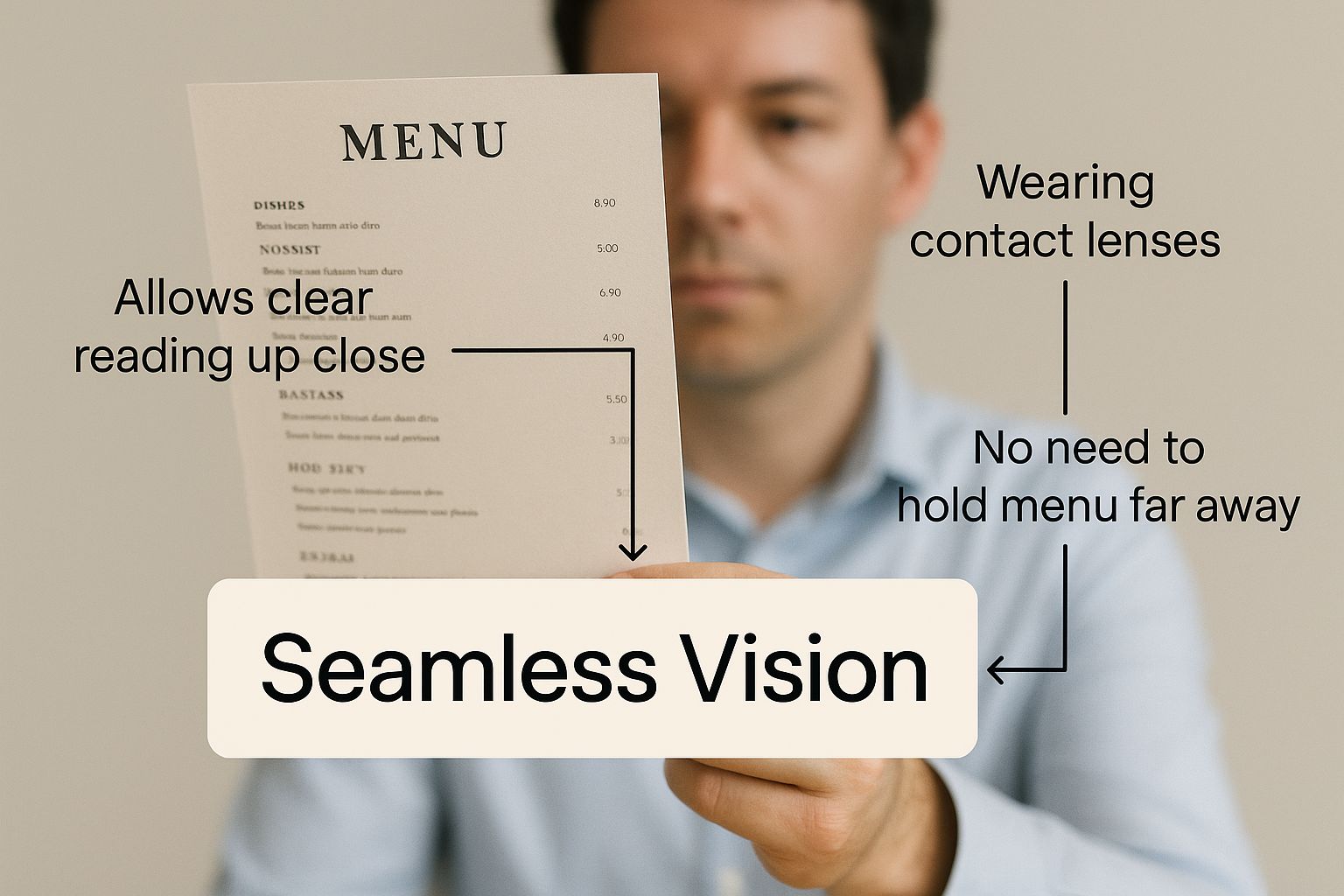
As the visual above shows, the goal is to get back to seeing the world naturally, without the constant frustration of blurry vision up close.
Why Multifocal Lenses Are More Relevant Than Ever
The need for a better solution to presbyopia isn't just a niche problem; it's massive. In fact, the global market for multifocal contact lenses was valued at around USD 4.5 billion in 2023. That number is only expected to climb as more people look for vision correction that fits their active lives.
This growing demand highlights just how much of a breakthrough products like Biofinity multifocal lenses are. They tackle one of the most common vision issues adults face head-on. If you're curious to learn more about the condition itself, our guide on presbyopia and contact lens options is a great place to start.
By putting multiple focusing powers into one lens, Biofinity multifocal lenses give you the freedom to see clearly and comfortably, no matter what you're doing. It’s about getting your visual independence back without compromise.
Ultimately, instead of changing your habits to accommodate your vision, these lenses adapt to your life. They offer a practical, effective way to handle presbyopia without slowing down.
How Balanced Progressive Technology Works

The secret sauce behind Biofinity multifocal contact lenses is CooperVision's unique Balanced Progressive® Technology. While the name sounds a bit technical, the concept is surprisingly clever. It's what allows a single, tiny lens to give you clear vision up close, far away, and everywhere in between.
Think of it like this: instead of the harsh, distinct lines you see in bifocal glasses, Balanced Progressive Technology creates a smooth, gradual transition between different prescription powers. The lens has multiple concentric zones—like ripples in a pond—that handle near, intermediate, and distance vision all at once.
This means your eye can access every focusing power it needs simultaneously. Whether you’re reading a text message, working on a computer, or spotting a street sign in the distance, the right prescription is always there. Your brain does the rest of the work.
Your Brain Is Part of the System
This technology isn't just about optics; it's a team effort between the lenses and your brain. When you first wear them, your brain is presented with several images at once. It might sound confusing, but our brains are incredibly good at adapting.
Within a short time, your brain learns to automatically select the clearest, most relevant image for whatever you're looking at and simply ignore the others. Look down at a menu, and your brain hones in on the near-vision zones. Glance up at the TV, and it instantly shifts to the distance zones. This process, called neuro-adaptation, usually takes a few days to a week to feel completely natural and subconscious.
Of course, the lens material plays a huge role in making this all work comfortably. Biofinity lenses are made from a silicone hydrogel, which allows a high amount of oxygen to reach your eye. This is essential for keeping your eyes healthy and comfortable all day long. For a deeper dive, check out our article comparing silicone hydrogel vs. hydrogel contact lenses.
Why You Get Two Different Lenses: D and N
When you get fitted for Biofinity multifocals, you'll notice your prescription includes a "D" lens for one eye and an "N" lens for the other. This isn't a mistake—it's the core of what makes the technology so effective.
- The 'D' Lens (Dominant Eye): This lens goes on your dominant eye, which your brain naturally favors for distance vision. Its design is weighted to prioritize clear sight for things far away.
- The 'N' Lens (Non-Dominant Eye): This lens is for your other eye and is weighted to provide stronger focusing power for near tasks, like reading your phone.
By assigning a primary task to each eye, the 'D' and 'N' lenses work together to give your brain all the information it needs. It then fuses the two images into a single, seamless picture with fantastic depth perception.
This two-lens system is precisely why a professional fitting is non-negotiable. Your eye doctor will determine which of your eyes is dominant and prescribe the exact combination of D and N lenses to give you the best possible vision. This personalized approach is what truly sets Biofinity multifocal contact lenses apart from simpler, one-size-fits-all options.
Key Benefits of Biofinity Multifocal Lenses

While the technology inside Biofinity multifocal contact lenses is complex, what it does for your daily life is beautifully simple. These aren't just about correcting your vision. They're about giving you a lifestyle upgrade, freeing you from the constant on-and-off hassle of reading glasses and delivering clear, comfortable sight from morning to night.
The biggest, most immediate win is freedom. Imagine glancing from your car's dashboard to a distant road sign, or from a cookbook to the spices on the shelf, all without missing a beat. That seamless transition is the core promise of Biofinity multifocals—they get rid of that frustrating "in-between" blur that can interrupt your flow.
This kind of performance leads directly to a more spontaneous life. You no longer have to remember to bring reading glasses everywhere. You can just live in the moment, confident your vision will keep up.
All-Day Comfort Powered By Aquaform Technology
One of the key things that sets Biofinity multifocal lenses apart is CooperVision’s exclusive Aquaform® Technology. This isn't just a surface coating that can wear off. It's built right into the lens material. Think of it as a natural moisture magnet, locking water molecules inside the lens to keep it soft and hydrated all day long.
This is a game-changer if you spend hours in front of a screen. We all tend to blink less when we're focused on a computer or phone, which can make traditional contacts feel dry and gritty. Aquaform Technology fights back against this digital eye strain by maintaining moisture, helping you avoid that dreaded late-afternoon discomfort.
The lens material itself is a soft silicone hydrogel, a major leap forward in contact lens design. The main advantage here is incredible breathability.
- High Oxygen Permeability: It allows plenty of oxygen to reach your cornea, which is essential for keeping your eyes looking white and feeling healthy.
- Natural Wettability: The lens surface stays moist on its own, without needing extra wetting agents. This also means less chance for irritating deposits to build up.
- Flexible and Soft Material: The lens is designed to feel comfortable from the moment you put it in until you take it out.
All these features work together to create a lens you might honestly forget you're even wearing. As a monthly disposable option, they also offer fantastic convenience. If you're curious about this wear schedule, you can learn more about monthly contact lenses in our detailed guide at https://contactlenshq.com/monthly-contact-lenses/.
A Smart Investment In Your Eye Health
Picking the right contact lens is about more than just seeing clearly today; it's an investment in the long-term health of your eyes. The super-breathable material in Biofinity multifocal contact lenses plays a huge part in this. A cornea that gets enough oxygen is simply a healthier cornea, less prone to complications down the road.
These lenses come from CooperVision, a brand known for its commitment to quality and innovation. And it’s no surprise that soft lenses like Biofinity dominate the market. In 2021, silicone hydrogel materials made up over 88.4% of all contact lens revenue, proving how much wearers value their comfort and health benefits. As the global market for contacts continues to grow—it's projected to hit USD 23.65 billion by 2033—lenses like Biofinity are leading the way. You can explore more about the booming contact lens market on StraitsResearch.com.
To see how these lenses stack up against more traditional options, let's break it down.
Biofinity Multifocal vs Traditional Vision Correction
Many people struggling with presbyopia are used to juggling different pairs of glasses. Here’s a quick comparison of how Biofinity multifocals change the game.
| Feature | Biofinity Multifocal Lenses | Bifocal Glasses | Contacts + Readers |
|---|---|---|---|
| Visual Field | Full, uninterrupted field of view | Limited by frames; distinct line can be jarring | Clear distance vision, but requires glasses for near work |
| Convenience | Wear them all day for all activities | Requires switching or looking through specific zones | Constant hassle of putting on/taking off readers |
| Appearance | Invisible | Visible frames, often with a noticeable bifocal line | Contact lenses are discreet, but readers are not |
| Active Lifestyle | Ideal for sports and activities | Can slip, fog up, or get in the way | Impractical for dynamic activities requiring quick focus shifts |
| Intermediate Vision | Smooth transition for computer and dashboard distances | Can have a "blind spot" at intermediate ranges | Requires removing readers to see a computer screen clearly |
As you can see, while bifocals and readers are functional, they come with compromises. Biofinity multifocals are designed to eliminate those trade-offs.
The real benefit of Biofinity multifocal lenses is the way they simplify your life. They remove the visual barriers that presbyopia creates, allowing you to focus on what matters most without being constantly reminded of your vision limitations.
Ultimately, the combination of crisp multi-distance vision, long-lasting comfort from Aquaform Technology, and the health benefits of a breathable silicone hydrogel makes these lenses a powerful, practical solution. They don’t just give you clear sight; they give you back a sense of total visual freedom.
What to Expect During Your Lens Fitting
Getting fitted for Biofinity multifocal contact lenses isn't quite like your typical exam for standard contacts. Think of your eye doctor less as a technician and more as a vision architect, carefully designing a solution that's built just for your eyes.
This is a highly personalized process. We're not just finding a lens; we're finding the perfect pair of lenses that will work with your brain to give you seamless vision at every distance. This takes a few extra steps and relies heavily on your doctor's expertise and, just as importantly, your feedback.
The Crucial First Step: Finding Your Dominant Eye
One of the very first things your doctor will do is figure out which of your eyes is the dominant one. It’s a simple concept—just like you have a dominant hand you write with, you also have a dominant eye that your brain relies on a little more, especially for processing distance vision.
This quick and easy test is the bedrock of a great multifocal fit. It tells the doctor which eye gets the 'D' (Dominant) lens, which is geared for distance, and which gets the 'N' (Non-dominant) lens, which gives a bit more help for up-close tasks. This clever two-lens approach is the whole secret behind CooperVision's Balanced Progressive® Technology.
The fitting process for Biofinity multifocal lenses is a collaborative effort. Your eye doctor brings the technical expertise, but your real-world feedback on how you see during trial wear is the final piece of the puzzle that ensures a successful fit.
After determining dominance, your practitioner will pick out trial lenses based on your prescription. They'll pop them in and check how they sit on your eye—making sure they move correctly and stay centered—before they even start testing what you can see.
Evaluating Vision and Making Adjustments
With the trial lenses settled, it's time to see how they perform. Your doctor will test your vision in scenarios that mimic your daily life. You'll look at distance charts, of course, but you'll also be asked to read small print up close and check your vision at intermediate ranges, like looking at a computer screen or your phone.
Your feedback here is gold. Instead of just saying "it's blurry," try to be more specific. Something like, "The distance is great, but my phone screen seems a little fuzzy" gives your doctor the exact information they need to fine-tune the lens powers. Don't be surprised if it takes another visit or two to get everything dialed in perfectly.
Understanding the Brain's Adaptation Period
Maybe the most important part of this whole process is knowing what to expect after you walk out the door. Your brain has to learn a whole new way of seeing, and that takes a little time. For the first few days, or even up to a week, you might notice a few odd things:
- Slight ghosting or halos, especially around lights at night. This is very common and typically fades as your brain gets used to the lenses.
- Initial blurriness where your vision doesn't feel perfectly sharp at all distances right away. This is your brain learning how to pick the right focal point for what you're looking at.
- Variable vision, where things might seem clearer at certain times of the day than others.
This is all completely normal. The best thing you can do is wear the lenses consistently to help your brain adapt faster. Most people find their vision settles in and feels natural within one to two weeks. If things still seem off after that, just schedule a follow-up; a small tweak is often all that’s needed.
Biofinity Multifocal vs. The Competition
So, you’re trying to figure out if Biofinity multifocal is the right lens for you. That’s a smart move. With so many great monthly multifocal lenses on the market, it’s easy to get lost in the options. There really is no single "best" lens for everyone, but by looking at how Biofinity stacks up against the others, you and your eye doctor can make a much more informed choice.
The big names you'll likely hear about are lenses like Alcon's AIR OPTIX® plus HydraGlyde® Multifocal and Bausch + Lomb's ULTRA® for Presbyopia. They're all solid contenders, but they each take a different approach to solving the presbyopia puzzle. Biofinity’s edge comes from a very specific combination of design and material that zeroes in on the two things multifocal wearers care about most: seeing clearly at every distance and staying comfortable all day long.
What really sets it apart is the optical design. Biofinity’s secret sauce is its Balanced Progressive® Technology, which uses two different lens designs—a ‘D’ lens for your dominant eye and an ‘N’ lens for your non-dominant eye. This isn't just a one-size-fits-all solution; it's a more personalized approach that helps your brain seamlessly integrate what you're seeing up close and far away.
What Makes Biofinity Different?
Other brands use really effective technology, too, but it's often a different philosophy. Many rely on a "center-near" aspheric design, where the near prescription is in the middle of the lens. This works well for a lot of people, but the 'D' and 'N' system in Biofinity lenses is designed to give you that extra bit of fine-tuning for a more natural visual experience. Think of it as the difference between a standard setup and one that’s calibrated specifically for you.
But clear vision is only half the battle. Comfort is king, and that's where the lens material comes into play.
- Aquaform® Technology: This is CooperVision’s signature material science. Instead of adding a surface coating or wetting agent that can eventually wear off, Aquaform builds long-chain silicone molecules that lock water right into the lens material itself. The result is a lens that's naturally moist and flexible, which is a huge plus if you struggle with dry eyes or stare at screens for hours.
- Plenty of Oxygen: One of the reasons Biofinity lenses feel so good is their breathability. They let a ton of oxygen reach your cornea, which is essential for keeping your eyes looking white and feeling healthy, especially when you're wearing them day in and day out for a month.
The real magic of Biofinity multifocal is how it brings together a smart, customized optical design with a material that's built from the ground up for hydration and breathability. It’s an all-in-one package for both performance and comfort.
A Look at the Leading Options
To put it all into perspective, let's see how Biofinity stacks up against two other leading monthly multifocals. Each has its own unique strengths, and the best one for you often comes down to your individual eye chemistry and what your eye doctor recommends.
Feature Comparison of Leading Monthly Multifocal Lenses
| Feature | Biofinity Multifocal | AIR OPTIX® plus HydraGlyde® Multifocal | Bausch + Lomb ULTRA® for Presbyopia |
|---|---|---|---|
| Optical Design | Balanced Progressive® Technology ('D' & 'N' Lenses) | Precision Profile® Design | 3-Zone Progressive™ Design |
| Moisture Tech | Aquaform® Technology (Naturally wettable) | HydraGlyde® Moisture Matrix (Surface hydration) | MoistureSeal® Technology (High water retention) |
| Material | comfilcon A (Silicone Hydrogel) | lotrafilcon B (Silicone Hydrogel) | samfilcon A (Silicone Hydrogel) |
| Oxygen Flow | High (142 Dk/t) | High (138 Dk/t) | Very High (163 Dk/t) |
As you can see, Bausch + Lomb's ULTRA lenses are known for their MoistureSeal technology, which is designed to hold 95% of its moisture for a full 16 hours. Likewise, AIR OPTIX lenses use the HydraGlyde Moisture Matrix to keep the lens surface hydrated. The best technology for you is personal; some people find the inherent wettability of Aquaform works best, while others might get better results from a different approach.
The Big Picture
This push for better, more specialized lenses is happening for a reason. The global contact lens market was valued at an impressive USD 11.63 billion in 2024, and it's expected to keep growing. This growth is fueled by a demand for innovative lenses that solve specific problems like presbyopia. If you want to dive deeper, you can explore the data behind the future of the contact lens market on MarketResearchFuture.com.
In the end, the only way to truly know which lens is right is to try them. Talk to your eye care professional about these differences—they can guide you toward the lens that has the highest chance of success for your unique eyes and lifestyle.
Keeping Your Lenses (and Your Eyes) in Top Shape
Getting crisp vision with your Biofinity multifocal contact lenses is a great start, but it's only half the battle. The other half? Taking great care of them. Proper cleaning and handling aren't just suggestions; they're the key to keeping your lenses comfortable, your vision clear all month long, and your eyes healthy.
Think of it like this: you wouldn't drive your car for thousands of miles without changing the oil. Your daily lens care routine is that essential maintenance. It gets rid of all the gunk that builds up during the day and helps you sidestep potential problems. Skipping this can lead straight to irritation, fuzzy vision, and a much higher risk of nasty eye infections.
Your routine should start before you even touch a lens. Wash your hands thoroughly with soap and water, then dry them on a lint-free towel. This one simple step is your first line of defense against transferring germs, oils, and dirt from your fingers into your eyes.
The Daily "Rub and Rinse" Ritual
The best way to keep your Biofinity multifocals feeling fresh is to use the "rub and rinse" method every single time you take them out. This is hands-down the most effective way to remove the proteins, lipids, and other deposits that your eyes naturally produce.
It’s a simple process that takes less than a minute:
- Palm the Lens: After taking a lens out, cup it in the palm of your clean, dry hand.
- Add Solution: Squeeze a few drops of a fresh, doctor-recommended multipurpose solution onto the lens.
- Rub Gently: Use your index finger to softly rub the lens back and forth for about 20 seconds. Don't forget to do both sides.
- Rinse It Off: Give the lens a good rinse with more fresh solution to wash away all the debris you just loosened.
- Store Safely: Pop the clean lens into your case and fill it with fresh disinfecting solution. Never, ever just top off yesterday's solution.
It might seem small, but this quick ritual makes a massive difference in how your lenses feel from day one to day thirty.
Your Lens Case Matters, Too
Don't forget about the home your lenses live in! Your contact lens case can easily become a breeding ground for bacteria if you neglect it. Every morning after you put your lenses in, rinse the case out with fresh solution—never use tap water—and let it air-dry upside down with the caps off.
Here’s a rule that’s crucial but often ignored: toss your lens case and get a new one every three months. No matter how well you clean it, a sticky, invisible layer called biofilm can build up, and that’s a risk you just don’t want to take with your eyes.
The Dos and Don'ts of Healthy Lens Wear
A few simple ground rules can help you avoid the most common contact lens mistakes. Stick with these, and you'll be protecting both your lenses and your long-term eye health.
DO:
- Always use fresh solution. Topping off old solution is like trying to get clean by bathing in dirty water. It just doesn't work.
- Stick to the replacement schedule. Biofinity multifocals are monthly lenses. Trying to stretch them longer is a bad idea that can compromise oxygen flow and safety.
- Keep up with your annual eye exams. Your prescription can change, and your eye doctor needs to ensure your eyes are staying healthy.
DON'T:
- Never use tap water or saliva on your lenses. Both are loaded with microorganisms that can cause serious, vision-threatening infections.
- Don't "power through" the pain. If your eyes are red or irritated, take the lenses out. Give your eyes a break and call your doctor if it doesn't get better.
- Avoid sleeping in your lenses unless your eye care professional has specifically given you the green light for continuous wear.
By making these simple but powerful habits part of your daily routine, you can make sure your Biofinity multifocal contact lenses deliver the clear, comfortable vision you rely on, month after month.
Your Top Questions About Biofinity Multifocal, Answered
Alright, so you’ve gotten the rundown on the technology behind Biofinity multifocal contact lenses, but it's totally normal to still have some practical, real-world questions. How will these actually work for you, day in and day out?
Let's tackle some of the most common questions people have. Think of this as the final checklist to make sure you're feeling confident and ready. We'll cover everything from the break-in period to wearing them overnight.
How Long Does It Take to Get Used to Biofinity Multifocal Lenses?
This is probably the number one question I get, and the honest answer is: it varies. For most people, it takes about one to two weeks for their vision to feel completely crisp and natural.
Don't be surprised if you notice some minor blurriness or halos around lights at first, especially when driving at night. That's your brain doing its job, learning to process visual input from the different zones in the lens. The best advice is to wear them consistently—that's the fastest way to adapt. If things still feel off after a couple of weeks, just give your eye doctor a call for a follow-up.
Can I Sleep in Biofinity Multifocal Contact Lenses?
Technically, yes. Biofinity lenses are FDA-approved for continuous wear for up to 6 nights and 7 days. Their silicone hydrogel material is incredibly breathable, which is what makes this possible. It lets a healthy amount of oxygen pass through to your eye, even with your eyelids closed.
But this isn't a green light for everyone.
Important Takeaway: You absolutely must get the okay from your eye care professional before sleeping in any contact lens. They need to check your eye health, tear quality, and other factors to decide if extended wear is safe for you. Never just assume you can do it.
Are Biofinity Multifocal Lenses Good for Dry Eyes?
They're often a fantastic option for people who struggle with dry eyes, and it all comes down to their Aquaform® Technology.
Here’s the key difference: many lenses use surface coatings to stay moist, but those can wear off as the day goes on. Aquaform builds moisture right into the lens material itself. This creates a naturally wet lens that resists drying out, keeping your eyes comfortable even after a long day staring at a computer screen.
How Do I Know if I Need the D or N Lens?
This is the easy part—you don't have to figure this out on your own! The 'D' for Dominant and 'N' for Non-dominant lens is something your eye doctor determines during the fitting.
Your doctor will do a quick, simple test to see which of your eyes is dominant (the one your brain prefers for distance vision). Based on that, they'll assign the 'D' lens to that eye and the 'N' lens to the other. It's this precise, tailored approach that makes the whole system work so well.
At Contact Lens HQ, we're committed to helping you make informed decisions about your vision. For more expert advice and doctor-reviewed guides, check out our full resource library at https://contactlenshq.com.


