
When it comes to the best colored contacts brands, the answer is always the same: the ones prescribed by your eye doctor.
Brands like Alcon's FreshLook and Air Optix Colors, or Acuvue Define, didn't become industry leaders by accident. They consistently top the charts because they’re built on a foundation of solid research and advanced technology, all with your eye health as the top priority. Ultimately, the "best" lens isn't just a brand name; it's the one that has been professionally fitted to your unique eyes.
Finding Your Perfect Match in Colored Contacts
Picking the right colored contacts involves so much more than just clicking on a cool-looking shade you saw online. This is a decision that directly affects your vision and the health of your eyes. Let's cut through the marketing noise and get to what really matters for choosing a brand safely and with total confidence.
Your perfect lens really comes down to a few key things: your natural eye color, whether or not you need vision correction, and the final look you're going for. Someone with deep brown eyes, for example, will need a totally different type of lens to make a noticeable change compared to someone with light green eyes. You can dive deeper into this with our guide on choosing the right lens for your eye color.
Before you dive into brands and colors, it's helpful to understand the main types of lenses available. Each is designed for a different purpose, from a subtle boost to a complete color overhaul.
Quick Guide to Top-Rated Colored Contact Lens Types
| Lens Type | Best For | Effect on Eye Color | Common User |
|---|---|---|---|
| Enhancement Tints | Light-colored eyes | Adds depth and definition to your natural color | Someone with blue eyes who wants them to appear more vibrant. |
| Opaque Lenses | Dark-colored eyes | Completely changes your natural eye color | A person with dark brown eyes who wants to try a striking hazel or gray. |
| Visibility Tints | Handling the lenses | A very faint tint (usually blue or green) that doesn't change your eye color | Anyone who has trouble seeing their clear lenses in solution or on their finger. |
| Theatrical/Special FX | Costume & special events | Creates dramatic, unnatural looks (e.g., cat eyes, zombie white-out) | Actors, cosplayers, or anyone looking for a bold Halloween costume effect. |
This table gives you a quick snapshot, but remember, the right choice still depends on a professional evaluation of your eyes.
Why a Professional Fitting Is Non-Negotiable
Let's be crystal clear about this: your first step, before you even start browsing for brands, must be a professional eye exam and contact lens fitting. There are no exceptions.
Contact lenses are not fashion accessories; they are FDA-regulated medical devices. A lens that doesn't fit your eye properly is a recipe for disaster. It can lead to some truly serious problems:
- Corneal scratches or painful ulcers
- Nasty eye infections
- Starving your eye of oxygen, which can cause long-term damage
- In the worst cases, permanent vision loss
During a fitting, your eye doctor measures the specific curvature and diameter of your eye. This ensures the lens sits correctly, moves as it should, and allows oxygen to pass through freely. They’ll also check your tear film to find a lens material that won't leave your eyes feeling dry and irritated. This expert oversight is your number one defense against harm.
A Booming Market—and the Risks That Come With It
Colored contacts have exploded in popularity, becoming a go-to accessory in beauty and fashion. The global market for these lenses is massive, jumping from around USD 2.5 billion in 2023 to a projected USD 4.5 billion by 2032.
But with this boom comes a major red flag. Improper use is a huge problem, contributing to 1 in 5 eye infections related to contact lenses. It’s no surprise, then, that doctor-recommended brands make up 80% of prescriptions worldwide. These are the brands with a proven track record of safety and quality.
Your eyes are irreplaceable. Changing their color is a fun way to express yourself, but it should never, ever come at the expense of your health. Always start with a prescription.
With that in mind, let's explore the landscape of reputable colored contact brands—from the ones that offer a subtle enhancement to those that deliver a dramatic transformation. This guide will give you the knowledge you need to make a choice that leaves you seeing clearly, feeling great, and looking your best.
Decoding the Different Types of Colored Lenses
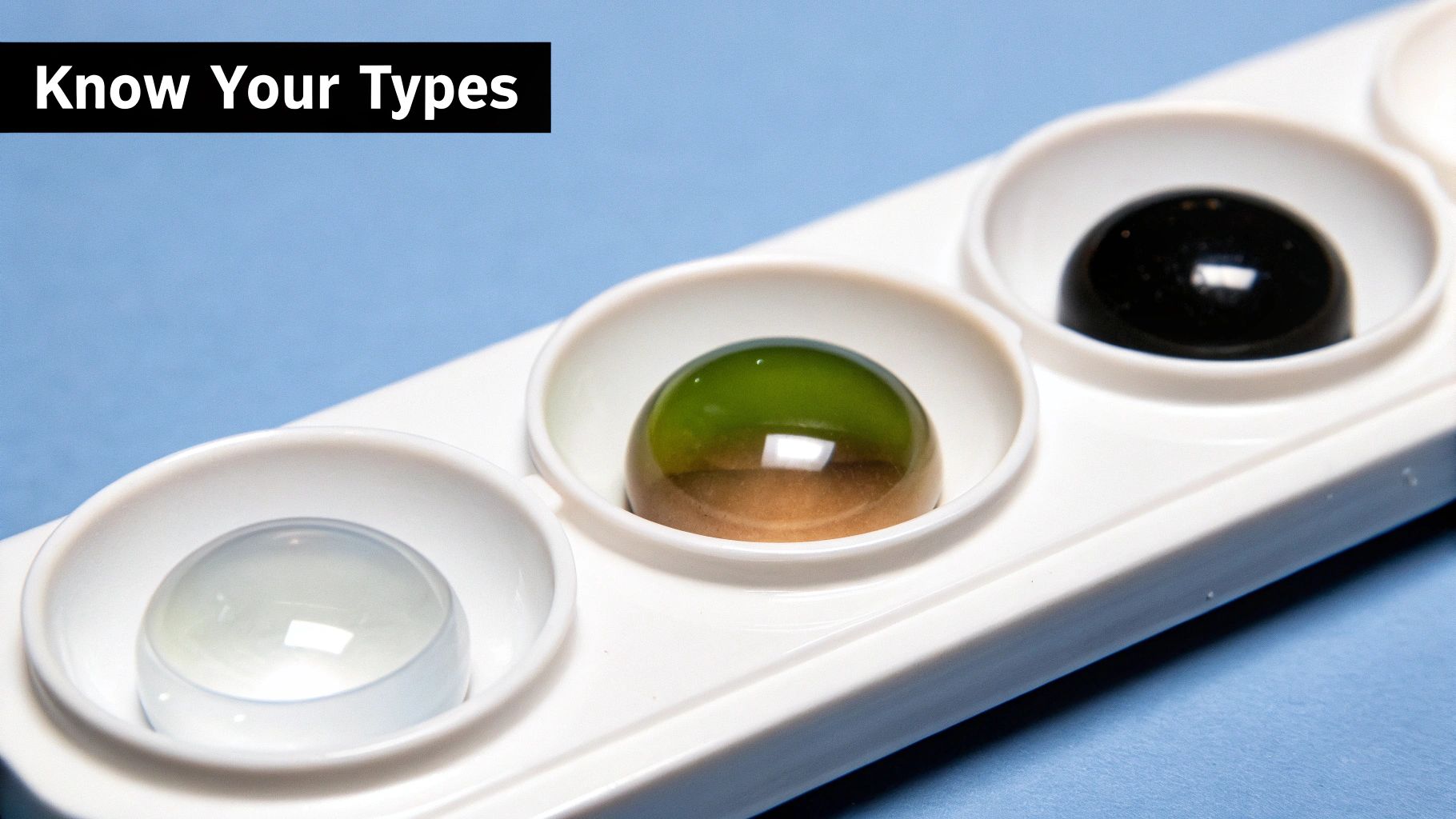
Before you can even begin to compare brands, you need to know what you're actually looking for. The technology that creates the color is just as crucial as the name on the box. Think of it like painting a room—are you going for a subtle, translucent stain that lets the wood grain show through, or a solid, opaque coat of paint for a completely new look?
Colored contacts work the same way. They generally fall into three main categories, and each one is engineered to achieve a very different effect. Getting a handle on these types is the first step to narrowing down your options and finding the perfect lenses for your vision and your style.
The Subtle Boost of Enhancement Tints
Think of enhancement tints as a way to turn up the volume on your natural eye color. They don't shout; they amplify. Imagine applying a soft photo filter that just makes the existing colors pop—that’s exactly what these lenses do.
They have a see-through tint that layers over your natural iris, adding depth and intensity. This makes them a fantastic choice if you have lighter eyes—like blue, green, or light hazel—and just want to make them look more vibrant and defined. They won't give you a totally new eye color, but they will give your natural shade a beautiful, noticeable kick.
The Total Transformation of Opaque Tints
If you're after a dramatic change, opaque tints are your ticket. These lenses are the equivalent of a full repaint for your eyes, designed to completely cover your natural color with a new, solid one.
This is how someone with dark brown eyes can pull off a startlingly bright blue or a warm, honey-gold hazel. The best opaque lenses have intricate patterns of flecks and lines printed on them to mimic the texture of a real iris, which helps sell the illusion. Pretty much every major colored contact brand has a big selection of opaque options.
The Practicality of Visibility Tints
The third type isn't really "cosmetic" at all. Visibility tints are a very faint light blue or green hue added to a regular, clear contact lens. The one and only reason they exist is to help you spot the lens in your case or when it’s sitting on your fingertip.
Once it's in your eye, that light tint is completely invisible and has zero effect on your eye color. It's purely a handling feature, but it's good to know the term so you don't accidentally buy them thinking they’ll change your look.
All colored contact lenses, whether they correct your vision or not, are considered medical devices. This classification by the FDA is a critical safety measure, ensuring that any lens you put in your eye meets specific health and safety standards.
Prescription vs. Plano Lenses
This brings us to one of the most important things you need to understand: the difference between prescription and plano lenses. Getting this right is fundamental when you're exploring how prescribed colored contact lenses work.
- Prescription Lenses: These lenses do two jobs at once. They change your eye color while also correcting vision issues like nearsightedness (myopia), farsightedness (hyperopia), or astigmatism.
- Plano Lenses: These are "non-prescription" in the sense that they have zero corrective power. They don't fix your vision at all; their only purpose is to change the color of your eyes.
Here’s the critical takeaway: both types require a valid prescription from an eye doctor. An optometrist needs to professionally fit you for any contact lens to measure your eye's unique curvature and diameter. This ensures the lens sits correctly, lets your cornea breathe, and helps you avoid nasty complications like corneal scratches or infections. If a seller is willing to sell you lenses without asking for a prescription, run the other way. It's illegal and incredibly risky for your eyes.
How We Vet and Choose the Best Contact Lens Brands
When it comes to finding the best colored contacts brands, we think you deserve total transparency. It's easy to just list a few popular names, but that doesn't really help you understand why one brand is a safe choice and another is a major risk. So, we're pulling back the curtain on our evaluation process.
Think of this as our expert checklist. It’s what we use to scrutinize every brand to ensure it meets the highest standards for your vision and eye health. We'll get into the nitty-gritty of lens materials, what "breathability" actually means for your eyes, and why a brand's reputation is about much more than just slick marketing. Knowing this stuff makes you a smarter, safer consumer.
Before we even look at a brand’s color options or comfort claims, there's one make-or-break requirement that comes first.
The Foundation of Safety: FDA Approval
Let’s get this out of the way first: any brand we even consider must be cleared by the U.S. Food and Drug Administration (FDA) or a similar international regulatory body. This is our non-negotiable starting point, and it should be yours, too.
FDA clearance is a signal that the manufacturer has gone through rigorous testing to prove their products and manufacturing processes meet strict health and safety standards. A lens without that seal of approval is a complete gamble. You have no idea what it's made of, where it was made, or if it's even shaped correctly for a human eye.
A contact lens is a medical device, period. That’s true even if you have perfect vision and are just wearing them for fun. Brands that skip regulatory approval aren't just cutting corners—they are actively ignoring safety rules designed to protect you.
Once we confirm a brand is legally and safely on the market, we start digging into the science of the lens itself. The material it's made from directly impacts how it feels and, more importantly, how healthy it keeps your eyes.
Material Science: Breathability and Hydration
Not all contacts are created equal. The material is everything, dictating how much oxygen gets to your cornea and how well your eyes stay hydrated all day. You'll generally run into two main types of materials: standard hydrogel and silicone hydrogel.
Standard Hydrogel: These are the classic soft lenses, made from a water-infused plastic. Their ability to transmit oxygen is tied directly to how much water they hold—more water means more oxygen. They often feel great right when you put them in.
Silicone Hydrogel: This is the newer, more advanced material. It allows up to five times more oxygen to flow through the lens to your eye compared to most traditional hydrogels. This superior "breathability" is a game-changer for keeping eyes healthy and comfortable, especially if you wear your lenses for long hours.
We look closely at a lens’s oxygen permeability, which is measured as its Dk/t value. A higher Dk/t number means more oxygen can get through, helping to prevent the irritation and dryness that can come with extended wear. It's like choosing between a thick cotton t-shirt and modern athletic wear for a run—the high-tech fabric lets your skin breathe, and that’s exactly what a high Dk/t lens does for your cornea.
Brand Reputation and Quality Control
Finally, we look at the company's track record. How long have they been around? What do eye care professionals think of them? Established manufacturers like Alcon, Johnson & Johnson, and Bausch + Lomb have invested decades of research and millions of dollars into their lens technology.
That massive investment pays off in ways that directly benefit you:
- Consistent Quality: They have incredibly strict quality control, ensuring every lens that comes off the line is perfect.
- Advanced Technology: These are the companies pioneering new ways to blend colors naturally and embed moisture agents right into the lens for all-day comfort.
- Professional Trust: Eye doctors prescribe these brands for a reason—they have a proven history of safety, reliability, and performance.
A brand with a solid, long-standing reputation gives you peace of mind. It means they stand behind their product and put your well-being first. This combination of official approval, modern materials, and a trusted history is what separates the best from the rest.
Top Doctor-Recommended Colored Contact Brands
Alright, now that we’ve covered the nitty-gritty of what makes a colored contact lens safe and effective, let's get to the fun part: the brands that eye doctors actually trust and recommend. This isn't just a popularity contest. These are the industry leaders known for their obsessive commitment to eye health, all-day comfort, and creating beautifully realistic looks.
We'll break down what makes each one special, from their unique coloring techniques to the specific experience they offer. Whether you’re after a subtle change for your 9-to-5 or a bold new look for a night out, one of these brands will have a doctor-approved lens that’s right for you.
Alcon: The Architect of Natural Blending
When you talk about the best colored contacts, Alcon is almost always the first name that pops up—and for good reason. They are an absolute giant in eye care, pouring massive resources into research and development. Their two main lines, FreshLook and Air Optix Colors, hit different notes but are both built on a solid foundation of safety.
FreshLook Colorblends were the lenses that really changed the game for natural-looking color. Instead of using a flat, single-color tint that screamed "fake," they pioneered a patented 3-in-1 technology. This clever process layers three different colors together to mimic the natural depth and pattern of a real iris. The result? A believable, vibrant change that avoids that artificial, painted-on look.
FreshLook has been a dominant force for years; its Colorblends line launched way back in 2002, introducing that groundbreaking tech. By 2023, the brand still held an impressive 22% of the global color contacts market. That long-term success is built on a lineup of 12 shades and a comfortable hydrogel material that allows 55% oxygen transmission. In fact, 92% of wearers reported they were comfortable all day in clinical trials. You can dig into these market trends in this comprehensive industry report.
Air Optix Colors is Alcon's more modern, premium option. These are made from a cutting-edge silicone hydrogel material, which is a game-changer because it lets a whole lot more oxygen pass through to your eye. If your top priorities are breathability and comfort for long days, Air Optix Colors is an incredible choice. They also come with Alcon's SmartShield Technology, an ultra-thin protective layer that helps block irritating buildup on the lens.
Acuvue Define: The Master of Subtle Sparkle
Johnson & Johnson’s Acuvue brand is a household name for comfort and quality in regular contacts, and they carry that same philosophy over to their Acuvue Define line. But these lenses aren't about drastic color changes at all. Their approach is completely different.
The goal here isn't to change your eye color—it's to enhance it. Think of it less as a new coat of paint and more like a perfectly applied touch of makeup for your iris.
Acuvue Define lenses use a beautiful, intricate design inspired by the natural iris. They add a dark outer ring (the limbal ring) and delicate, translucent highlights. This makes your eyes look brighter, deeper, and more vibrant without actually covering up your natural color.
This makes them absolutely perfect for daily wear, especially if you just want your eyes to "pop" a little without anyone knowing you're wearing colored contacts. They are also daily disposables, which is the gold standard for hygiene—nothing beats starting with a fresh, sterile pair every single morning.
Bausch + Lomb: A Legacy of Opaque Color
Bausch + Lomb is another one of the original players, with a long and trusted history in eye care. While their colored lens collection might not be as vast as Alcon's, what they offer is known for rich, opaque color and reliable comfort. Their lenses are a fantastic choice for people with dark eyes who want a truly noticeable transformation.
Their opaque designs are meant to completely mask your natural iris, delivering a bold and consistent new color. They use advanced printing methods to make sure the color is safely encapsulated within the lens material, so the pigment never, ever touches the surface of your eye.
What’s more, Bausch + Lomb is one of the few top-tier brands that offers toric colored lenses for people with astigmatism. This commitment to serving more complex vision needs is just one more reason they remain a go-to brand for eye doctors everywhere.
Feature Comparison of Top Colored Contact Brands
To make it easier to see how these brands stack up, here’s a quick side-by-side comparison. This table helps break down what each one does best.
| Brand | Key Technology | Best For | Oxygen Permeability | Replacement Schedule |
|---|---|---|---|---|
| FreshLook Colorblends | 3-in-1 Color Blending | Natural color change for both light and dark eyes | Medium (Hydrogel) | Monthly |
| Air Optix Colors | Silicone Hydrogel Material | Extended comfort and maximum breathability | High (Silicone Hydrogel) | Monthly |
| Acuvue Define | Iris-Inspired Design | Subtle brightening and defining effect | High (Silicone Hydrogel) | Daily |
| Bausch + Lomb | Rich Opaque Tints | Dramatic color change, especially for dark eyes | Medium (Hydrogel) | Monthly |
In the end, picking the right brand really comes down to what you want to achieve. Are you looking for a complete, head-turning makeover? Or do you prefer a subtle enhancement that just makes your eyes sparkle a bit more? By matching your personal style with the proven, safe technology of these doctor-recommended brands, you can get the look you’ve always wanted without compromising your eye health.
How to Safely Purchase and Wear Your Lenses
Picking out a great brand of colored contacts is just the first step. The real key to protecting your vision lies in knowing how to buy and wear them safely. This is where we shift from the what to the how—think of this as your essential safety manual for enjoying a new look without risking your eye health.
The journey to wearing colored contacts safely actually starts long before you click "add to cart." It begins in an eye doctor's office with a professional fitting and a valid prescription. This isn't just a strong suggestion; in the United States, it's the law. All contact lenses, even the non-corrective "plano" ones, are considered medical devices and require a prescription.
An eye doctor's prescription is what guarantees the lens is the right size and shape for your eye's unique curve. An ill-fitting lens can cause some serious problems, including corneal scratches, oxygen deprivation, and nasty infections that could lead to permanent vision loss.
Once you have that all-important prescription, you can start shopping from a reputable seller. This is a critical step where you need to be a little bit of a detective.
This flow chart gives you a peek into what top brands prioritize—a seamless blend of natural appearance, vibrant color, and all-day comfort.

It shows how the best lenses aren't just about one feature; they're about mastering all three to create a product that both looks fantastic and feels great.
Spotting a Legitimate Seller
The internet is packed with retailers, but they are definitely not all created equal. Knowing how to tell a legitimate vendor from a risky one is crucial. A legitimate online seller will always ask you to provide or verify a valid prescription from your eye doctor before they'll ship your order. If they don’t ask for one, they're breaking the law and likely selling unregulated, potentially dangerous products.
Here's a quick checklist to help you identify a safe online retailer:
- Prescription Verification: They must have a clear process for checking your prescription with your doctor.
- Reputable Brands: They stock well-known, FDA-approved brands like Alcon, Acuvue, and Bausch + Lomb.
- Real Contact Info: The website should have a physical address and a customer service phone number you can actually call.
- Clear Policies: You should easily be able to find their return policies and shipping information.
For a deeper dive, you can learn more about how to buy contact lenses online the right way. My advice? Steer clear of sellers on third-party marketplaces, costume shops, or anyone willing to sell you "prescription-free" lenses. These are massive red flags.
Your Daily Hygiene and Care Routine
After your lenses arrive, proper hygiene is your single most important job. Your hands can transfer all sorts of nasty bacteria straight to your eyes, so a strict cleaning routine is completely non-negotiable if you want to avoid painful infections.
Following these steps every single time is the best defense you have for keeping your eyes healthy. It’s a simple routine, but it's incredibly powerful.
Here’s the process you should follow every time you handle your lenses:
- Wash Your Hands Thoroughly: Before you even think about touching your lenses, wash your hands with soap and water. Dry them with a lint-free towel to avoid transferring germs or fuzz.
- Use Fresh Solution Every Time: Never, ever top off old solution in your case. Always dump the used stuff out and refill the case with a fresh, sterile disinfecting solution.
- Clean Your Lenses Correctly: If you wear monthly or two-week lenses, put a lens in your palm, add a few drops of solution, and gently rub it with your fingertip. This removes any buildup. Then, rinse it well with more solution before storing it.
- Replace Your Case Regularly: Your lens case can become a breeding ground for bacteria. You need to toss it and get a new one at least every three months.
By making these steps a habit, you build a powerful defense against the most common risks that come with wearing contacts. Following your doctor’s instructions and the brand's replacement schedule is the ultimate way to enjoy your new eye color without any trouble.
Your Questions About Colored Contacts, Answered
Even with all the facts, a few questions always pop up. That’s perfectly normal—when it comes to your eyes, you can never be too careful. This is where we tackle the most common things people wonder about, whether they're trying colored contacts for the first time or have been wearing them for years.
Think of this as tying up the loose ends. We'll clear up some common confusion and bust a few myths so you can feel completely at ease with your choice. Let's get into it.
Can I Wear Colored Contacts if I Have Perfect Vision?
Yes, you can, but this is probably the single most misunderstood thing about colored lenses. Even if you have 20/20 vision and don't need glasses, you must get a prescription from an eye doctor. It's not just a suggestion; it's a legal requirement and a critical safety step.
Lenses made for perfect vision are called plano lenses—they have zero corrective power. The prescription, however, isn't just about how well you see. It’s all about the fit. Your eye doctor takes precise measurements of your eye's unique curve and size to make sure the lens sits properly. A good fit is essential for comfort, clear vision, and letting your eye breathe.
How Do I Choose a Color That Looks Natural?
The secret to a believable look is to work with your natural eye color, not fight against it. Your strategy really depends on your starting point.
- For light eyes (blue, green, gray): Your best friend is an enhancement tint. These lenses are translucent, designed to amplify your natural color rather than mask it. They add depth and vibrancy, making your eyes pop in a subtle way. Think of a subtle green tint over blue eyes—it can create a gorgeous, one-of-a-kind teal.
- For dark eyes (brown, deep hazel): To get a noticeable change, you'll need opaque lenses. The trick to keeping it natural is sticking with warmer tones. Colors like honey, hazel, or a soft gray often blend beautifully. Bright blues or greens can sometimes look a bit stark or unnatural against darker features, so it’s often better to start subtle.
Are "Over-the-Counter" Lenses from Costume Shops Safe?
Let me be crystal clear: no. Any place that sells contact lenses—colored or not—without asking for a valid prescription is breaking the law in the United States and many other countries. These aren't just unregulated; they're genuinely dangerous.
These illegal lenses are often made from cheap, substandard materials that don't let enough oxygen through to your cornea. Worse, they can be poorly made, with rough edges or an incorrect shape that can do real damage.
Buying lenses from an unauthorized source is a huge gamble with your eyesight. It can lead to painful scratches on your cornea (abrasions), serious eye infections like keratitis, and allergic reactions. In the worst cases, it can cause permanent vision loss. It's just not worth the risk.
Can You See Through the Colored Part of the Lens?
That’s a great question, and it makes perfect sense to ask. Reputable brands design their lenses very intentionally, with a clear, un-tinted circle right in the middle that sits directly over your pupil.
This means the color only covers your iris (the colored part of your eye), leaving your line of sight totally clear. You’ll see the world just as you would without them. The only time you might notice something is in very low light. Your pupils naturally get bigger to let more light in, and they can sometimes expand beyond the clear zone of the lens. This might cause a slight halo effect, but it's temporary and not an issue in normal lighting.
What's the Most Popular Type of Colored Contact Lens?
When you look at the brands people trust, a few names always come up. Johnson & Johnson's Acuvue Define line, for example, has been a major player since it launched in 2010. By 2024, it had captured 18% of the enhancement tint market with its unique ‘Natural Shine’ design, which subtly makes the eyes look bigger and more defined.
A huge part of their success is the focus on health and convenience. In 2024, their 1-Day disposables saw a 32% uptake among young adults. It makes sense, as daily lenses can slash infection risks by 50% compared to lenses you have to clean and reuse. You can learn more about the trends in the colored contact lens market on lucintel.com.
Ready to explore the world of vision correction with expert guidance? At Contact Lens HQ, we provide doctor-reviewed articles and in-depth guides to help you make informed decisions about your eye health. Visit us at https://contactlenshq.com to learn more.


