
If you’re all about convenience and prioritizing your eye health, daily contacts are hard to beat. The biggest win? You can completely forget about cleaning routines. A fresh, sterile lens every single day drastically cuts down the risk of eye infections.
But "better" isn't a simple, one-size-fits-all answer. The right choice really boils down to your lifestyle, how often you plan to wear contacts, and of course, your budget.
Daily vs. Reusable Contacts: A Head-to-Head Comparison
To help you figure it out, this guide breaks down the essential differences—from hygiene and comfort to cost and environmental impact. Getting a clear, balanced view of these points is the key to having a productive conversation with your eye doctor and finding the perfect fit.
The most obvious difference is how often you replace them and what's required to maintain them. Daily disposable contacts are exactly what they sound like: you wear them once and toss them out before bed. Reusable lenses, whether they're weekly or monthly, need to be cleaned and stored in a disinfecting solution every single night.
Daily vs Reusable Contacts At a Glance
This difference in the replacement schedule creates a domino effect, impacting everything from your daily habits to your long-term eye health. It's no surprise that more people are leaning toward dailies, reflecting a bigger trend toward simplicity and hygiene.
In fact, a deep dive into global prescribing trends revealed that daily disposables now make up 47% of all soft lens fittings, just sneaking past monthly lenses. This shift clearly shows a growing demand for the benefits single-use lenses bring. You can explore more data on contact lens trends to see how preferences are evolving.
Often, the decision comes down to a trade-off. Daily lenses might look more expensive at first glance, but they save you the recurring cost of cleaning solutions and lens cases, which definitely add up.
The core advantage of daily disposables is the elimination of human error. By removing the cleaning and storage steps, you significantly reduce the risk of contamination that can lead to irritation or serious eye infections.
To make things simpler, here’s a quick overview of the main trade-offs between these two popular options. This table should help you quickly see which features line up best with your daily routine and priorities.
| Feature | Daily Disposable Contacts | Reusable (Monthly/Weekly) Contacts |
|---|---|---|
| Replacement Schedule | Discarded after a single use | Replaced every 2-4 weeks or longer |
| Maintenance | None required; no cleaning or storage | Daily cleaning and overnight storage in solution |
| Hygiene Level | Highest; fresh, sterile lens every day | Lower risk of buildup with proper cleaning |
| Upfront Cost | Higher per box | Lower per box |
| Long-Term Cost | No additional cost for solutions or cases | Requires ongoing purchase of solutions and cases |
| Best For | Busy lifestyles, occasional wear, allergy sufferers | Consistent daily wearers, complex prescriptions |
Ultimately, this at-a-glance view shows there’s a clear give-and-take. Dailies offer unmatched convenience and hygiene, while reusables can be more budget-friendly upfront for dedicated, everyday wearers.
How Hygiene and Long-Term Eye Health Compare

When you’re weighing daily contacts against monthlies for long-term wear, the entire conversation really has to start with hygiene. Your eyes are incredibly delicate, so the habits you build around your lenses directly impact their health. This is where daily disposables have their single biggest advantage.
The beauty of dailies lies in what you don't have to do. There's no cleaning, no rubbing, and no storing. Every morning, you pop in a brand-new, sterile lens straight from its sealed pack. This design completely removes the chance of human error—you can't forget a cleaning step, top off old solution, or use a contaminated case, because those things are no longer part of your routine.
The Inevitable Problem of Protein Buildup
Even if you have the most meticulous cleaning regimen in the world, reusable lenses will accumulate deposits. It's just a fact of life. Your tears are full of proteins, lipids, and calcium that naturally stick to the lens surface. Over a few weeks, this buildup creates a film that not only makes your lenses feel less comfortable but also becomes a perfect breeding ground for bacteria.
This gradual accumulation is exactly why a monthly lens might feel great on day one but feels scratchy and irritating by day twenty-five. A fresh daily lens, on the other hand, gives you a perfectly clean slate every single morning, completely free from the gunk of the day before.
By taking the lens case and cleaning solution out of the equation, daily disposables eliminate the two most common sources of contamination that lead to eye infections. It’s a simple change that can dramatically lower your risk of complications.
The global market for soft contact lenses is projected to surge from USD 10.61 billion in 2025 to USD 18.27 billion by 2032. A huge driver of this growth is the consumer shift towards dailies, prized for their superior hygiene which minimizes allergen buildup and slashes infection risks. You can discover more insights about the soft contact lens market and see how health-conscious trends are shaping the industry.
Lowering the Risk of Serious Infections
The link between poor lens hygiene and eye infections is something optometrists see all the time. One of the most severe risks is microbial keratitis, a painful and potentially vision-threatening infection of the cornea that’s often tied to improper contact lens care.
Reusable lenses inherently depend on a flawless multi-step cleaning process. Any single slip-up—rinsing with tap water, reusing solution, or not washing your hands properly—can introduce nasty pathogens to the lens and, by extension, your eye.
Daily disposables just sidestep that whole minefield. Tossing the lens each night means you're also throwing away any bacteria, pollen, or other allergens that collected on it during the day. This makes dailies a fantastic option for anyone who struggles with allergies.
Why Lens Materials Also Play a Role in Hygiene
Modern contacts are engineered from incredible materials that let more oxygen reach your cornea, which is essential for keeping your eyes healthy. But these different materials interact with your tear film in unique ways.
- Silicone Hydrogel: Famous for its amazing oxygen permeability, but this material can sometimes be a magnet for lipid (oily) deposits.
- Hydrogel: Known for its high water content and comfort, though it may be more susceptible to protein buildup.
While monthly lenses are built for durability, their surface properties can actually change after repeated cleaning cycles. In contrast, a daily lens offers a consistently pristine surface every time, ensuring you get the same great performance and comfort from the moment you put it in. To get the full picture, you can learn more about silicone hydrogel vs hydrogel contact lenses in our article.
When Daily Lenses Really Shine
For some people and situations, the hygiene benefits of daily contacts are a game-changer. If you have an active or unpredictable lifestyle, that convenience translates directly into better, safer vision.
Think about these real-world scenarios:
- Traveling: Who wants to lug around bulky solution bottles and lens cases? With dailies, you just pack the exact number of pairs you need. No spills, no forgotten supplies.
- Camping or Outdoor Trips: Finding a clean sink and sterile environment to handle your lenses outdoors can be tough. Tossing your lenses at the end of the day avoids all the risks of contamination.
- Playing Sports: After a sweaty game or a swim, popping in a fresh pair of lenses feels amazing. More importantly, it prevents bacteria from being trapped against your eye.
In every one of these cases, daily disposables are the smarter choice—not just for convenience, but because they offer a foolproof way to protect your eye health.
Comfort and Convenience: Where Dailies Often Win
Let's move past the basics of hygiene and cost for a moment. When people ask me "are daily contacts actually better?", the conversation almost always lands on two things that are deeply personal: comfort and pure, simple convenience. How the lens feels at 8 PM versus 8 AM and how it slots into your life can make or break the whole experience.
Modern contacts are all pretty comfortable, thanks to huge leaps in material science. But daily disposables have a secret weapon: consistency. Think about it—a reusable lens, no matter how meticulously you clean it, naturally wears down. The surface gets a little less slick, and tiny deposits can build up over weeks of use.
With a daily lens, you get a brand-new, perfectly smooth, and fully hydrated surface every single morning. There's no slow decline in comfort. That crisp, fresh feeling is there every day, which is a world away from how a 30-day old monthly lens can feel.
The Grab-and-Go Lifestyle
When it comes to convenience, dailies are in a league of their own. This is especially true if your schedule is anything but predictable. The whole ritual of cleaning, rinsing, and storing lenses? Gone. Buying bottles of solution? A thing of the past.
This isn't just about saving a few minutes. It's about removing a daily chore and all the mental baggage that comes with it.
- Athletes & Gym-Goers: Finished a sweaty workout or a swim? Just toss the lenses. No fussing with gritty, dirty lenses. Pop in a fresh pair whenever you're ready.
- Travelers: Packing is a breeze. Forget bulky solution bottles that might leak in your bag. Just count out how many pairs you need for your trip and go.
- Part-Time Wearers: If you only wear contacts on weekends or for special occasions, dailies are a no-brainer. You use them when you need them, without a monthly lens sitting in solution and nearing its expiration date.
This kind of flexibility makes daily disposables an incredibly practical fit for modern, busy lives.
The real convenience of daily lenses isn't just saving five minutes before bed. It's about completely removing a recurring task and all its supplies from your mental to-do list.
There's no need to track when you opened your monthly pair or make a late-night run to the store because you're out of cleaning solution. It just works.
A Breakthrough for Allergy Sufferers
If you're one of the many who dread allergy season, daily contacts can feel like a miracle. Airborne culprits like pollen, dust, and dander love to cling to the surface of contact lenses, leading to that all-too-familiar itchiness, redness, and irritation.
Cleaning a monthly lens helps, of course, but it's nearly impossible to scrub away every last microscopic allergen. Those leftovers get trapped against your eye, re-exposing you day after day.
Daily disposables offer a brilliantly simple fix. At the end of the day, you throw the lens out, and all the allergens that hitched a ride go with it. Starting fresh every morning with a sterile, clean lens can make a massive difference in your comfort.
For many with sensitive eyes, this benefit alone seals the deal. If you constantly struggle with irritation, looking into the best contact lenses for sensitive eyes can point you toward even more specialized options. It’s a change that can turn contact lens wear from a daily battle into a clear, comfortable experience, even when pollen counts are high.
A Realistic Breakdown of Annual Costs
When people ask, "are daily contacts better," the conversation almost always lands on cost. There's a common belief that dailies are a luxury item, and on the surface, it’s easy to see why. The price per box is definitely higher. But that's not the whole story—not by a long shot.
To get a real sense of the financial commitment, you have to look past the sticker price and consider the hidden costs of reusable lenses. More importantly, you have to be honest about how often you actually wear your contacts.
Monthly lenses come with their own set of required purchases. You'll need a steady supply of cleaning and disinfecting solutions, which easily adds up to $150 to $250 a year. On top of that, you have to replace your lens case every three months to keep bacteria at bay. With daily disposables, all of those extra costs and chores simply disappear.
Full-Time Wear: The Traditional Cost View
For someone who wears their contacts every single day, monthlies usually win the budget battle. If you're a dedicated, 7-days-a-week wearer, the lower per-lens cost of a monthly option really starts to add up over the year, even when you factor in the cleaning supplies.
Let's do some quick math for a full-time user:
- Daily Disposables: You can expect to spend anywhere from $500 to $800+ per year, depending on your prescription and the brand you choose.
- Monthly Disposables: The lenses themselves typically run between $250 and $450 annually.
- Essential Supplies for Monthlies: Don't forget to tack on another $150 to $250 for a year's worth of solutions and cases.
When you add it all up, the total for monthlies lands somewhere between $400 and $700. So, in this specific scenario, a daily wearer could save around $100 or more each year by sticking with reusables. If that sounds like you, exploring some of the best monthly contact lenses can help you find a great, wallet-friendly fit.
The real cost isn't just the price per box. It's the total annual investment, which must include cleaning solutions, replacement cases, and even the cost of replacing a lost or torn reusable lens.
Part-Time and Occasional Wear: The Surprising Twist
Here’s where the whole financial argument gets turned on its head. If you only wear contacts a few times a week—maybe for sports, weekend outings, or just to give your nose a break from glasses—daily disposables almost always come out cheaper.
Think about it. A monthly lens has a 30-day lifespan from the moment you open the blister pack. It doesn't matter if you wore it three times or thirty times; once that month is up, it has to be tossed. You end up paying for a full month's use even if you only needed it for a handful of days. It’s a waste of both the lens and your money.
With daily disposables, you pay as you go. A 90-pack of dailies could easily last a part-time wearer six months or more, which dramatically slashes the annual cost. There's no pressure to "get your money's worth" before a lens expires.
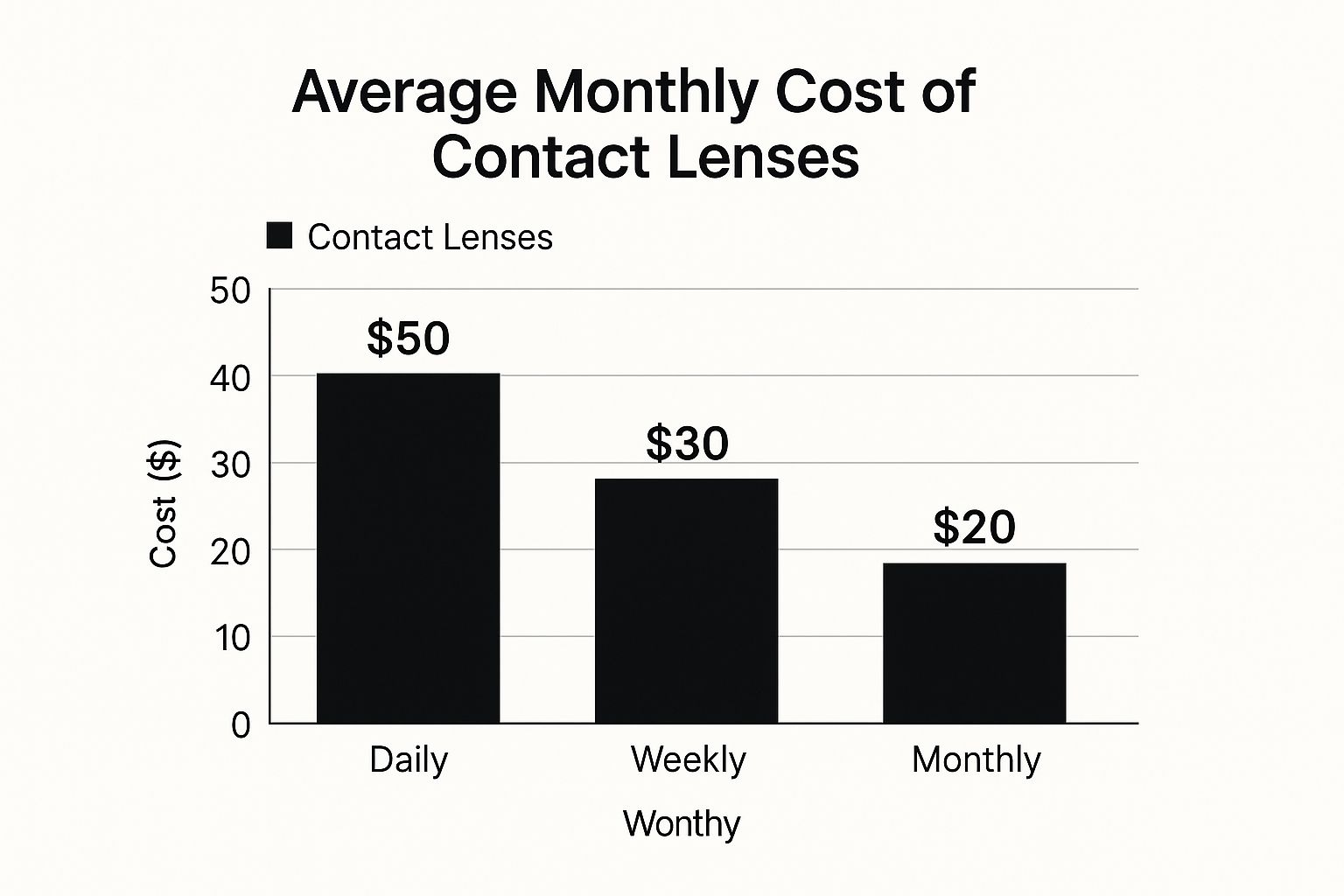
This chart gives a great visual snapshot. While dailies might seem more expensive for constant wear, their value proposition completely changes for anyone who doesn't need them every single day.
To make this even clearer, let's look at how the numbers shake out for different types of users.
Annual Cost Comparison Based on Wear Frequency
The table below breaks down the estimated annual costs for different wearing schedules, helping you see where you might fit in.
| Wearer Profile | Daily Disposables Estimated Annual Cost | Monthly Lenses Estimated Annual Cost (incl. solutions) | Cost-Effective Choice |
|---|---|---|---|
| The Full-Timer (Wears lenses 7 days/week) | $650 | $550 | Monthly Lenses |
| The Weekender (Wears lenses 2-3 days/week) | $250 | $550 | Daily Disposables |
| The Occasional User (Wears lenses ~4 times/month) | $120 | $550 | Daily Disposables |
As you can see, the moment you stop being a full-time wearer, the financial advantage flips dramatically in favor of daily disposables.
Calculating Your True Cost
So, what’s the takeaway? To figure out what’s truly best for your budget, you have to be honest about your lifestyle. Are you putting in contacts every morning without fail, or do you mix it up with glasses? Your answer to that one question is the key to knowing which lens type will actually save you money in the long run.
The Environmental Impact of Contact Lenses
For a growing number of us, the choice between daily and monthly contacts isn't just about cost or convenience—it's also about our environmental footprint. This isn't a simple black-and-white issue. Both types of lenses create waste, but in very different ways. We need to look at the entire lifecycle, from manufacturing to disposal, to get the full picture.
At first glance, daily disposables look like the bigger offender. If you wear them every day, you're tossing out 730 individual lenses a year, plus all the little plastic blister packs and foil tops they come in. That's a lot of single-use plastic, and it adds up fast.
But before you jump to conclusions, consider the other side of the coin. With monthly lenses, you only discard 24 lenses annually, but what about all the upkeep? You're also throwing away large plastic bottles of cleaning solution and replacing your lens case every few months. This "secondary" waste stream is often overlooked.
A Closer Look at the Waste Stream
When we compare the two, it’s about more than just counting lenses. It’s about the total volume and type of waste each one produces over a year.
- Daily Disposables: The waste here is a high volume of small items—the lenses, their plastic blister packs, and the foil lids. The sheer quantity is the primary concern.
- Monthly Lenses: The waste is dominated by bulky items like solution bottles and lens cases, which are often made from plastics that are harder to recycle than the packaging for dailies.
The environmental trade-off is often between a higher volume of small, packaged waste (dailies) and a lower volume of lenses but more substantial secondary waste from cleaning supplies (monthlies). Both options have a distinct impact.
Manufacturing and Shipping Considerations
We also have to think about what it takes to get these lenses to you in the first place. Producing a year's supply of daily disposables, with all their individual packaging, uses more raw materials and energy.
Then there's the shipping. A year's supply of dailies comes in a much larger, heavier box than a year's supply of monthlies. That means more fuel is needed to transport them, adding to their carbon footprint in a way that’s easy to miss if you're only focused on what you throw in the bin.
Taking Action with Responsible Disposal
No matter which type you choose, how you dispose of them matters. A lot. Flushing contacts down the toilet or washing them down the sink is a huge problem, contributing to the microplastic pollution that clogs our waterways. These tiny plastic fragments can harm aquatic ecosystems and work their way up the food chain.
The good news is that you have better options. Many eye care practices and manufacturers now offer specialized recycling programs that accept used lenses, blister packs, and even the foil tops. Before you decide, it’s worth asking your optometrist if they participate in a program like this. It’s a simple step that can make your contact lens use far more sustainable.
Which Lens Fits Your Life? Making the Right Choice
Figuring out if daily contacts are for you isn't about finding one right answer—it's about finding the right answer for your life. The "best" contact lens is simply the one that slots into your daily routine and meets your health needs without you having to think too much about it.
To help you figure this out, let's move past a generic pros and cons list. Instead, we'll look at a few real-world scenarios to see how each lens type works for different people. Find the profile that sounds most like you.
The Busy Professional
Your calendar is a testament to controlled chaos. You're bouncing between early meetings, late-night work sessions, and maybe squeezing in a gym class. Time is your most precious commodity, and you're constantly looking for ways to simplify your routine.
- Our Pick: Daily disposable lenses.
- Why it Works: The convenience here is a no-brainer. You pop them in, and at the end of a long day, you just toss them. There's no cleaning routine, no cases to worry about, and no mental energy spent tracking replacement dates. It’s one less thing on your plate.
The Athlete or Fitness Enthusiast
Whether you're on the court, in the gym, or hitting the trails, you lead an active life. That means dealing with sweat, dust, and maybe even a dip in the pool. For you, post-activity hygiene is non-negotiable to keep your eyes healthy and free from irritation.
- Our Pick: Daily disposable lenses.
- Why it Works: Tossing your lenses after a tough workout or game is a massive hygiene win. It guarantees you’re never trapping grime or bacteria against your eye, giving you a fresh, sterile lens every single time you need one.
This preference isn't just a hunch; it's a global shift. Eyecare practitioners in 71 countries reported that fittings for daily disposables jumped from just 17.1% in 2000 to 46.7% by 2023. This trend underscores a worldwide move toward the health and convenience they bring. You can read more about these long-term contact lens trends to see the data for yourself.
The Part-Time Wearer
You're a glasses person at heart, but you love the freedom of contacts for weekend outings, special events, or sports. You might only wear lenses a couple of times a week, so you need an option that's flexible and doesn't feel wasteful.
- Our Pick: Daily disposable lenses.
- Why it Works: This is where dailies can actually save you money. A monthly lens has a 30-day clock that starts the moment you open the pack, whether you wear it once or 30 times. With dailies, you only pay for what you use, making them the smarter, more economical choice for occasional wear.
The Allergy Sufferer
When allergy season hits, your eyes are ground zero—itchy, red, and watery. Pollen, dust, and other allergens love to stick to contact lenses, which can make a bad situation even worse. Your main goal is comfort and keeping those irritants at bay.
- Our Pick: Daily disposable lenses.
- Why it Works: Starting each day with a completely clean, sterile lens is a huge relief for allergy sufferers. You literally throw away the day's accumulation of pollen every night, preventing the buildup that makes reusable lenses feel so scratchy and uncomfortable during peak season.
Frequently Asked Questions
Even after weighing all the pros and cons, a few lingering questions are perfectly normal. Here are some straightforward answers to the things people ask most often when considering daily contacts.
Can I Wear My Daily Contacts More Than Once?
That's a hard no. You should never wear daily disposable contacts for more than a single day. They simply aren't designed or approved for it. The material is thinner and just isn't built to handle cleaning and disinfection.
Trying to reuse them is asking for trouble. It significantly raises your risk of protein buildup, reduces the oxygen your cornea gets, and can lead to some nasty eye infections. It's best to think of them like any other single-use medical item—their safety is tied to using them once and then tossing them.
Are Daily Contacts Available for Astigmatism?
Yes, absolutely. Contact lens technology has come a long way. Nearly all of the major brands now produce daily disposable toric lenses, which are made specifically to correct astigmatism.
On top of that, daily multifocal lenses are also widely available for people with presbyopia. While you might find a slightly wider range of options for very complex prescriptions in monthly lenses, the vast majority of people can now get the convenience of a daily lens without sacrificing sharp vision.
A common misconception is that daily disposables are only for simple prescriptions. Today, advanced designs mean that people with astigmatism or presbyopia can enjoy the same health and convenience benefits without compromising on visual clarity.
Is It Safe to Switch from Monthly to Daily Contacts?
Making the switch is generally very safe—in fact, many eye doctors encourage it because of the health benefits. The key thing to remember is that you must do this with your optometrist. It's not as simple as just picking a different box off the shelf.
You'll need a new fitting. Every contact lens model has a different material, curvature, and diameter. Your eye doctor needs to make sure the new lens fits your eye properly and will usually give you some trial pairs to test out first. This ensures your comfort and vision are exactly where they need to be.
Do Daily Contacts Feel Thinner or More Comfortable?
For a lot of people, the answer is yes. Many wearers find that daily disposables feel lighter and more comfortable, especially as the day wears on.
This comes down to a few things. Starting with a perfectly clean, smooth lens every morning means you avoid the tiny scratches and deposits that can make reusable lenses feel gritty over time. Plus, the high water content found in most modern daily lenses really helps keep them feeling fresh and comfortable from morning until night.
Ready to explore the best contact lens options for your eyes? At Contact Lens HQ, we provide doctor-reviewed guides and in-depth articles to help you see clearly and comfortably. Visit us at https://contactlenshq.com to find the information you need.


